

For a long time, space was considered a static and cold place, where huge chunks of rock flew through the void without any changes for millions of years. However, a recent study by astronomers at the University of Maryland (UMD) paints a very different picture. It turns out that binary asteroid systems are veritable “cosmic sandboxes” where objects constantly interact, exchanging material in a remarkable way reminiscent of a slow game of snowballs.
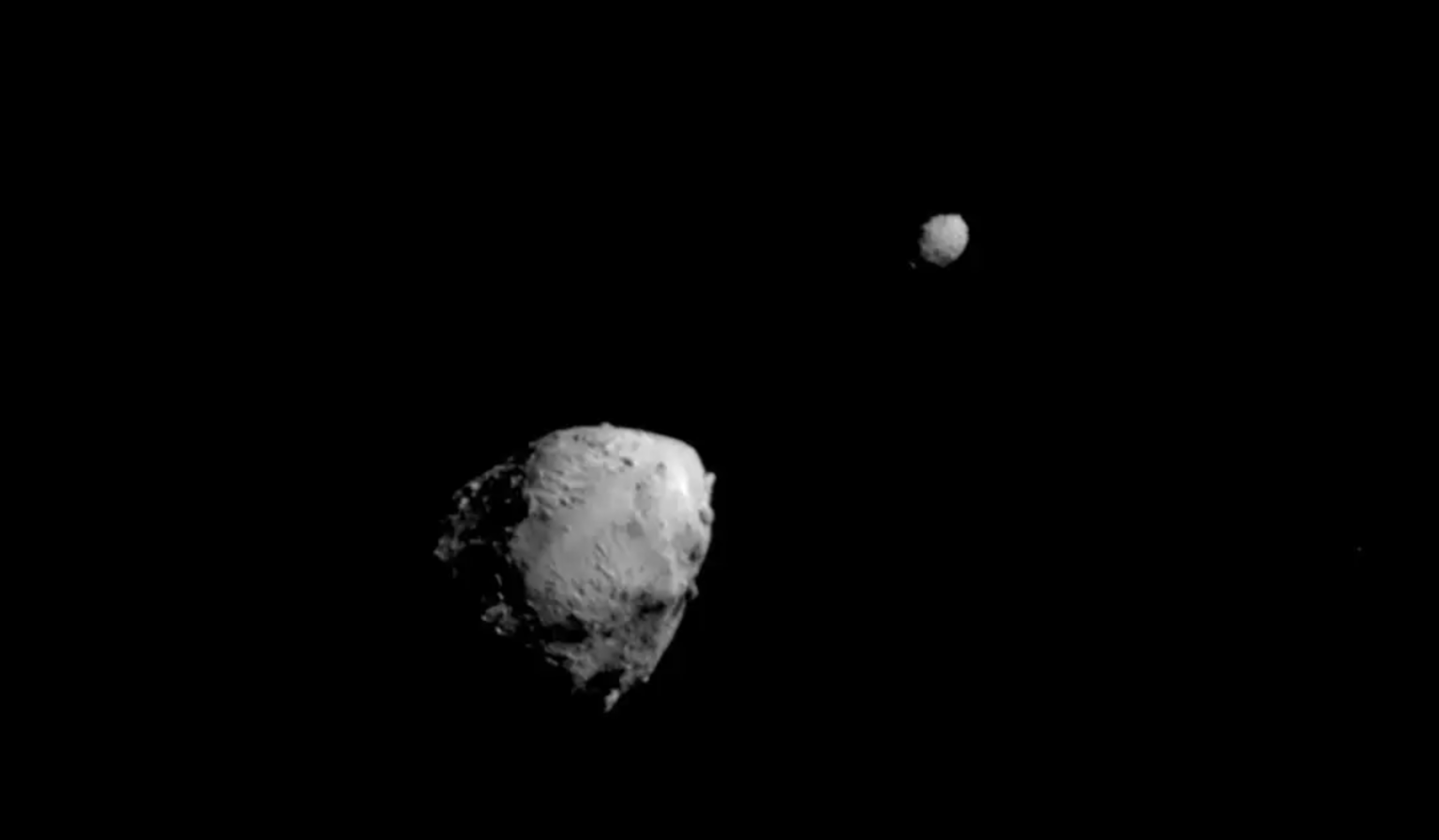
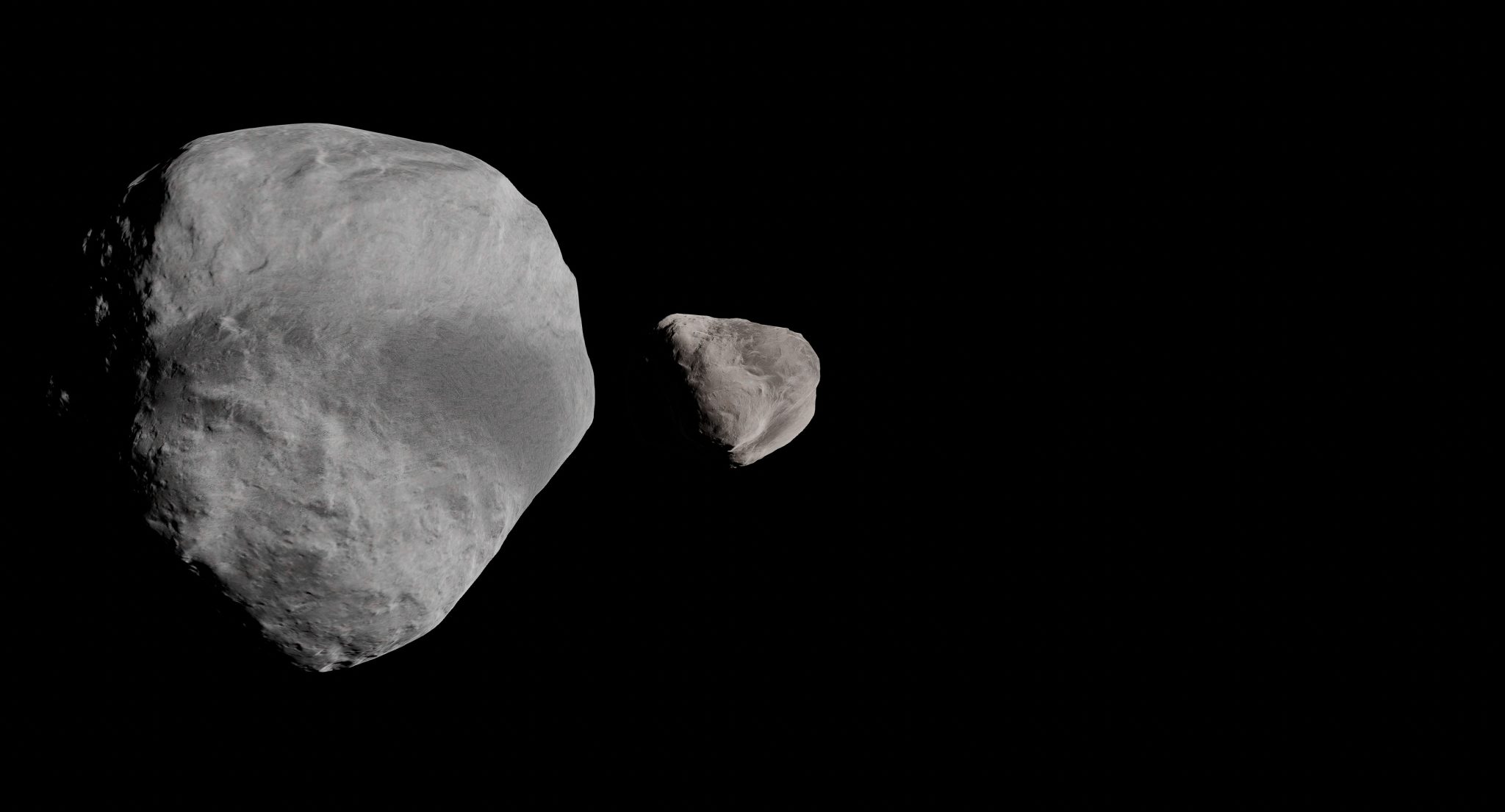
Do you know that approximately one in six asteroids, or about 15%, flying past Earth are not actually “lone wolves”? These are binary systems where a smaller companion orbits a larger object. Previously, scientists believed that these pairs simply existed side by side under the influence of gravity, but data published in the Planetary Science Journal proves that there is a fairly close connection between them.
The research team discovered that asteroids constantly “throw” rocks and dust at each other. These are not catastrophic collisions that tear celestial bodies apart, but gentle, almost delicate touches. These “cosmic kisses” gradually change the landscape of both bodies, transforming their surface into a dynamic environment that is constantly evolving.
Photographic evidence: a fan of dust and rocks
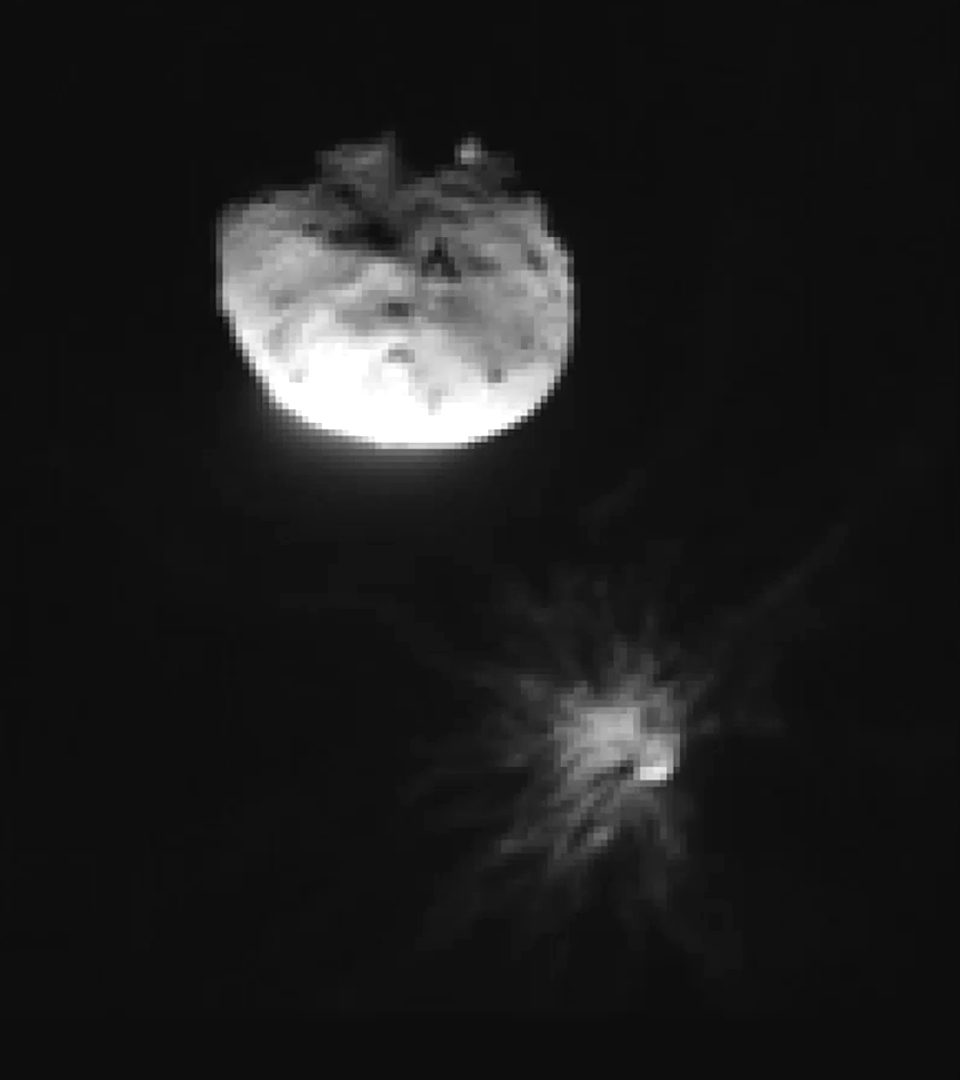
The key to the discovery was unique footage taken by a NASA spacecraft as part of the DART (Double Asteroid Redirection Test) mission in 2022. Before deliberately crashing into the asteroid Dimorphos, the spacecraft managed to transmit extremely clear images of the surface to Earth.
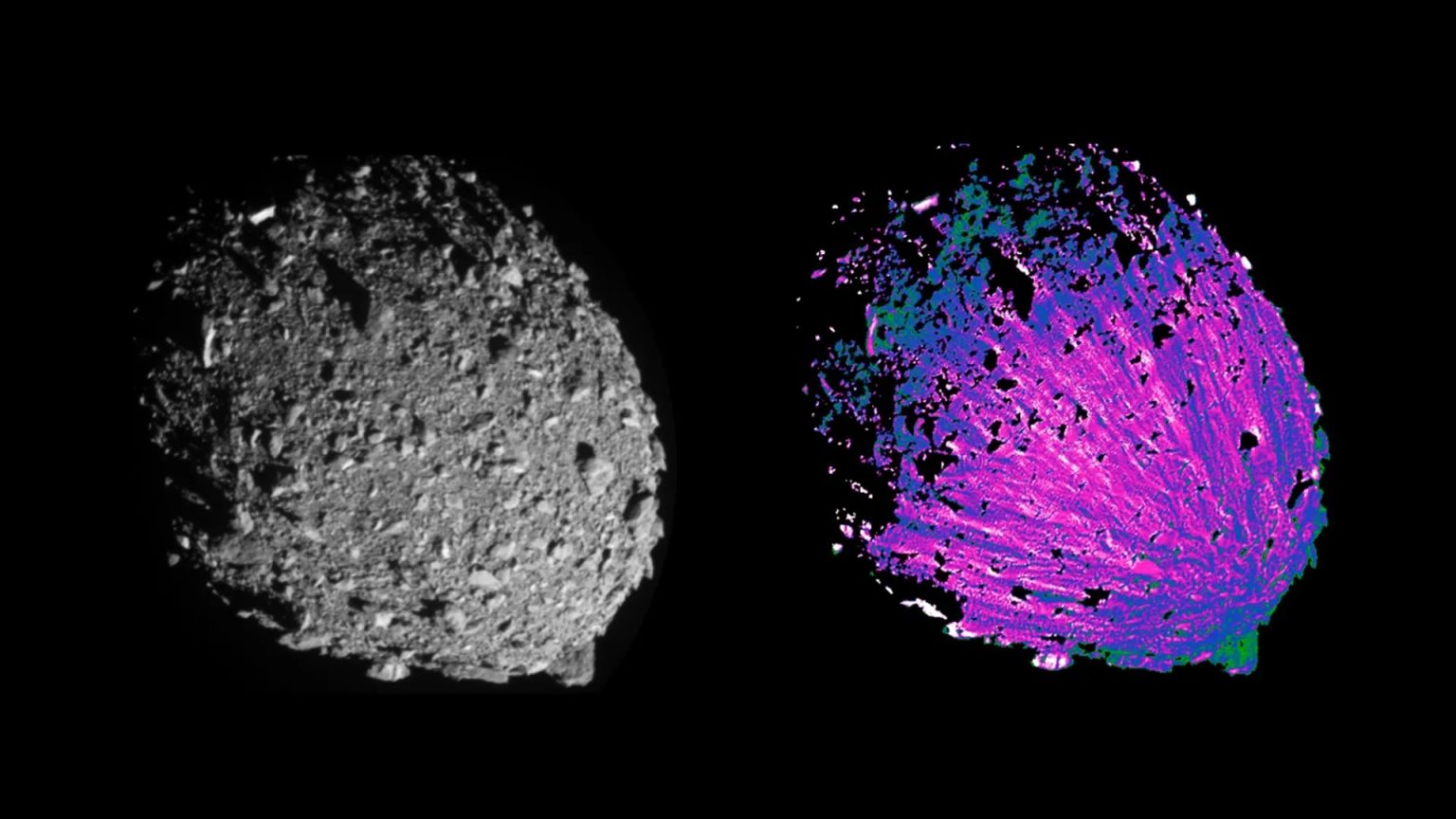
While analyzing these images, Professor Jessica Sunshine and her team noticed something strange — bright fan-shaped stripes stretching across the entire surface of Dimorphos. At first, scientists blamed camera defects or errors in data processing. But after carefully cleaning up the images, it became clear: what they were looking at was the first visual confirmation in history of the natural transfer of material from one asteroid to another.
“It looked as if someone had thrown space snowballs at the asteroid,” Professor Sunshine shares his impressions. These stripes are nothing more than “scars” from low-speed impacts left by material flying in from a neighboring asteroid.
Solar engine
Where does this “traveling rock” come from? Scientists explain this phenomenon as the YORP effect (the Yarkovsky–O’Keefe–Radzievsky–Paddack effect). This is a complex term for a fairly simple process: solar radiation heats the uneven surface of a small asteroid, causing it to spin faster and faster.
When the rotational speed becomes critical, centrifugal force begins to exceed the weak gravity of the asteroid. Rock fragments, dust, and boulders lying on the surface of Didymos’ parent body simply fly off into open space. And since Dimorphos is nearby, a significant portion of this “debris” falls into its gravitational trap and gently settles on its surface. Thus, the Sun acts as an invisible engine, spinning asteroids into cosmic sprinklers.
Detective work with pixels
Finding these stripes was a real challenge. In the original DART images, they were almost invisible due to complex lighting and the play of shadows from numerous boulders. Tony Farnham and Juan Rizos from the University of Maryland have developed special algorithms to “remove” excess light and shadows.
The probe’s flight itself complicated the task: it approached its target in almost a straight line, which meant that the angle and lighting angle remained virtually unchanged. This created the illusion that the stripes might just be an optical effect. However, the creation of a 3D model of the asteroid put everything in its place. The more accurate the model became, the clearer the fan-shaped structures appeared. They were concentrated along the equator of Dimorphos — precisely where, according to the laws of physics, the material ejected from Didymos should have landed.
Physics of “soft” collisions
We are used to cosmic speeds of thousands of kilometers per hour, but in the world of double asteroids, everything is different. Harrison Agrusa’s research showed that debris from Didymos traveled toward the moon at a speed of only 30.7 cm/s. This is three times slower than a person walking at a normal pace in a park.
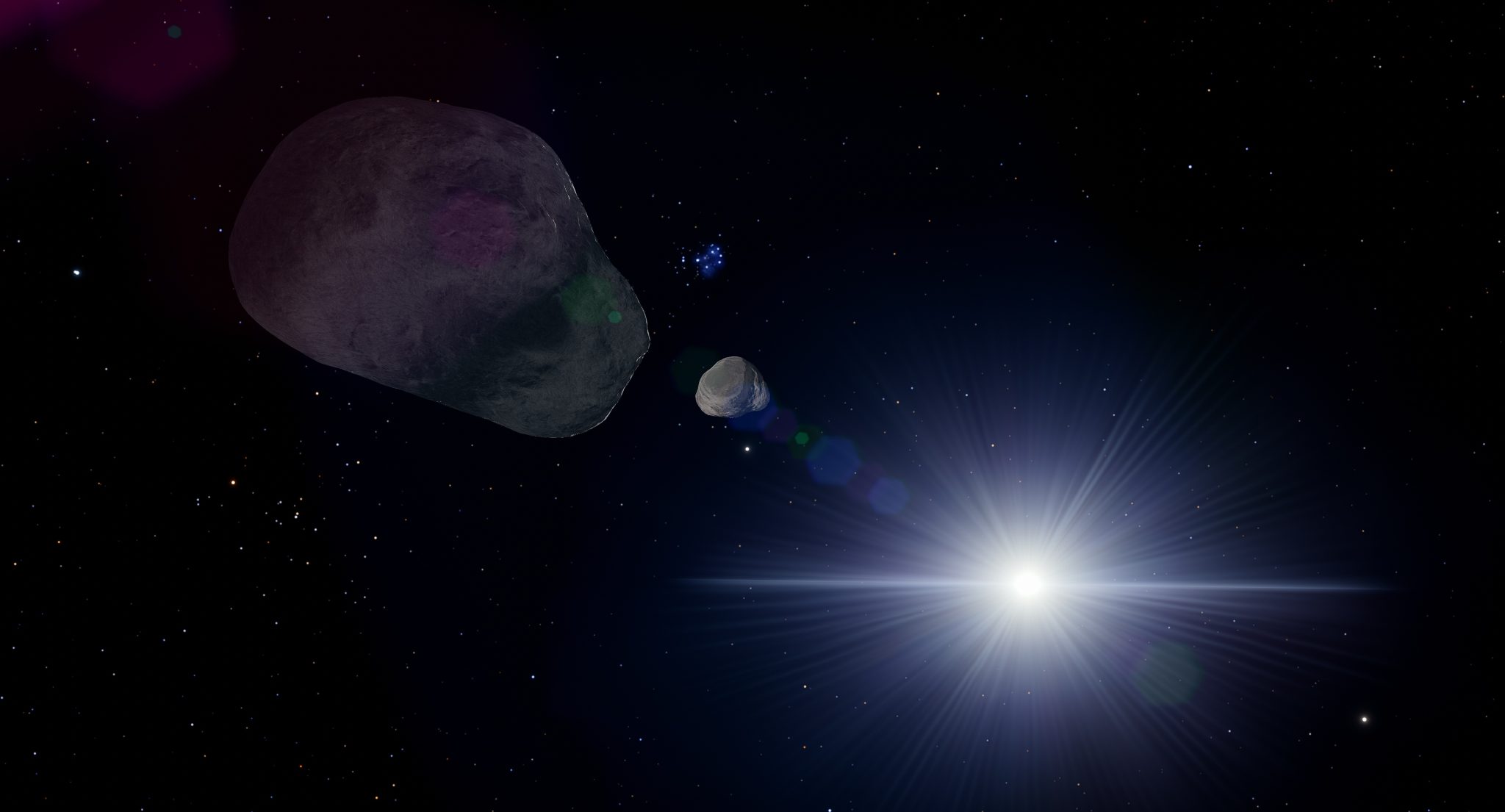
It is precisely thanks to this “turtle-like” speed that unique patterns are formed. Instead of creating huge craters, the rocks gently sink into the loose soil (regolith), leaving long rays of deposits. This is not destruction, but a gradual “increase” in the mass of the moon due to its “big brother.”
Checking the theory with sand
To finally confirm their hypothesis, scientists led by Esteban Wright conducted a series of experiments on Earth. At the UMD Institute of Physical Sciences and Technology, a special setup was created: balls were thrown at different angles into a container filled with sand mixed with colored gravel (simulating the surface of Dimorphos).
High-speed cameras captured an incredible resemblance: when the “stranger” hit the boulders on the surface, some of the matter was deflected, while other matter penetrated through the cracks, forming the very fan-shaped rays that we see in photographs from space. Computer modeling at Lawrence Livermore National Laboratory confirmed these results.
Next stop: the Hera mission
This discovery radically changes our understanding of how to protect Earth from asteroid threats. If we want to change the trajectory of an asteroid, we need to understand how dynamic it is and how it exchanges mass with its moons.
The next major event will take place in December 2026, when the European Space Agency (ESA) mission called Hera will arrive at the Didymos-Dimorphos system. It will conduct a thorough “inspection of the scene” after the DART impact. Scientists hope to see the very stripes that may not have been completely destroyed by the explosion and gain new insights into how this amazing cosmic conveyor belt works.
Earlier, we reported on how Hubble photographed the double tail of the asteroid Dimorphos.
According to NASA JPL

