

NASA has published an image created from photographs taken by the LRO spacecraft. It shows grabens, which look like scars stretching across the lunar surface.
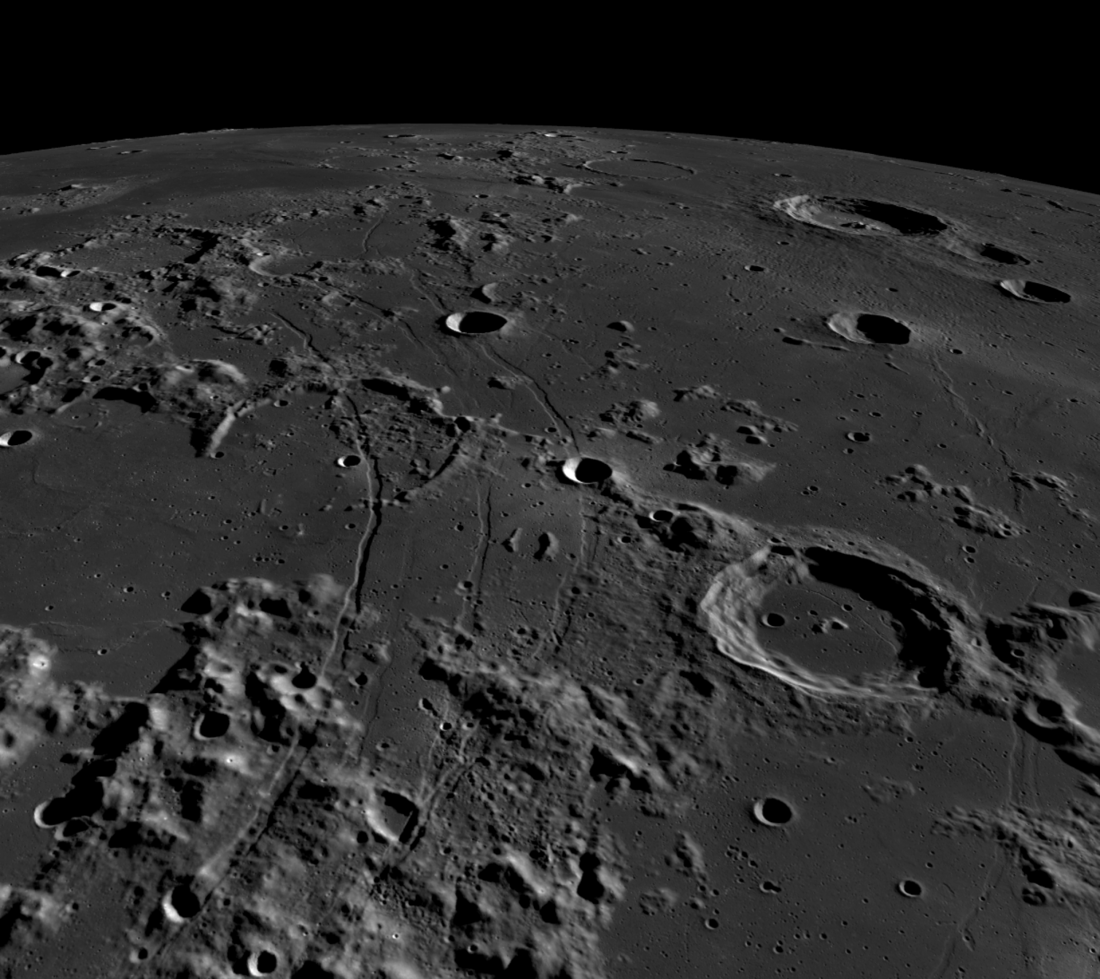
Grabens are geological structures consisting of blocks of crust that have sunk downward as a result of its stretching. They exist not only on Earth, but also on other bodies in the Solar System, including the Moon.
The grabens photographed by LRO are located in Mare Humorum, in the southwestern part of the visible side of the Moon. The stretching of the crust occurred due to the subsidence of the central part of the basin under the weight of dense basalt deposits. The grabens curve concentrically along the edge of the basin.
According to planetary scientists, volcanic activity in Mare Humorum reached its peak in the middle of the Imbrian period (3.3–3.7 billion years ago), allowing the processes of lava subsidence and cooling to put prolonged pressure on the lithosphere. This pressure caused the crust to stretch along the edges of the basin, resulting in the formation of grabens. The subsidence could have occurred gradually over a million years or episodically as a result of large-scale moonquakes. In this case, the shape of each valley indicates that they underwent different stages of formation at different times. Grabens with lower relief and less pronounced contours indicate subsequent volcanic episodes and partial filling with lava after their initial formation.
These lunar reliefs are particularly interesting because they resemble similar structures on Earth. Studying them can provide valuable information about the processes that shaped the surface of the Moon. In addition, scientists use such structures to reconstruct the chronology of impact events, mountain formation, and episodes of tectonic activity and volcanism.
Earlier, we reported on how LRO photographed a mysterious volcanic dome in Oceanus Procellarum.
According to LROC

