

In space technology, the power source is often just as important as the engine or the payload: a spacecraft can be launched into orbit or sent into deep space, but without a stable power supply, its mission will quickly come to the end. That is precisely why DARPA’s “Rads to Watts” program has attracted attention; its goal is to take nuclear batteries to the next level. The idea is to convert nuclear radiation energy directly into electricity, without the need for a conventional thermal cycle.
DARPA explicitly states that the ultimate goal of the program is to develop nuclear systems capable of operating with high-power radiation sources and, in the future, delivering kilowatt-level electrical power. Such power sources are particularly useful in environments where it is not possible to regularly maintain equipment, replace batteries, or rely on solar panels—specifically for spacecraft and remote underwater platforms. The main technical challenge today is the degradation of materials and semiconductor components due to radiation exposure, which reduces the device’s efficiency and lifespan.
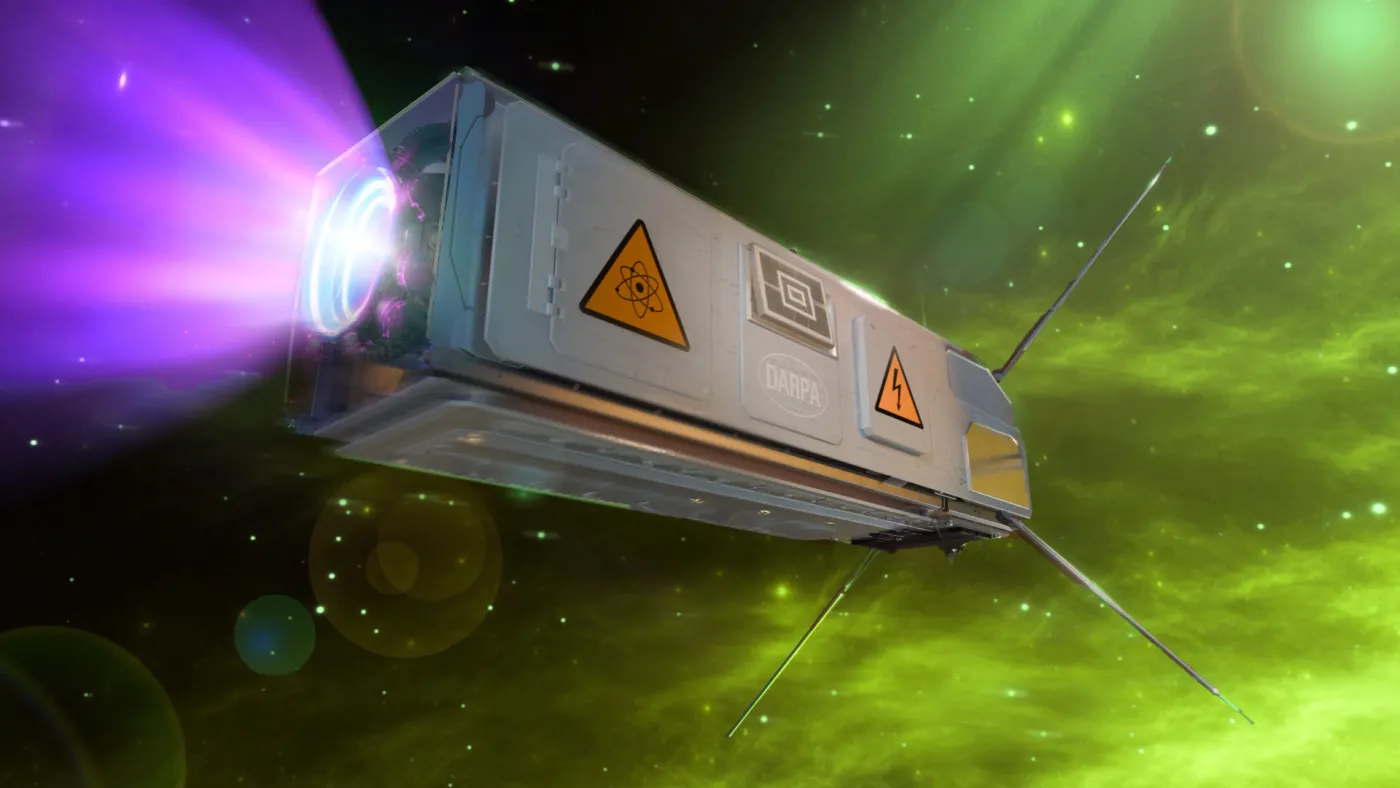
At the same time, similar solutions are already making their way from the laboratory to practical implementation. For example, the Australian GenX project (a 3D-printed battery that does not require charging), developed by entX and Adelaide University, combines additive manufacturing, advanced semiconductor deposition techniques, and the creation of highly efficient electrical junctions. The developers claim that this architecture delivers very high power density in a compact form factor and can be used for long-duration space and defense missions. If these approaches can be scaled up, nuclear micro-power sources could become a key enabler for equipment that operates for years without refueling, maintenance, or access to sunlight.
How does it work? Inside this type of battery is a radioactive source that constantly emits particles. These particles enter a special semiconductor layer and knock out charge carriers there, while the electrical junction directs them into a useful current. In other words, the battery doesn’t burn up like fuel in an engine and doesn’t need to be recharged from an outlet—it generates electricity on its own, slowly but for a very long time. DARPA aims to make such systems significantly more powerful and radiation-resistant, while industrial developers, such as entX, are working to create thin, multilayer structures and efficient electrical junctions to improve energy efficiency.
Why is this important? This technology is particularly valuable in space where solar panels are inefficient or vulnerable: on deep-space missions, in regions with high radiation levels, during prolonged solar eclipses, on the lunar surface, or on autonomous scientific platforms. In the future, such nuclear batteries could provide years of continuous operation for sensors, rovers, satellites, and observation instruments without the need for service missions, which fully meets the needs of space exploration and automated astronomy. This is partly confirmed by the fact that DARPA is considering such systems specifically for new energy-constrained environments, and entX explicitly mentions satellites, rovers, as well as space and lunar missions.

