

How likely is it that an asteroid will cause your demise? At first glance, this question seems to be from a horror game. But scientists have seriously calculated the risks of death from a space rock strike compared to familiar threats such as car accidents, carbon monoxide poisoning, or lightning strikes. And the conclusions were unexpected.
Danger from space: low, but not zero
Although the probability of an apocalypse caused by a giant asteroid is negligible, it exists. Recently, Earth narrowly escaped disaster when a newly discovered asteroid had a 1 in 63 chance of colliding with Earth in 2032. Fortunately, further calculations reduced the risk to almost zero. However, incidents such as the flyby of asteroid 2024 YR4 remind us of our vulnerability to space.
In a new study published on arXiv, scientists have determined the probability of Earth colliding with an asteroid within the average human lifespan. Their key conclusion is striking: if a huge asteroid does fall, your individual probability of dying from this global catastrophe is higher than the risk of dying from rabies infection. It has also been determined that an asteroid strike is more likely than a person being struck by lightning. Although lightning is more often fatal.
How was the risk calculated?
It is extremely difficult to assess the probability of an asteroid strike. For approximate calculations, researchers analyzed data on near-Earth objects (NEOs) larger than 140 meters. They determined the average frequency of such collisions and compared this figure with the risk of dying from other causes during the lifetime of an average person.
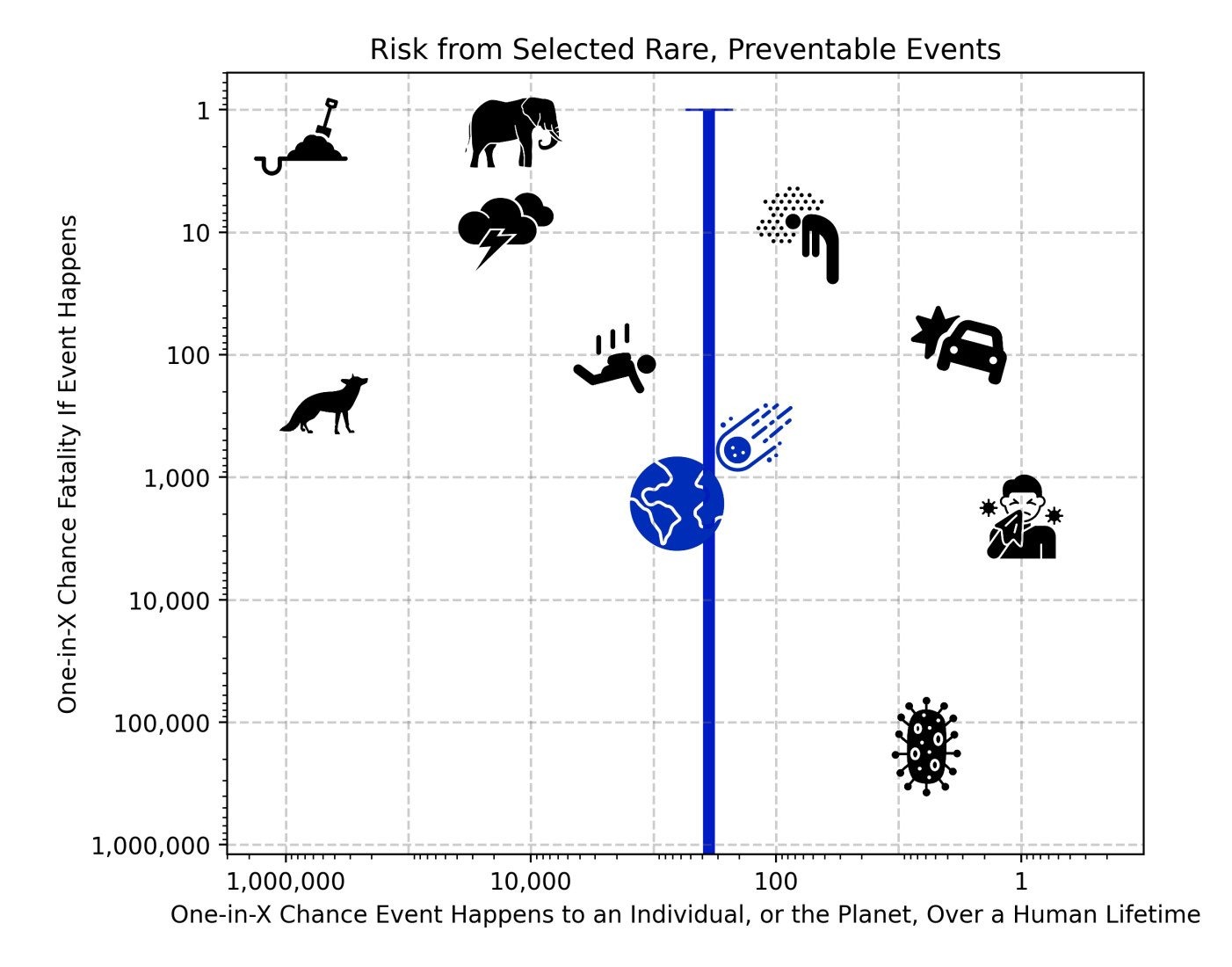
Of course, no one has ever died from an asteroid strike. At the same time, 13 people died from lightning strikes in the US in 2024. But the essence of the study lies in comparing a global event that could destroy the planet with individual risks that are familiar to everyone: traffic accidents, animal attacks, etc. This helps both experts and ordinary people to better assess the scale of the space threat.
Planetary protection
Fortunately, humanity is not sitting idly by. In 2022, NASA successfully carried out the DART mission: the spacecraft deliberately collided with an asteroid to test the possibility of changing its trajectory. This experiment gives us hope that we can protect the planet. A satellite is currently heading to the collision site to study the consequences of the impact in detail. Science is working to ensure that when the “death star” actually appears on our radars, we will be ready to fight back and protect our species from a cosmic strike.
Earlier, we discussed how astronauts would respond in the event of a sudden death in space.
According to Gizmodo

