

Astronomers working with the Hubble Space Telescope have published a new image. It shows a pair of galaxies known as Arp 4.
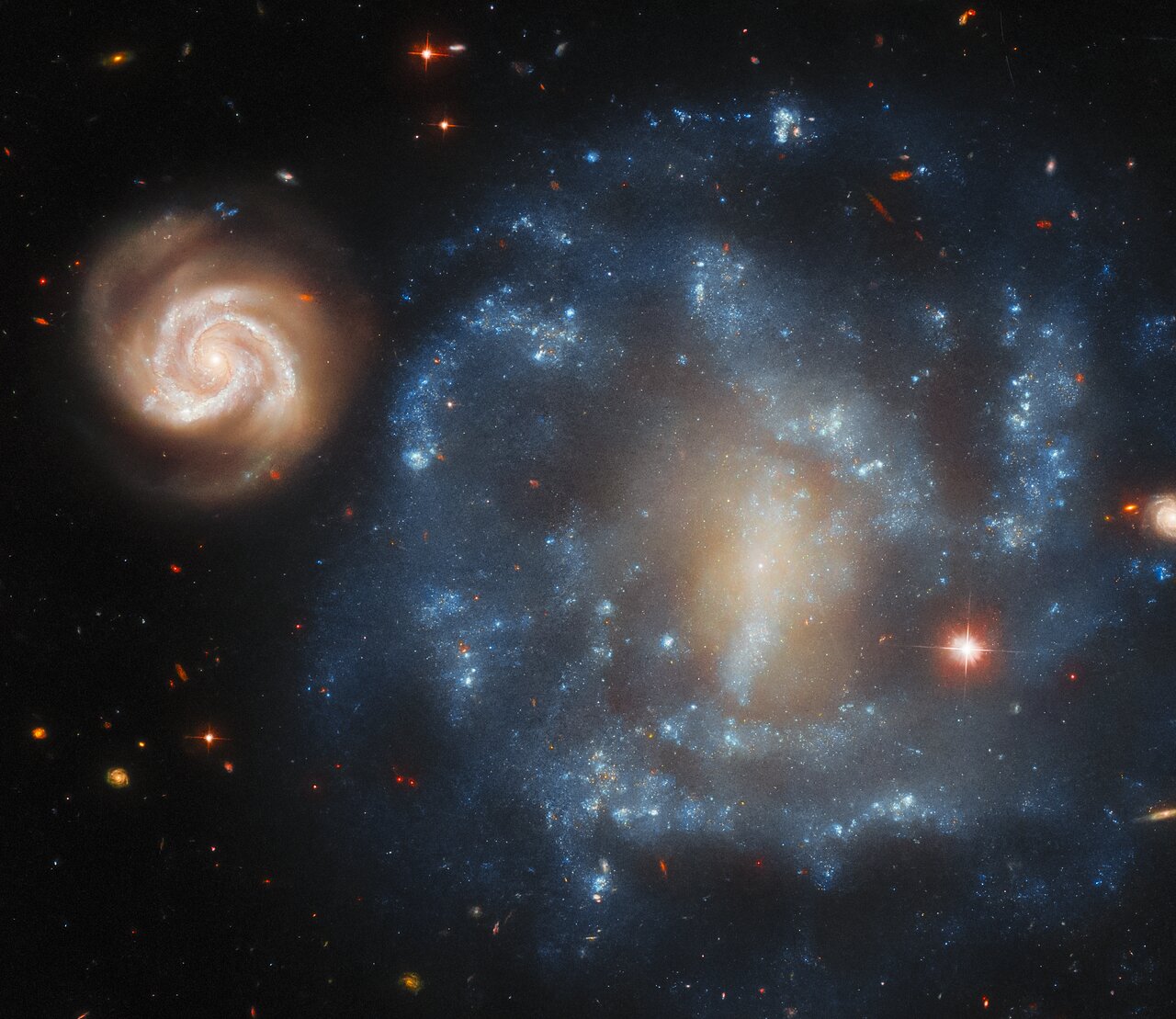
The name Arp 4 comes from the Atlas of Peculiar Galaxies, compiled in the 1960s by astronomer Halton Arp. “Peculiar Galaxies” were selected and photographed to provide examples of strange and unusual shapes, which would allow for a better understanding of how galaxies evolve.
Throughout its mission, the Hubble Space Telescope has regularly photographed galaxies of all possible types – including those listed in Arp’s atlas. The large galaxy in its image, also known as MCG-02-05-050, is a low surface brightness galaxy. It is characterized by fragmented arms and a faint disk. Its smaller companion on the left (MCG-02-05-050a) is a much brighter and more active spiral galaxy.
It may seem that the two galaxies that make up Arp 4 are close neighbors. But in reality, this is not the case at all. MCG-02-05-050 is located 65 million light-years from Earth, while MCG-02-05-050a is 675 million light-years away. That’s ten times farther!
In reality, MCG-02-05-050a is probably the larger of the two galaxies, while MCG-02-05-050 is relatively small. Their proximity in this image is simply an incredible visual coincidence. However, this does not prevent us from enjoying their beautiful combination.
Earlier, we talked about how Hubble photographed a galaxy with a gas tail.
Provided by Esahubble

