

Astronomers have published a new image obtained by the Hubble telescope. It shows the spiral galaxy NGC 4388. It is interesting because a stream of gas is “escaping” from it, forming a huge tail.
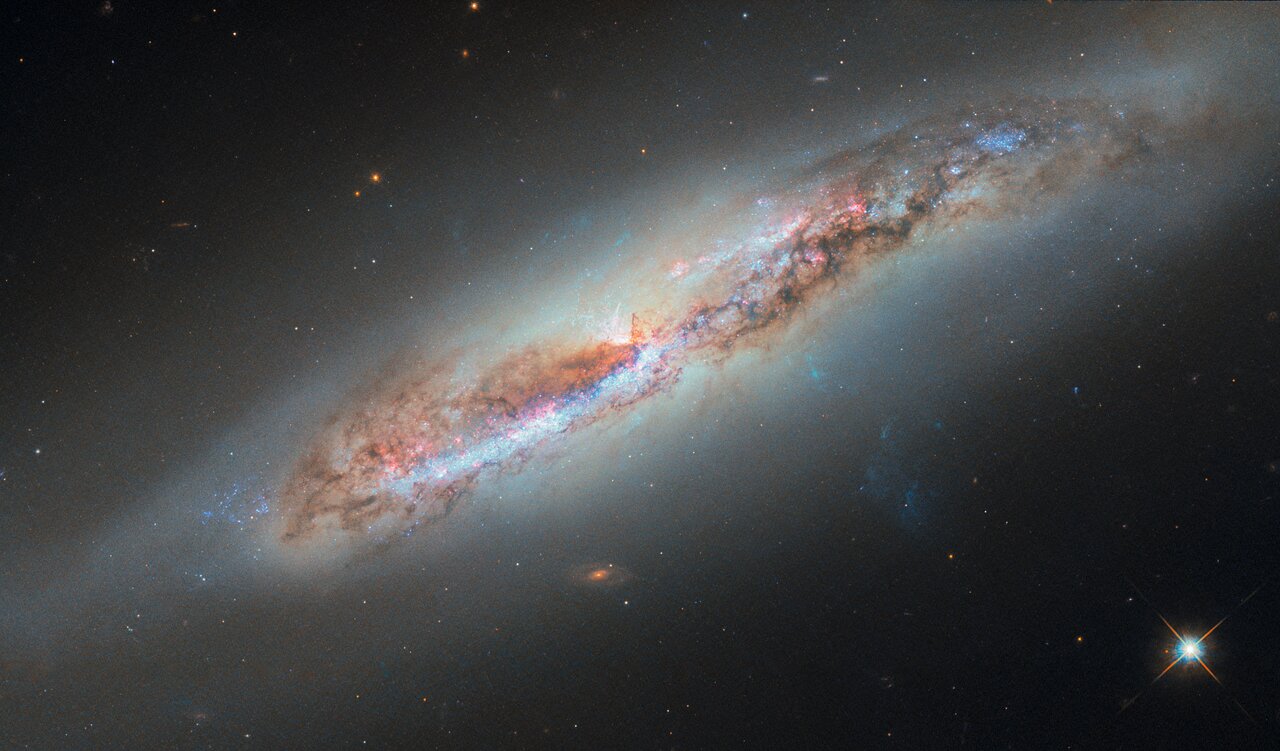
NGC 4388 is located about 60 million light-years from Earth and is part of the Virgo Cluster. It contains more than a thousand galaxies and is the closest large galaxy cluster to the Milky Way.
We see NGC 4388 from the side, which allows us to observe it from an extreme viewing angle. This perspective reveals an interesting feature that was not visible in the previous image of the galaxy taken by Hubble in 2016. It is a jet of gas escaping from the core of NGC 4388. It can be seen in the lower right corner of the image.
But where did this tail come from, and why does it glow? The answer probably lies in the vast spaces separating the galaxies in the Virgo cluster. It appears empty, but in reality it is filled with hot jets of gas. As NGC 4388 moves through the cluster, this hot gas displaces gas from the galactic disk, which led to the formation of the tail.
The source of energy that ionizes this gas and causes it to glow is less certain. Researchers suggest that some of the energy comes from the center of the galaxy, where a supermassive black hole is located. It is surrounded by an accretion disk consisting of superheated matter. Its bright radiation can ionize the surrounding gas.
The image of NGC 4388 includes new data, including several additional wavelengths of light, which allow us to see the gas tail. It was obtained during several observation programs aimed at studying galaxies with active black holes.
Earlier, we reported on how Hubble photographed a sparkling blue galaxy.
According to Esahubble

