

Astronomers have published a new image taken by the Hubble Telescope. It shows a sparkling blue galaxy known as Mrk 178.
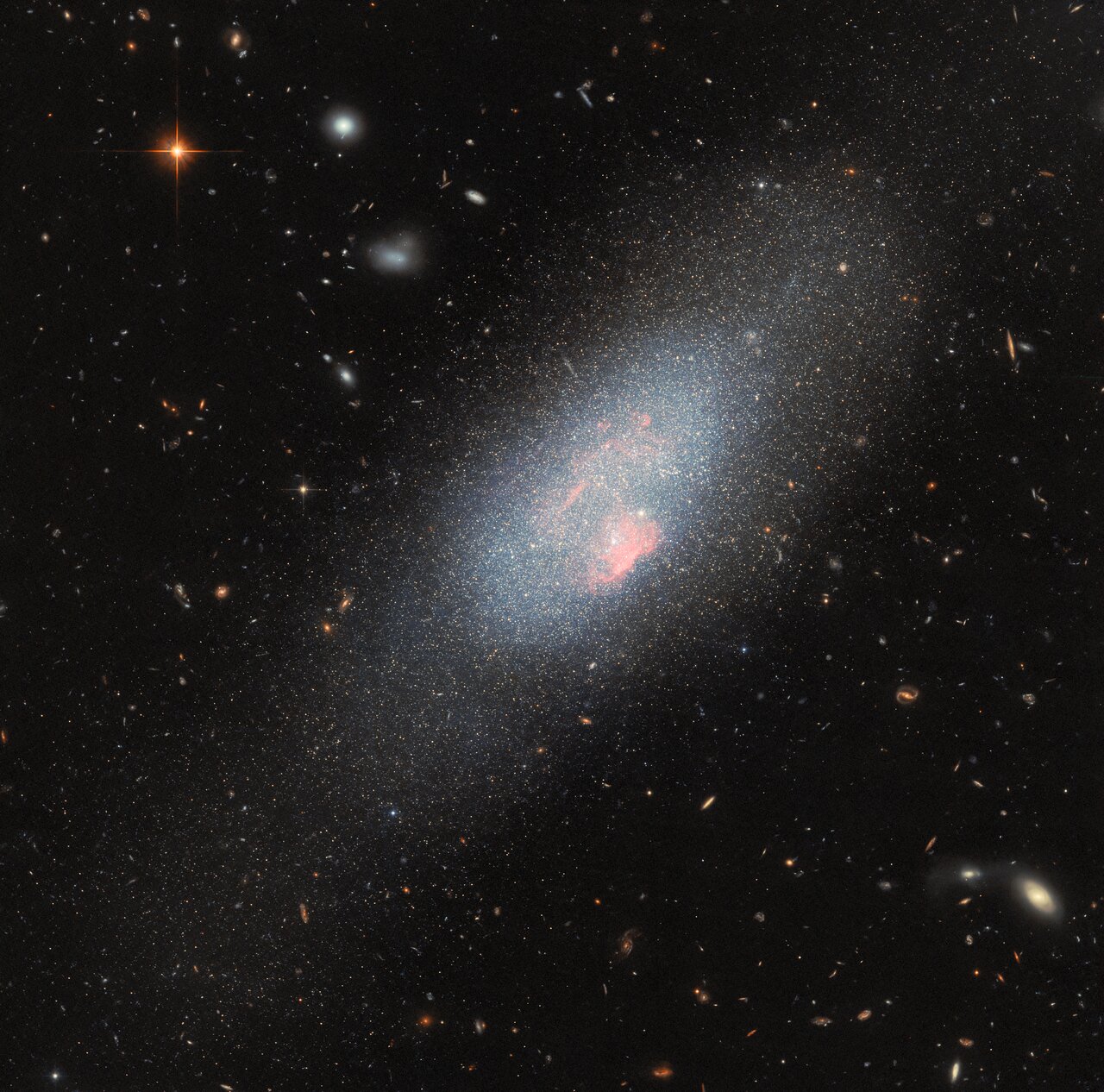
Mrk 178 is one of more than 1,500 Markarian galaxies. It was named after Armenian astrophysicist Benjamin Markarian, who compiled a list of galaxies that are remarkably bright in ultraviolet light.
The galaxy photographed by Hubble is located 13 million light-years from Earth in the direction of the constellation Ursa Major. It is much smaller than the Milky Way. Its diameter does not exceed 6,000 light-years.
Despite its modest size, Mrk 178 contains a large number of young, hot stars whose powerful radiation gives it its characteristic blue color. The Hubble image also shows reddish spots. These are clusters of massive stars, which are particularly concentrated in the brightest, reddish region at the edge of the galaxy. It is home to a large number of rare objects called Wolf-Rayet stars.
Wolf-Rayet stars are massive stars that shed their atmospheres through powerful winds. Because Mrk 178 contains so many Wolf-Rayet stars, bright emission lines from their winds are literally imprinted on the galaxy’s spectrum. In particular, ionized hydrogen and oxygen appear red due to special filters used by the Hubble Telescope during imaging.
Massive stars enter the Wolf-Rayet phase just before collapsing into black holes or neutron stars. Since such stars only exist for a few million years, there should be a reason for the recent burst of star formation in Mrk 178. Most often, this interaction occurs with other galaxies, but Mrk 178 has no close neighbors. Therefore, astronomers suspect that a gas cloud collided with Mrk 178, or that its gas may have been disturbed when the galaxy moved through the intergalactic medium.
Earlier, we reported on how astronomers discovered a huge filament of galaxies 140 million light-years from Earth.
According to Esahubble

