

A new class of space couriers is appearing in orbit. California startup Inversion has unveiled Arc, an autonomous reusable vehicle that is positioned as the world’s first space delivery service, promising to deliver cargo anywhere on Earth in less than an hour. According to the company’s plan, Arc devices will be placed in low Earth orbit (LEO) in advance, forming a group tailored to the customer’s needs. When a request is received, the device leaves orbit, undergoes a controlled hypersonic entry into the atmosphere, and lands under parachutes—completely autonomously. Inversion believes this marks the birth of a new logistics domain with speeds and accessibility that never existed before.
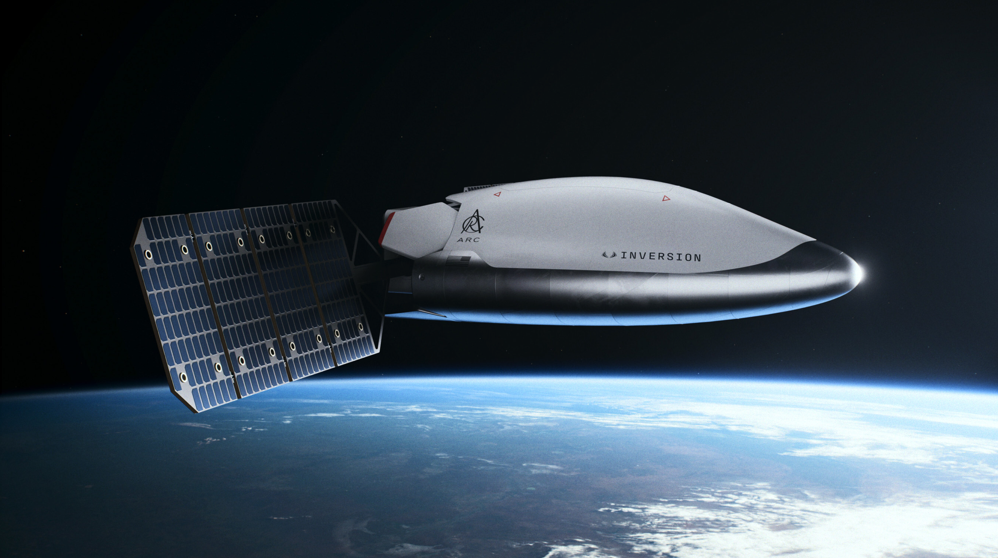
In addition to space delivery, Arc is being promoted as a platform for testing hypersonic technologies: it claims maneuverability at speeds of Mach 20+, long-term operation in extreme conditions, and precise controlled landings for rapid return of the vehicle. Arc’s first mission is scheduled for 2026; development builds on the flight heritage of the Ray demonstrator, which validated the company’s key onboard systems in January 2025. The long-term vision is thousands of such devices creating on-demand orbital logistics for defense and civilian markets.

How does it work? In simple terms, Arc is a depot in orbit. Several such capsules are launched into low orbit in advance and kept on standby. When a request comes in, the spacecraft fires its engines briefly, leaves orbit, and enters the atmosphere. The special shape of the body gives it lift, allowing the capsule to controllably glide through dense layers of air, while heat shielding safely dissipates heat and the autopilot adjusts the course to a specific landing point.
The secret of this approach lies in the combination of two things: preliminary placement on the LEO (no need to wait for a new launch) and controlled hypersonic entry for accuracy and repeatability, which reduces the cost of each flight and allows missions to be repeated quickly.

Why is this important? Rapid return from orbit opens up new scenarios for science: rapid delivery of spare parts, instruments, and resources. A network of pre-located devices reduces dependence on rare launch windows and can accelerate the “launch-test-return-refine” cycle, which is critical for rapid progress in astronomical and space programs.
Want to understand where the boldness of modern orbital vehicles and hypersonic programs comes from? That began with the legendary X-15 rocket plane—a flying laboratory that took pilots to the edge of space and set records for speed and altitude while testing heat protection, control in thin air, and reentry profiles. Our article tells the story of the people, risks, and engineering breakthroughs that paved the way for “faster and higher” in space exploration. If you are a fan of technology, the history of discovery, and honest stories about the limits of possibilities, now is the time to immerse yourself in “Faster and higher! The history of the X-15 rocket plane.”
According to prnewswire, interestingengineering

