

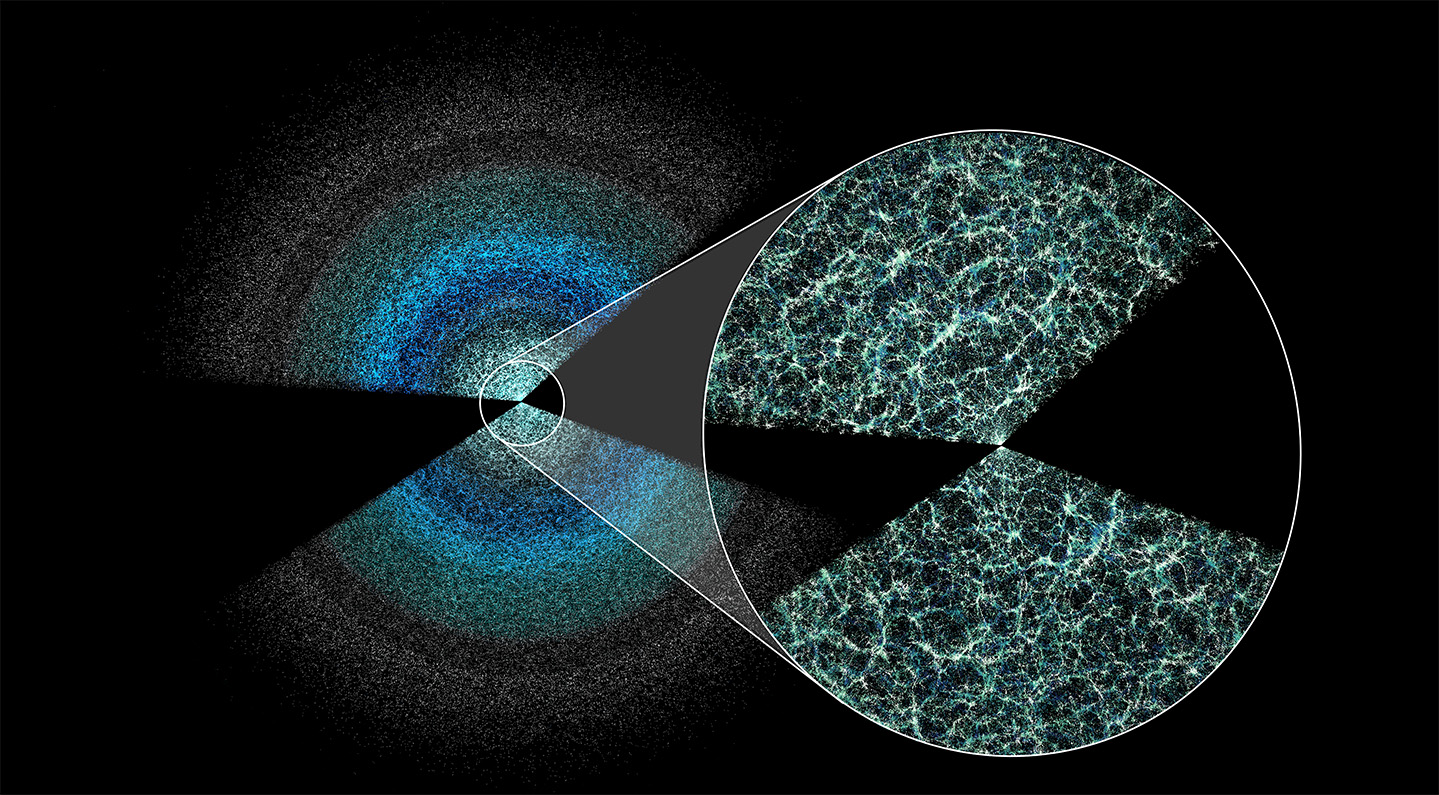
The astrophysics community is celebrating the conclusion of a landmark event. The Dark Energy Spectroscopy Instrument (DESI), based at the Kitt Peak National Observatory in Arizona, has officially completed its five-year primary mission. The result of this meticulous work is the largest and most accurate three-dimensional map of the Universe in human history.

Last night, DESI recorded its latest data, bringing the total count to an incredible figure: more than 47 million galaxies and quasars, as well as about 20 million stars in our galaxy and its vicinity. This huge amount of data spans an enormous period of time—more than 11 billion years of cosmic history—allowing scientists to see how our Universe has evolved practically from the moment of its birth.
How DESI operates
The technological complexity of DESI is just as impressive as the data it collects. The device is equipped with 5,000 tiny fiber-optic “robot eyes.” Each of these manipulators is capable of targeting a separate galaxy with pinpoint accuracy, allowing the spectra of thousands of objects to be recorded simultaneously. At least 80 GB of data was made available to the researchers every night.
The light received is analyzed by ten spectrographs, which determine not only the object’s position but also its chemical composition and the rate at which it is receding from us. It is precisely because of this efficiency that DESI has managed to collect six times more cosmological data than all previous similar projects combined. Over the course of five years of observations, the instrument has scanned two-thirds of the northern sky, creating a detailed “map” of the cosmic structure.
Mystery of Dark Energy
The primary goal of DESI is to unravel the nature of dark energy, the mysterious force that accounts for about 68.7% of the universe’s total mass and is causing it to expand at an ever-increasing rate. Understanding this force is the key to answering the question of how our Universe will come to an end: whether it will freeze in endless expansion or, perhaps, tear itself apart into atoms.
Until recently, it was believed that dark energy was a constant—an unchanging quantity that remained uniform over time. However, in 2025, the initial results of the DESI analysis caused a veritable scientific earthquake. Preliminary analysis of data from the instrument’s first three years of operation suggested that dark energy may evolve and change over time. If this is confirmed by a complete set of data, we will have to reevaluate the fundamental laws of cosmology and the entire standard model of the universe.
Crisis or revolution?
Although the official registration of the sites has been completed, the real work for the scientists is only just beginning. Adam Myers, one of DESI’s operations managers, notes that the team is incredibly proud of the project, which many have been working on for over a decade. Cosmologists around the world are now focused on deciphering the “subtle details” in the final dataset.
The “full picture” is now available, but the volume of data is so vast that scientists haven’t even finished analyzing the first set of results yet. However, one thing is already clear: there are surprises in store for us. Additional datasets and advanced analytical methods will make it possible to identify even the slightest deviations from existing theories.
Beyond the plan
Although the initial survey has been completed, DESI is not “retiring.” Scientists have already launched a parallel project, the Bright-Time Survey, which studies the effect of moonlight on distant objects, and plan to continue their observations until at least 2028.
Plans include a follow-up survey of hard-to-reach regions of the sky and the study of dark matter. In addition to addressing global cosmological questions, DESI will help us study the Milky Way’s “neighbors” in detail: dwarf galaxies and stellar streams—the remnants of smaller star systems that our galaxy once absorbed.
As the participants in the collaboration say, we are venturing into uncharted territory. We don’t know exactly what we’ll find in the depths of this massive data archive, but it will certainly change our understanding of humanity’s place in the vastness of space. Stay tuned—space is just beginning to reveal its true nature.
We previously reported on how dark energy evolves and weakens.
According to newscenter.lbl.gov

