

In the boundless expanse of the Universe, most galaxies shine brightly, like giant cosmic lanterns. But sometimes astronomers encounter real ghosts — objects so faint that they are almost impossible to see. Recently, an international team of researchers stumbled upon one such “phantom”: a galaxy that consists almost entirely of dark matter, with stars that barely glow in the cosmic darkness.
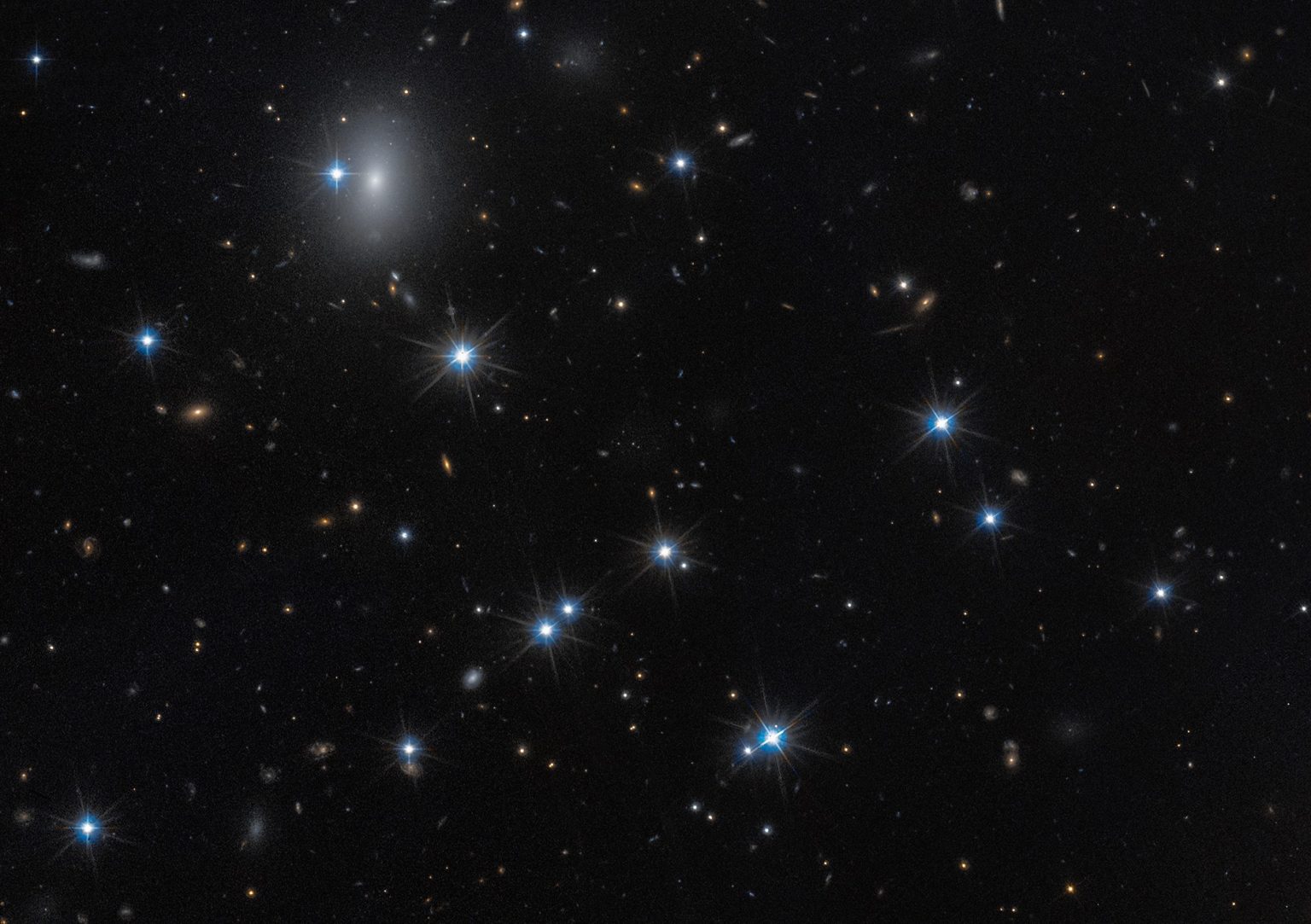
The object, modestly named Candidate Dark Galaxy-2 (CDG-2), is located 300 million light-years away from us in the Perseus galaxy cluster. It is so dim that its luminosity is only equal to the radiation of about a million Suns. By comparison, our Milky Way shines at least hundreds of times brighter. But the most surprising thing is not even that: preliminary analysis shows that 99% of the mass of this galaxy is dark matter — an invisible substance that does not emit, absorb, or reflect light.
How can we see the invisible?
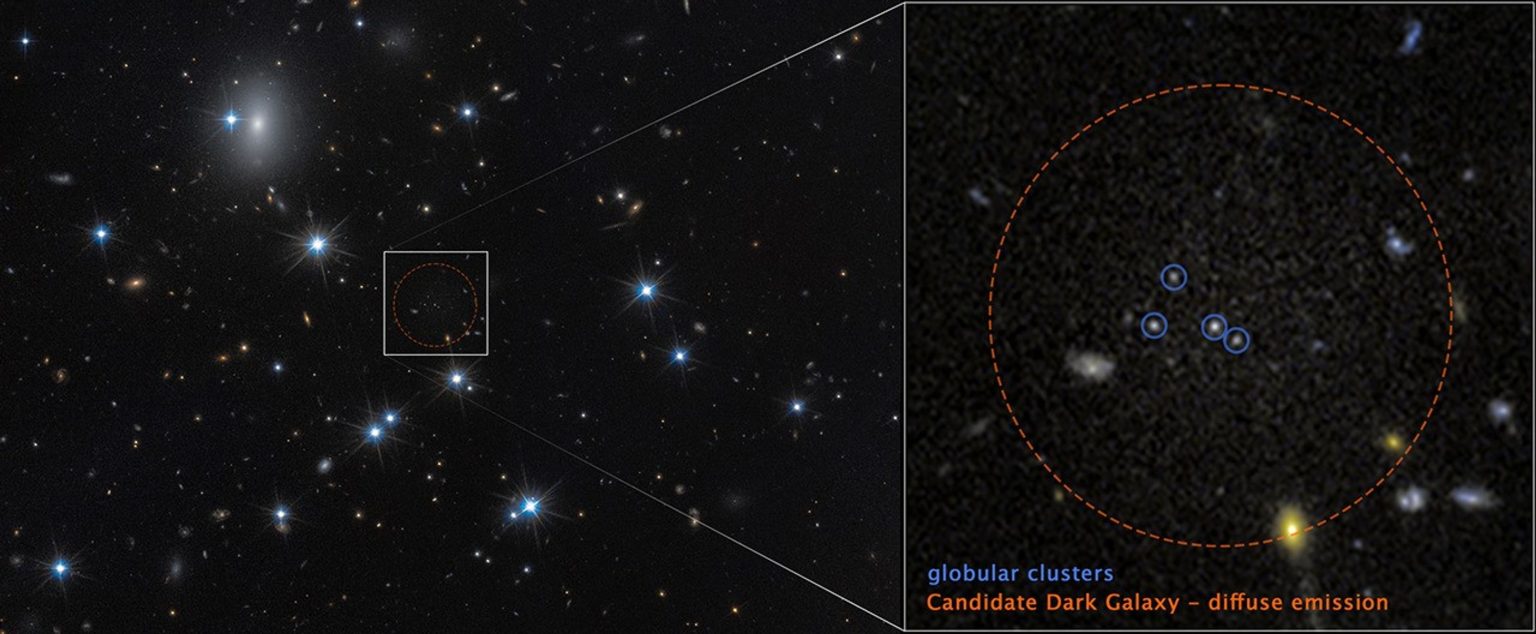
Detecting such a “ghost galaxy” is an extremely difficult task. Astronomers usually search for galaxies by the light of stars, but this method did not work here. So David Li from the University of Toronto and his colleagues took a clever approach. Instead of searching for the galaxy itself, they began looking for its “companions” — compact globular star clusters.
These are dense, gravitationally bound groups of old stars that typically orbit around galaxies. They are much brighter than the blurred halo of the galaxy itself and more resistant to the destructive effects of gravity. Therefore, if a group of such clusters is found in empty space, it may mean that an invisible galaxy is hidden somewhere nearby.
This is exactly what happened with CDG-2. Using the Hubble Space Telescope, scientists observed only four globular clusters. For scale: there are more than 150 of them in our Milky Way. But were they just randomly scattered throughout space, or did they all belong to the same system?
To find out, astronomers combined the efforts of three powerful observatories: Hubble, Euclid, and the ground-based Subaru telescope in Hawaii. Euclid’s data proved decisive — it recorded an extremely faint, diffuse glow around these four clusters. It was that very “stellar halo” that revealed the presence of the galaxy.
“This is the first galaxy discovered solely because of its globular clusters,” explains David Li. According to him, these four clusters are most likely almost the entire visible part of CDG-2.
Where did the dark galaxy come from?
Why is this galaxy so dim? Scientists believe that this is due to its aggressive environment. CDG-2 is located within the massive Perseus cluster, where galaxies constantly interact with each other. Gravitational swings probably “blew out” almost all the gas necessary for the birth of new stars. What we see today is perhaps only the “half-dead” remnant of a former galaxy that has lost its stellar matter but retained a giant invisible core of dark matter.
Studying objects such as CDG-2 gives astronomers a unique opportunity to investigate the nature of dark matter. After all, in this galaxy it is almost undiluted by ordinary matter. Furthermore, this discovery demonstrates the incredible capabilities of modern telescopes, particularly Euclid, which was specifically designed to search for such faint and elusive objects. Perhaps this is just the first of a whole swarm of cosmic ghosts waiting to be discovered.
We previously reported on how dark matter warped our galaxy.
According to esahubble.org

