

Our Universe continues to bleed. According to a new study, planets that are too close to their stars are doomed to a violent death. Scientists have finally obtained direct evidence that stars, expanding with age, literally swallow their closest companions. The results of the study are published in the journal Monthly Notices of the Royal Astronomical Society.
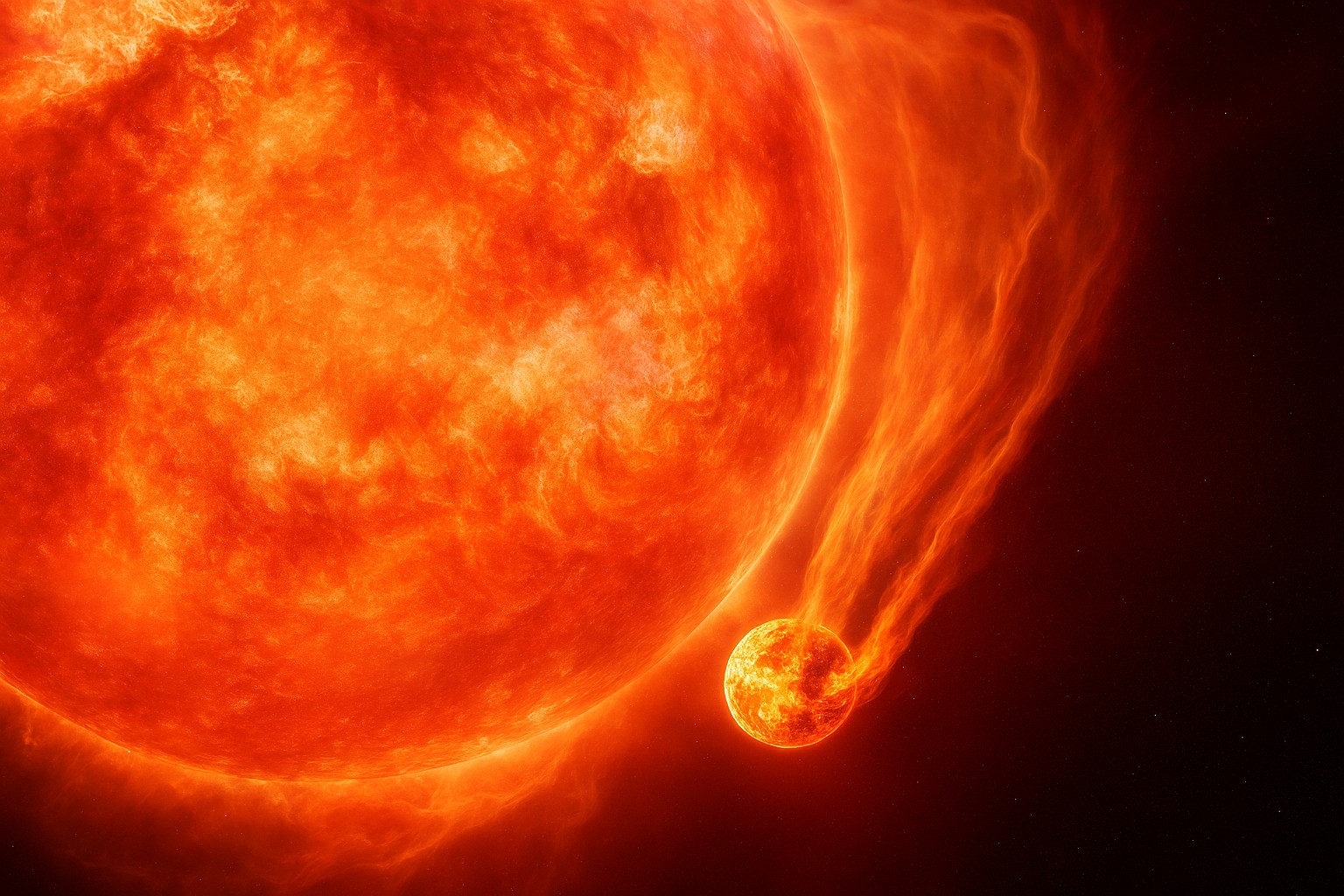
The idea that a dying star could destroy the planets around it has been around for a long time, but only now scientists have been able to study this process on a large scale. A team of astronomers analyzed data on more than 400,000 stars that have already passed their “stable” phase of life. The goal was to find out whether the number of planets around such aging stars decreased.
Using the powerful TESS (Transiting Exoplanet Survey Satellite), scientists have discovered 130 planets close to stars. Analysis showed a clear trend: the older the star, the less likely it is to find a gas giant near it. Their frequency dropped from 0.35% for “young” stars to only 0.11% for giant stars.
Destruction mechanism
“We expected to see this effect, but we were still surprised by how efficiently these stars absorb their nearby planets,” admits Edward Brant, lead author of the study.
The key factor is the orbital period. Planets with the shortest rotation periods (up to 12 days) are the first to perish. Powerful tidal forces act between the star and the planet, similar to those that cause tides on Earth. These forces gradually destroy the orbit, causing the planet to spiral closer to the star until it tears it apart or completely swallows it.
Future of the Solar System: What lies ahead for Earth?
This study also sheds light on the distant future of our own planetary system. In five billion years, the Sun will begin to expand, turning into a red giant. How safe will our planet be? Unlike gas giants, which are the first to perish, Earth is at a safer distance. However, this does not guarantee its salvation.
“Life on Earth will probably perish,” notes study co-author Vincent Van Eylen. Our planet may avoid direct absorption, but it will become a barren, scorched piece of rock.
To further study this cosmic spectacle, scientists are pinning their hopes on the future PLATO mission, scheduled for launch in 2026. Its telescopes will be able to peer even deeper into the mysteries of the evolution of stars and their planets.
We previously reported when the Sun would dim and the Earth would perish.
According to sciencealert.com

