

In 2024, scientists observed a rare phenomenon: the almost complete disappearance of the star ASASSN-24fw. However, it reappeared later. Now astronomers have figured out how this happened.
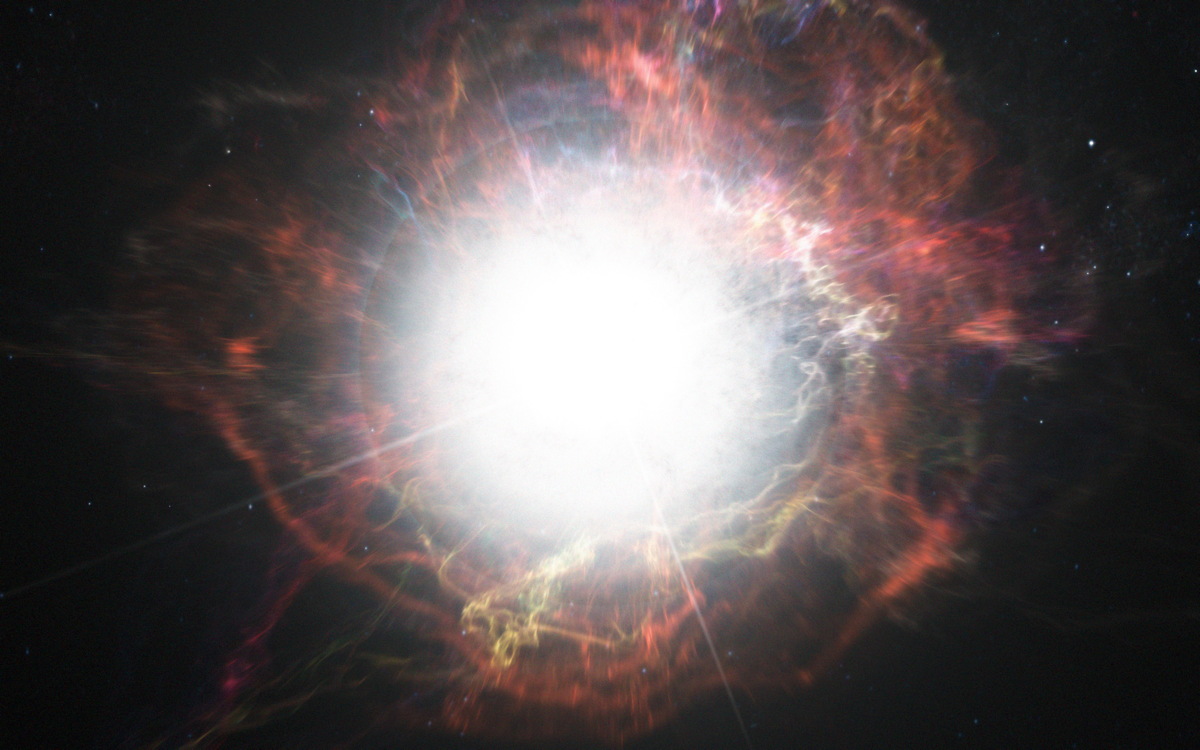
Disappeared star
Stars constantly die and disappear from view, but this usually happens during supernova explosions. Astronomers were surprised when a star that had been stable for more than ten years almost disappeared for eight months.
Between late 2024 and early 2025, a star in our galaxy named ASASSN-24fw dimmed by about 97% and then brightened again. Since then, scientists have put forward various theories about the causes of this rare and fascinating phenomenon.
An international team led by scientists from Ohio State University may have found the answer to this mystery. In a new study published in The Open Journal of Astrophysics, astronomers suggested that since the color of the star’s light did not change during the eclipse, the cause of this phenomenon was not its evolution, but a large cloud of dust and gas that temporarily blocked the star from Earth.
“We explored three different scenarios for what could be going on,” said Raquel Forés-Toribio, lead author of the study and a graduate student in astronomy at Ohio State University. “Evidence suggests it is likely that there is a cloud of dust in the form of a disk around it.”
Causes of eclipses
ASASSN-24fw is a star of spectral type F, slightly more massive than the Sun and about twice its size. It is located about 3,000 light-years from Earth. According to researchers’ estimates, the surrounding cloud disk has a diameter of about 1.3 astronomical units (AU) — even greater than the distance from Earth to the Sun.
Researchers suggest that this disk also likely consists of large clusters of carbon or water ice, similar in size to large dust particles found on Earth. This material is quite similar to planet-forming disks, so studying it could give astronomers new insights into the formation and evolution of stars.
However, these conclusions alone do not explain all the anomalies in the system, notes Forés-Toribio. Meanwhile, researchers think there might be a smaller, cooler star orbiting ASASSN-24fw, which would make it a hidden binary system. Scientists now believe that there should be two stars in a binary system. The second star, which is much dimmer and less massive, may be the cause of changes in geometry leading to eclipses.
“While dimming systems like the one the team saw are rare, this one-in-a-million eclipsing was especially dramatic,” said Chris Kochanek, co-author of the study and professor of astronomy at Ohio State University. “As even when researchers searched for similar objects, they couldn’t find one that fit the same exact pattern.”
Amazing discovery of the ASAS-SN project
The system was discovered as part of the All-Sky Automated Survey for Supernovae (ASAS-SN) project, a network of small telescopes that observe the entire visible night sky. Since its launch, ASAS-SN has collected around 14 million images of space, and this number continues to grow.
According to the team, the ASASSN-24fw system is likely to undergo an eclipse approximately once every 43.8 years, with the next eclipse expected no earlier than 2068. Although some team members no longer hope to investigate this event, they believe that their work in developing these long-term astronomical studies will provide future scientists with a foundation for new and exciting discoveries.
“We want our data to be accessible a hundred years from now, even if we are not around,” said Krzysztof Stanek, one of the co-authors of the study. “The main point of ASAS-SN is, if something happens in the sky, we’ll have historical data for it.”
Meanwhile, the team wants to use larger telescopes, such as the James Webb Space Telescope and the Large Binocular Telescope Observatory, to conduct more comprehensive observations of the system when it returns to full brightness.
“This study is a particularly interesting example of a broader class of still very strange objects,” Stanek said. “We learn more about astrophysics when we find things that are unusual, because it pushes our theories to the test.”
According to phys.org

