
Astronomers have used images from the James Webb Space Telescope (JWST) for the first time to detect the progenitor star of a supernova. Its surroundings were so dusty that even the Hubble telescope couldn’t see it.
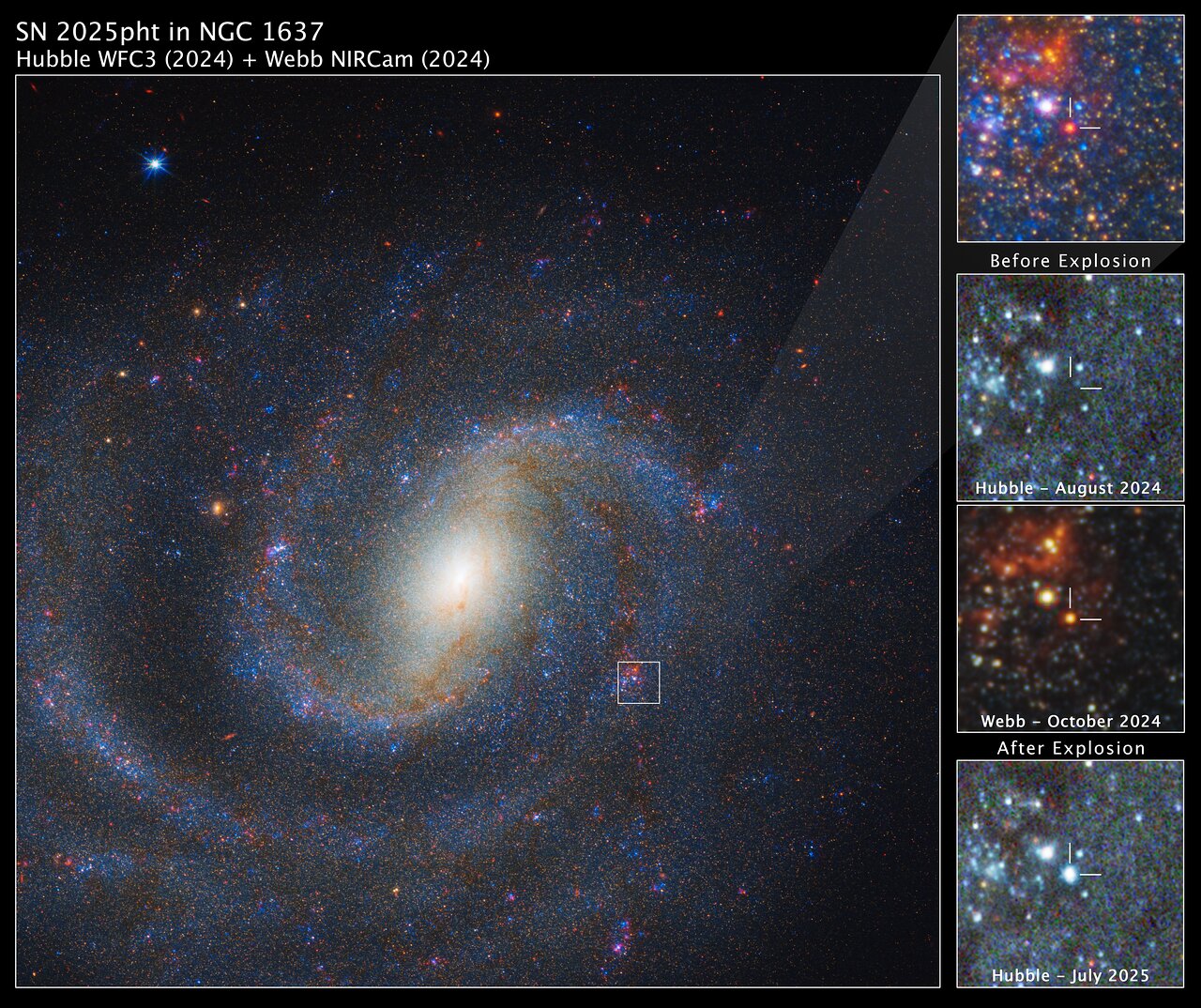
Astronomers had been waiting for a supernova explosion in the galaxy, which had already been photographed by the JWST telescope, in order to obtain data about the star that gave rise to it. This occurred on June 29, 2025, when the ASAS-SN automated survey detected a flare designated 2025pht. It was located in the galaxy NGC 1637, 40 million light-years from Earth.
After that, scientists turned to archival images of NGC 1637 to determine exactly how its stars exploded. And they succeeded. By carefully comparing images of NGC 1637, the team was able to identify the star’s predecessor in photos taken by JWST in 2024. They discovered that the star appeared remarkably red, indicating that it was surrounded by dust that blocked shorter, bluer wavelengths of light. Because of this, it was not visible in images taken by the Hubble telescope.
“It’s the reddest, most dusty red supergiant that we’ve seen explode as a supernova,” said graduate student and co-author of the study Aswin Suresh of Northwestern University.
This excess dust may help explain a long-standing problem in astronomy known as the mystery of the missing red supergiants. It is expected that the most massive stars, exploding as supernovae, will also be the brightest and most luminous. Thus, they should be easy to identify in images taken before the supernova explosion. However, in reality, this is not the case.
One possible explanation is that the most massive aging stars are also the dustiest. If they are surrounded by a large amount of dust, their light may be dimmed to such an extent that it cannot be detected. JWST observations of supernova 2025pht confirm this hypothesis.
Scientists were surprised not only by the amount of dust, but also by its composition. Modeling showed that it is likely rich in carbon, whereas it was expected to be rich in silicates. The team suggests that this carbon could have been ejected from the star’s interior shortly before its explosion. They are now working on finding similar red supergiants that could become supernovae in the future.
Earlier, we reported on how James Webb tracked the life cycle of a nearby galaxy.
According to Esawebb

