

Astronomers working with the James Webb Space Telescope (JWST) have published a spectacular new image. It shows the galaxy NGC 5134.
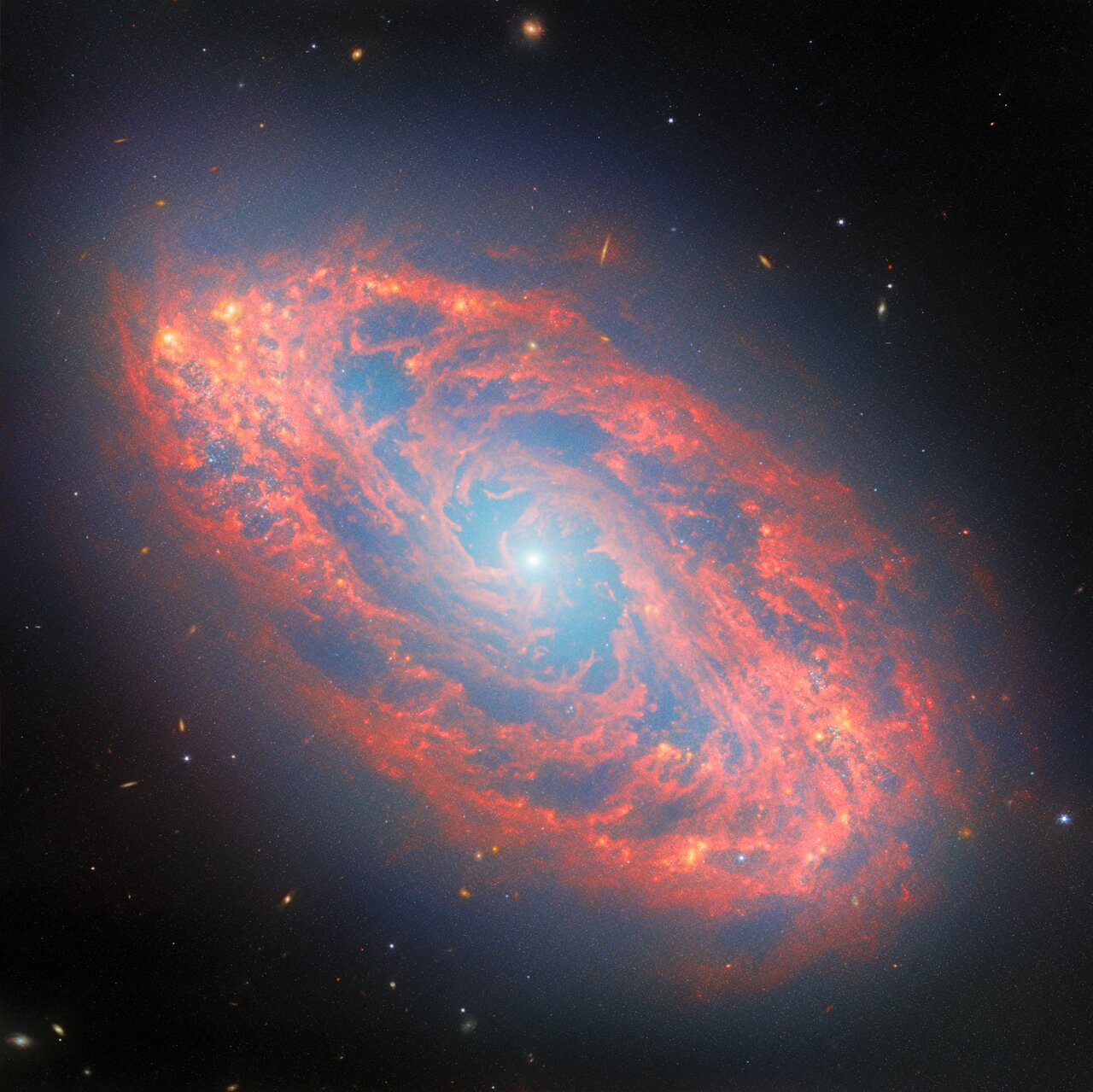
NGC 5134 is located 65 million light-years from Earth in the direction of the constellation Virgo. This is a gigantic figure by human standards — we see the galaxy as it was at the time of the extinction of the dinosaurs. But by cosmological standards, NGC 5134 is quite close to us. And thanks to this relative proximity, JWST was able to see many details of its spiral structure.
JWST conducts observations in the near and mid-infrared range. The main source of “near” infrared waves are stars and star clusters scattered throughout the spiral arms of the galaxy. As for “medium” waves, they are emitted by warm dust, which saturates the gas clouds filling the galaxy. Dust particles consist of complex organic molecules called polycyclic aromatic hydrocarbons. They form flat ring-shaped structures, very similar to honeycombs in beehives. On Earth, they are found in smoke from fires, car exhaust fumes, or, say, burnt toast.
By combining the data collected by JWST, astronomers were able to obtain a portrait of the life cycle of a galaxy. The gas clouds stretching along the spiral arms of NGC 5134 are sites of star formation. Each star that forms gradually depletes the available gas reserves. They are partially replenished in the process of the death of old stars. The largest stars, whose mass exceeds that of the Sun by more than eight times, do so in spectacular ways, as a result of catastrophic supernova explosions, ejecting their matter hundreds of light years away.
Stars similar to the Sun also return some of their material, although not as spectacularly. They become red giants, after which they shed their atmosphere into space, forming planetary nebulae. In the future, this ejected material may become part of a new generation of stars. The same fate awaits our Sun in the future.
According to Esawebb

