

NASA has published satellite images showing what was once the world’s largest iceberg, A-23A. As it melted, it turned an unusual blue color.
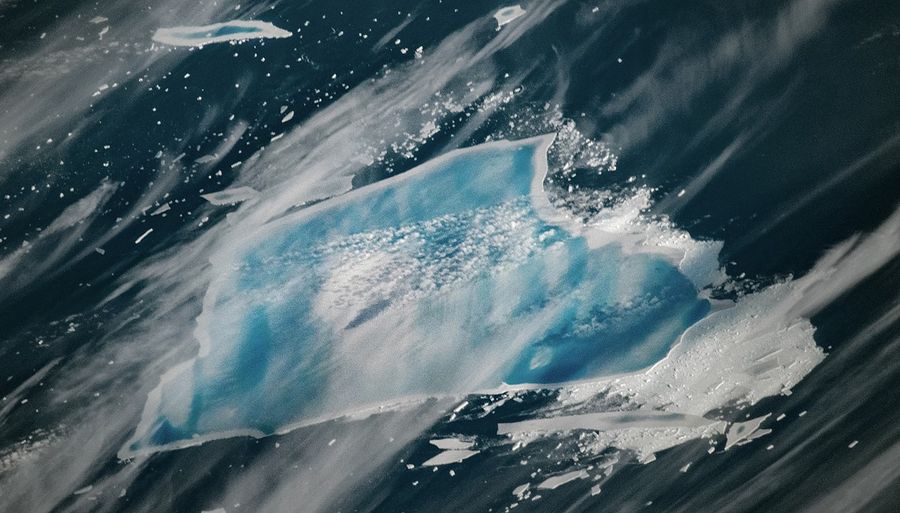
This year, A-23A could have celebrated its 40th “birthday.” The fact is that the iceberg formed back in 1986, breaking off from the Filchner Ice Shelf in West Antarctica. However, initially, A-23A did not travel far. It became stuck on the seabed in the Weddell Sea and remained in the same place for the next three decades. It was not until 2023 that shelf currents finally shifted the giant iceberg and carried it out to the open sea. At that point, the iceberg covered an area of 3,900 km², was 400 meters wide, and weighed about one trillion tons, making it the largest iceberg in the world.
The A-23A spent the next two years in the ocean, gradually moving away from the cold waters around Antarctica that had helped it survive. In March 2025, it became stuck in shallow water 100 km from South Georgia Island. The iceberg spent two months there, after which it broke away from the shelf and resumed its drift. Currents carried it to warmer waters to the north, after which it began to rapidly break up.
As of early January 2026, the area of A-23A had shrunk to 1,182 km2. Nevertheless, it is still the largest iceberg in the open ocean. Its size exceeds the area of Kyiv.
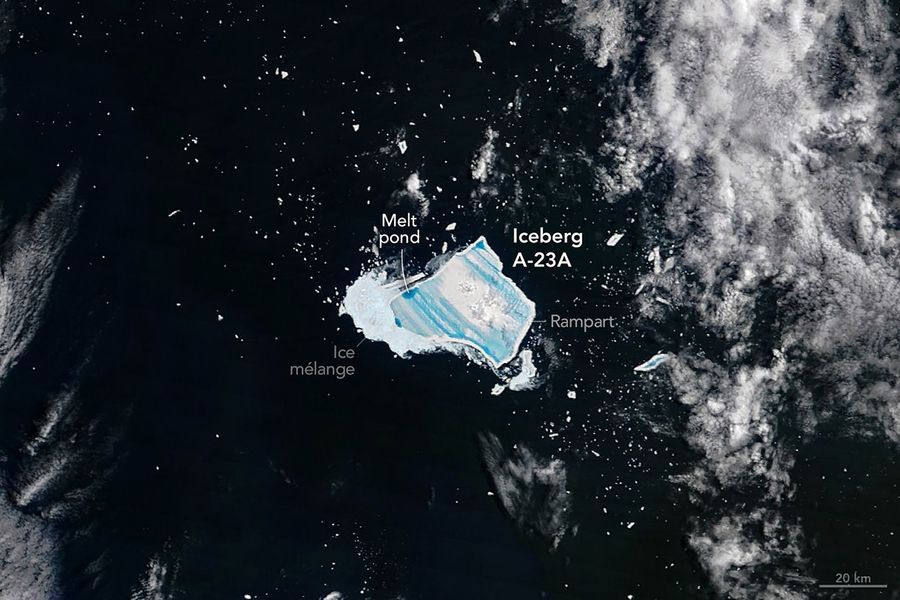
The iceberg has not only shrunk in size, but also changed color. As shown in images taken by the Terra satellite and the ISS crew, A-23A has acquired a distinctive blue color. This is because its surface is covered with numerous ponds filled with melted glacial water. The bright linear patterns of blue and white across the iceberg are likely related to grooves that formed hundreds of years ago when it was part of a glacier sliding over Antarctic bedrock.
The image obtained by the Terra satellite also suggests that the iceberg has “sprung a leak.” The white area to its left may be the result of what scientists figuratively describe as a blowout. The weight of the water accumulated at the top of the iceberg created enough pressure on the edges to break them. The blowout could have caused meltwater to spill tens of meters down onto the ocean surface, mixing with the slush of nearby floating ice chunks.
Scientists say that all these signs indicate that A-23A could completely break up within a few days or weeks. It is currently summer in the Southern Hemisphere, and the iceberg has entered an area known as the “graveyard” of icebergs. A-23A is currently in water with a temperature of about 3 °C, and currents are pushing it toward even warmer waters, which will quickly complete the disintegration process.
According to NASA

