

NASA has released new satellite images showing a once-giant iceberg known as A-23A. It is actively breaking down and will soon cease to exist.
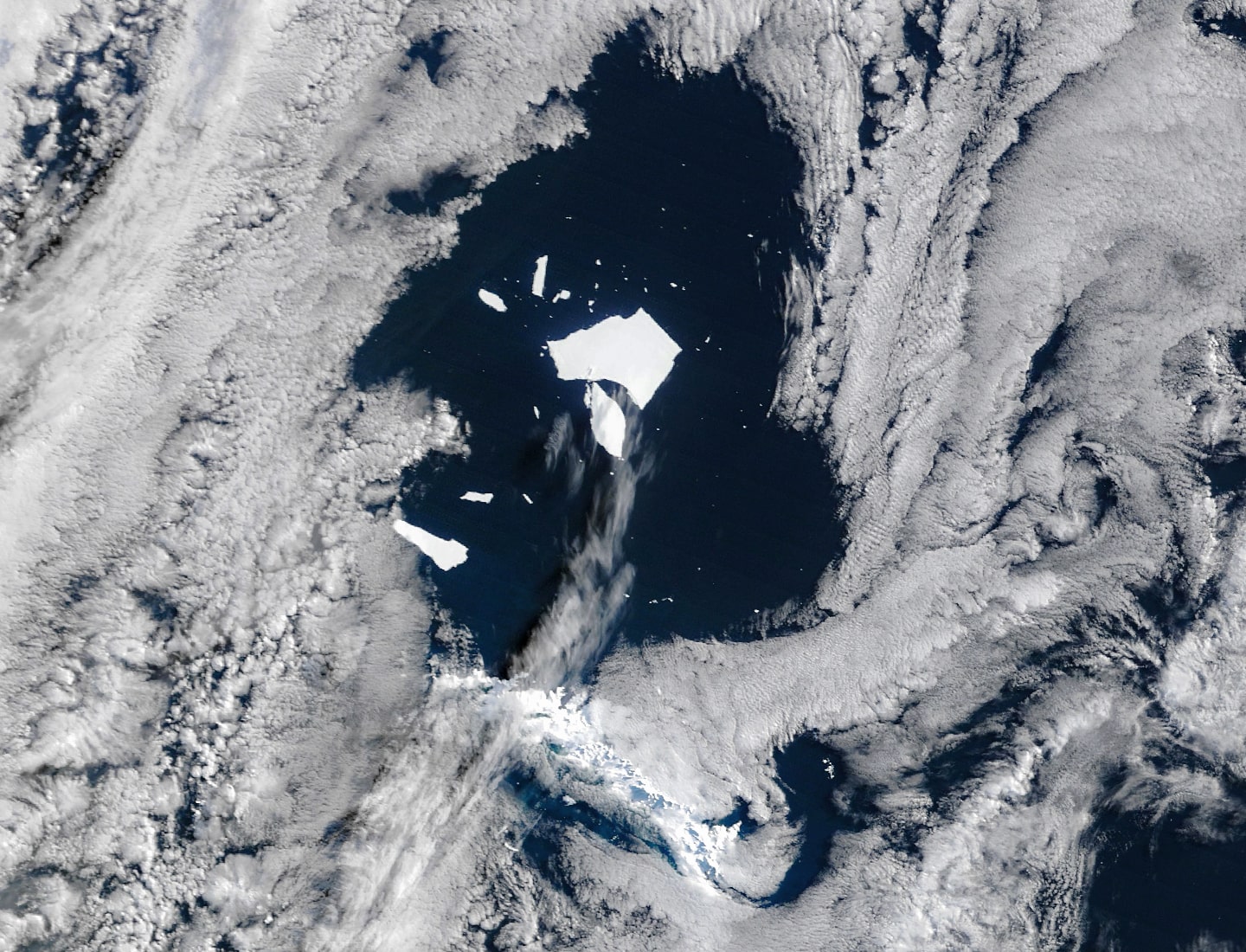
A-23A formed in 1986 when it broke off from the Filchner Ice Shelf in West Antarctica. However, the iceberg did not stray far from its birthplace. It became stuck on the seabed in the Weddell Sea and remained in the same place for the next three decades. It was only in 2023 that shelf currents finally shifted the giant iceberg and carried it out to the open sea. At that time, the iceberg had an area of 3,900 km², a width of 400 meters, and a mass of about one trillion tons, making it the largest iceberg in the world.
The A-23A spent the next two years in the ocean, gradually moving away from the cold waters around Antarctica that had helped it survive. In March 2025, it became stuck in shallow water 100 km from South Georgia Island. The iceberg remained there for two months, after which it broke away from the shelf and resumed its drift. The currents carried it to warmer waters north of the island in the so-called “iceberg alley.” This event marked its imminent demise.
An image taken on September 11, 2025, by the Terra satellite clearly shows the breakup of A-23A. At the time of the photo, the iceberg had already lost about two-thirds of its original size. Its largest remaining fragment covered an area of just over 1,500 km², making it the second largest free-floating iceberg in the world.
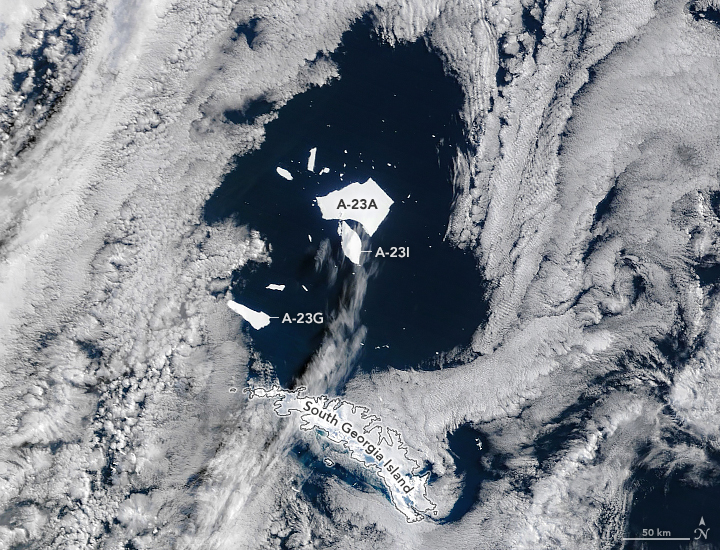
At the time of the photograph, large fragments that had broken off from A-23A were located nearby, namely icebergs A-23G and A-23I, with areas of 324 km² and 344 km² respectively. The US National Ice Center names, tracks, and documents Antarctic icebergs that are at least 69 km² in area or at least 19 km in length.
As it moves northward, fragments of A-23A will rapidly break up, creating smaller and smaller icebergs, some of which may reach shipping lanes. Spacecraft help scientists track their drift. Landsat satellites can observe some of these small ice fragments when weather permits, while satellites such as Terra or Aqua, equipped with synthetic aperture radars, can conduct observations at any time of day and in any weather conditions.
According to Earthobservatory

