

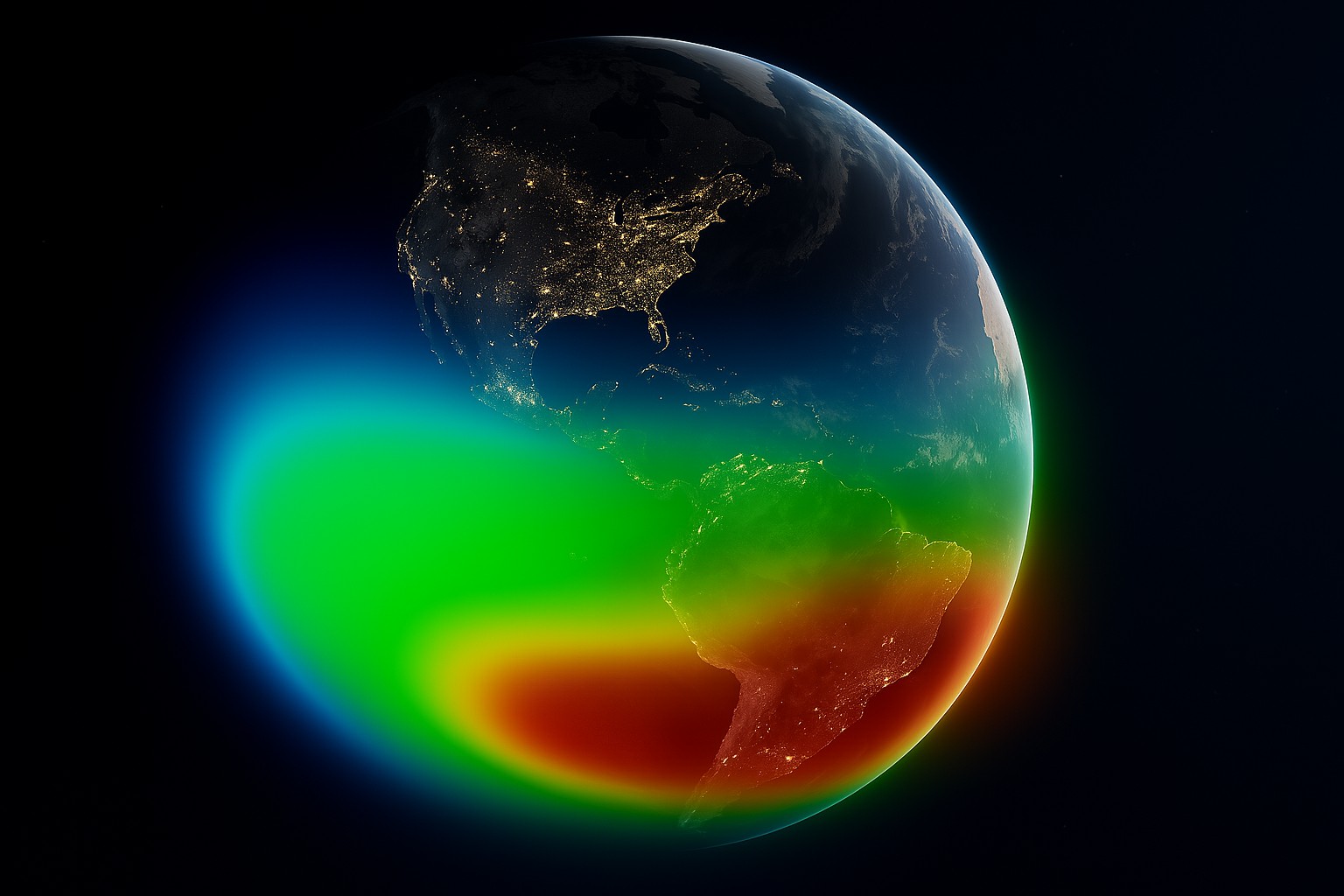
The Earth’s magnetic field is our invisible protective shield. It keeps the planet safe from dangerous cosmic radiation and solar particles. But this shield has begun to weaken. Thanks to data from the European Space Agency’s Swarm satellite constellation, scientists have obtained worrying evidence: one of the weakest areas of the field — the South Atlantic Anomaly — is rapidly expanding.
What is the South Atlantic Anomaly?
This anomaly is a huge area over the South Atlantic where the magnetic field is significantly weaker than normal. It was first discovered in the 19th century. Today, it poses a real threat to spacecraft. Satellites flying through this zone receive increased doses of radiation, which can damage their equipment.
The Swarm mission, consisting of three identical satellites, has been continuously measuring the Earth’s magnetic field since 2013. Data published this month shows that since 2014, the anomaly has expanded to cover almost half of Europe. But what is most concerning is that since 2020, an area of even more rapid weakening has formed over the Atlantic southwest of Africa.
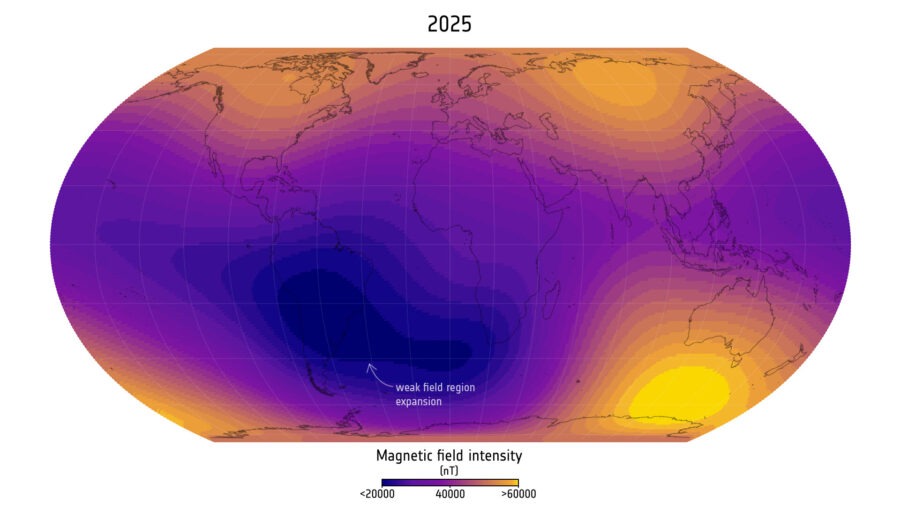
“The South Atlantic Anomaly is not just one block,” explains Professor Chris Finlay, lead author of the study. “It changes in different ways. Something special is happening in this region, causing a more intense weakening”.
Probable cause
Scientists attribute this strange behavior to processes in the Earth’s core, at a depth of about 3,000 km. There molten iron creates electric currents that generate a magnetic field. Unusual areas have been discovered beneath the South Atlantic Anomaly – so-called “reverse flow zones.” There, instead of escaping outward, the magnetic field unexpectedly returns back to the core. Swarm data shows that one such zone is moving westward over Africa, which is exacerbating the weakening.
Global changes in the magnetic field
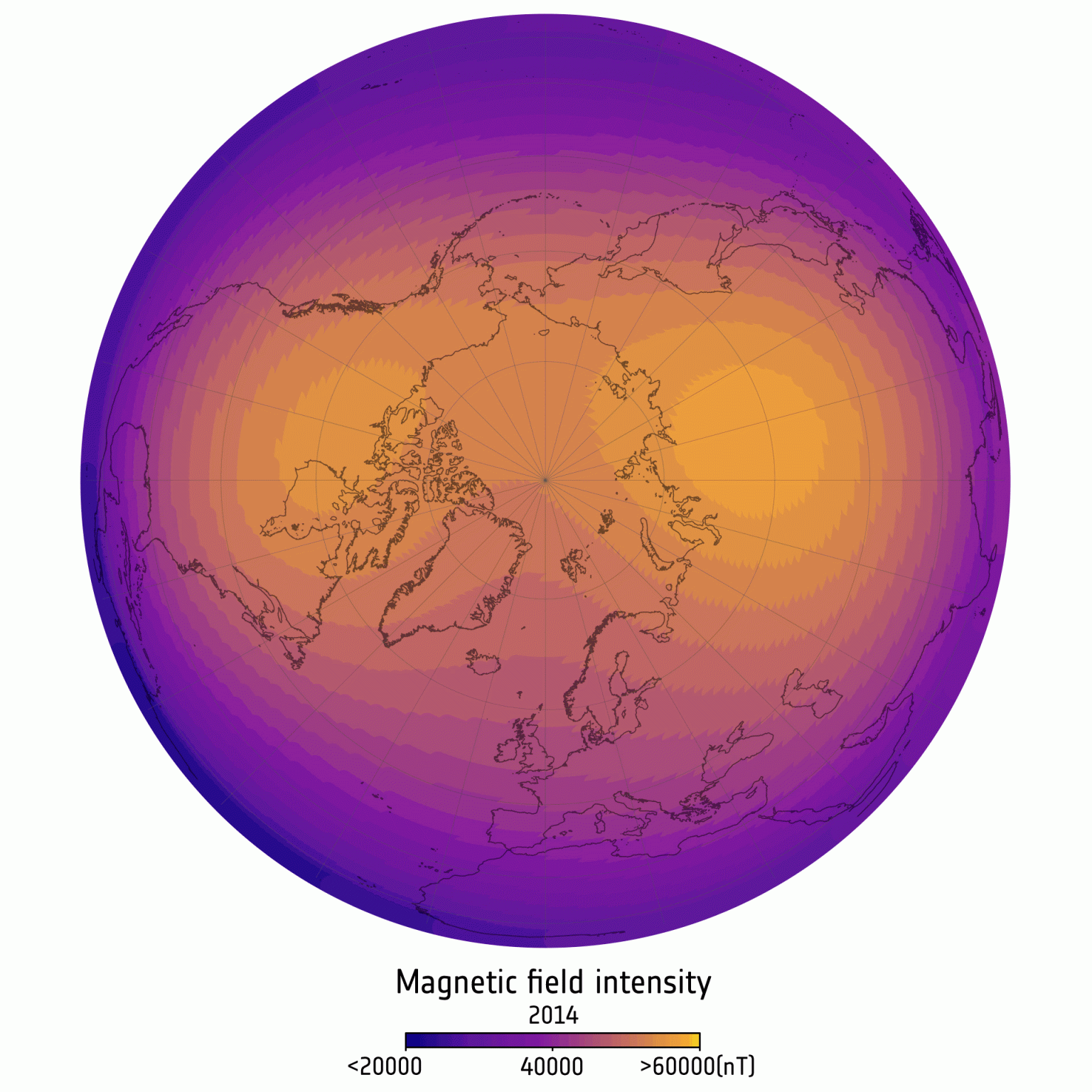
Recent discoveries emphasize that the Earth’s magnetic field is a dynamic and complex structure. For example, there are two powerful magnetic regions in the Northern Hemisphere: one above Canada and the other above Siberia. Since Swarm was launched, the Siberian region has strengthened, while the Canadian region has weakened. This is due to the fact that the North Magnetic Pole is rapidly drifting towards Siberia, which is important for global navigation systems.
The Swarm mission continues to provide unique data that helps us not only better understand our planet, but also protect our technological infrastructure. As mission leader Anja Stromme notes, they hope to continue this research after 2030 in order to obtain even more key answers.
Earlier, we talked about the anomaly that prevented GPS signals from being received over Brazil.
According to ESA

