

Contrary to existing predictions, Earth may avoid being swallowed by the Sun. A new study describes an alternative scenario in which our planet could survive the red giant phase and remain in orbit around the white dwarf that will form after the star’s transformation.
Not absorption, but migration
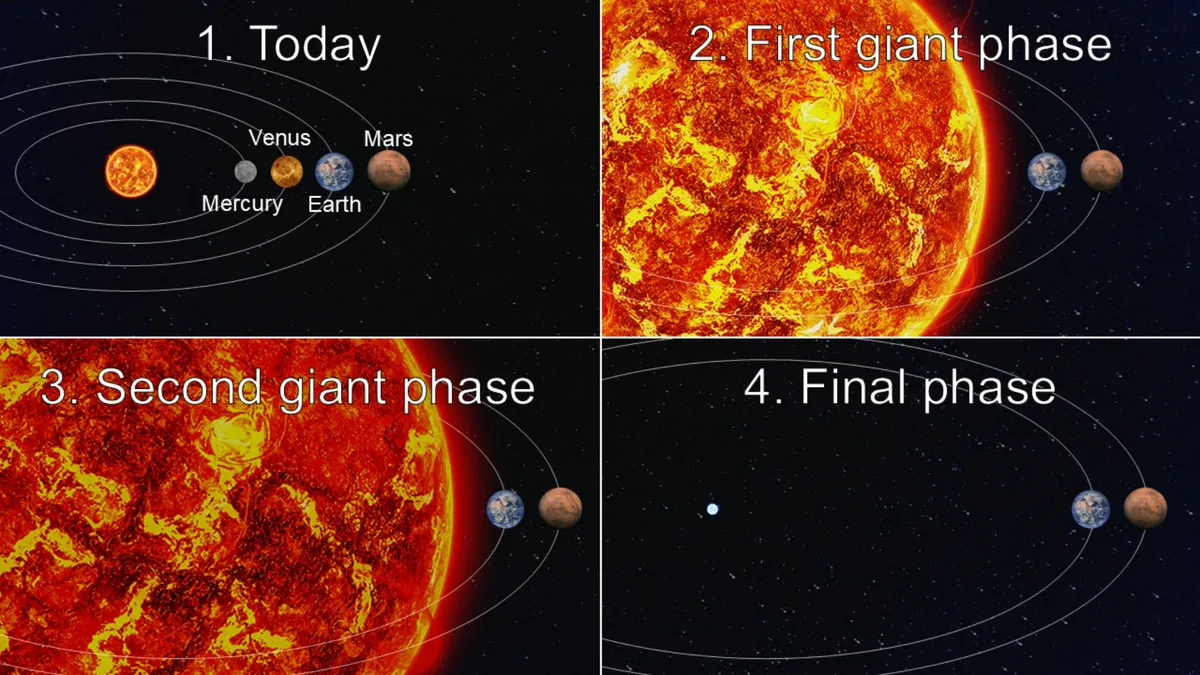
In about 5 billion years, the Sun will exhaust the hydrogen in its core. Gradually it will become a red giant, whose outer layers will expand so much that they will engulf Mercury and Venus. Many models have predicted the same fate for Earth.
A team led by Mats Esseldeurs of the Institute of Astronomy at the Catholic University of Leuven has recalculated the parameters of the gravitational interaction between the aging star and its planets, according to Space.com. It turns out that the tidal forces pulling Earth toward the Sun can be significantly weaker in the new models than previously thought.
At the same time, the Sun will shed a huge amount of matter, eventually losing almost half of its mass. As its gravity weakens, the orbits of the planets will gradually shift outward. According to the authors, the Earth and other planets could end up about twice as far from the Sun as they are today.
The fate of Earth depends on a delicate balance between these two effects. If tidal interactions prevail, our planet will be swallowed up. If mass loss dominates, it will slip into a safer orbit. Previous studies contradicted one another precisely because they accounted for these competing processes in different ways.
What has changed in the models
In the new work, the scientists used more modern models of the tidal interaction between the Sun and planets. They take into account how the star’s internal structure, convection, and energy dissipation mechanisms change as it ages. This allowed them to more accurately model the simultaneous effects of tidal forces and mass loss by the Sun.
The results were tested for various scenarios of mass loss during the final stage of a red giant’s life. The model showed that even with weaker tidal braking, Mercury and Venus cannot move away fast enough to outpace the star’s expansion, so they will inevitably be swallowed up by it.
In contrast, Earth and Mars perhaps safely pass through both of the Sun’s giant phases. The simulations also indicate that the giant planets are capable of surviving both phases, though their orbits may become destabilized due to mutual gravitational perturbations. Eventually, Earth will settle into a wider orbit around the white dwarf.
This picture is far from definitive
The authors emphasize that the study does not guarantee survival. It merely shifts the focus of uncertainty. Long before that, in about a billion years, Earth will become uninhabitable due to the Sun’s gradual increase in brightness; therefore, the planet’s fate after the star’s transformation is more a question of the physical survival of the celestial body itself than of the possibility of life existing on it.
The main unknown at this point is not tidal braking, but the exact amount of mass the Sun will lose during the final stages of its evolution. Observations of Sun-like stars in the red giant phase so far suggest that Earth will survive as a celestial body. But more data is needed to be certain. The article was published in the peer-reviewed journal Astronomy & Astrophysics; a preprint is available on arXiv.

