

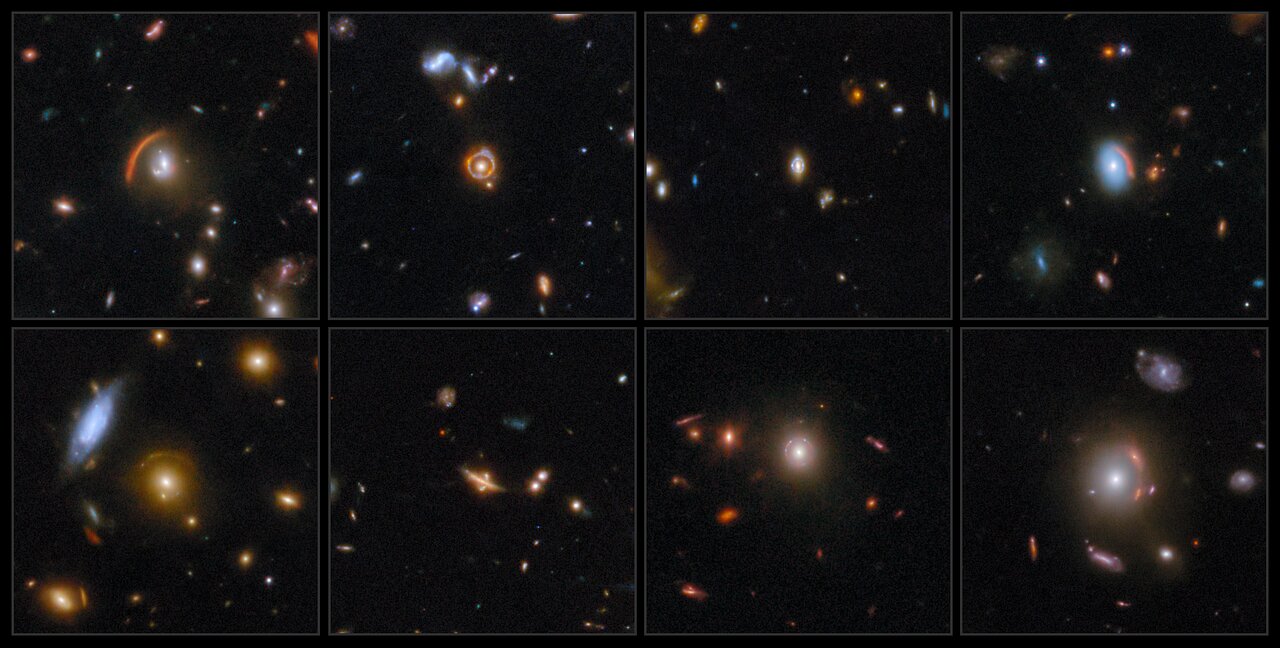
Astronomers working with the James Webb Space Telescope (JWST) have published a collage consisting of eight images they took. Each of them shows a gravitational lens.
Source: ESA/Webb, NASA & CSA, G. Gozaliasl, A. Koekemoer, M. Franco
The phenomenon of gravitational lensing was first predicted by Einstein. It consists of the fact that the gravity of the most massive objects in the universe, such as galaxies and galaxy clusters, sharply distorts the structure of space-time. When a massive object in the foreground aligns with a more distant galaxy in the background, it acts like a lens, amplifying and bending the light from the latter.
Depending on how perfectly aligned the objects are, light from the galaxy in the background can bend into an arc, a circle (a phenomenon called an “Einstein ring”), or even split into multiple images. Astronomers actively use gravitational lenses in their work. They allow them to observe extremely distant objects that under normal conditions would be too dim to be seen even by the most powerful existing telescopes.
The published collage shows eight different gravitational lenses. They were identified during the analysis of images taken by JWST as part of the COSMOS-Web program, which aimed to study galaxies. In total, researchers examined more than 42,000 galaxies and selected more than 400 promising lens candidates. The eight most impressive ones are shown in the image.
The JWST’s collection of gravitational lenses covers an incredible range of cosmic history. The galaxies in the foreground give us a glimpse of the universe when it was between 2.7 and 8.9 billion years old. The galaxies in the background, whose shapes appear noticeably distorted, go even further back in time, and one of the sources, nicknamed the “COSMOS-Web ring” (top row, left of center), allows us to glimpse an era just a billion years after the Big Bang. This collection includes several rare examples, including an unusual case where the galaxy acting as a gravitational lens is not an elliptical galaxy but a flattened disk galaxy (bottom row, second from left).
These images demonstrate JWST’s ability to detect and reveal previously unseen details in gravitationally lensed galaxies. Some of them were previously discovered by the Hubble Space Telescope, and we see them in a whole new light. Others, including those that appear particularly red due to dust or distance, were discovered for the first time by JWST. This discovery opens a unique window into the early days of the universe and allows us to study the smallest details in distant galaxies, such as individual star clusters and supernovae.
Earlier, we reported on how James Webb examined the structure of a black hole jet.
Provided by: Esawebb

