

An international team of researchers has managed to record electrical discharges on Mars for the first time. These discharges originate from dust devils.
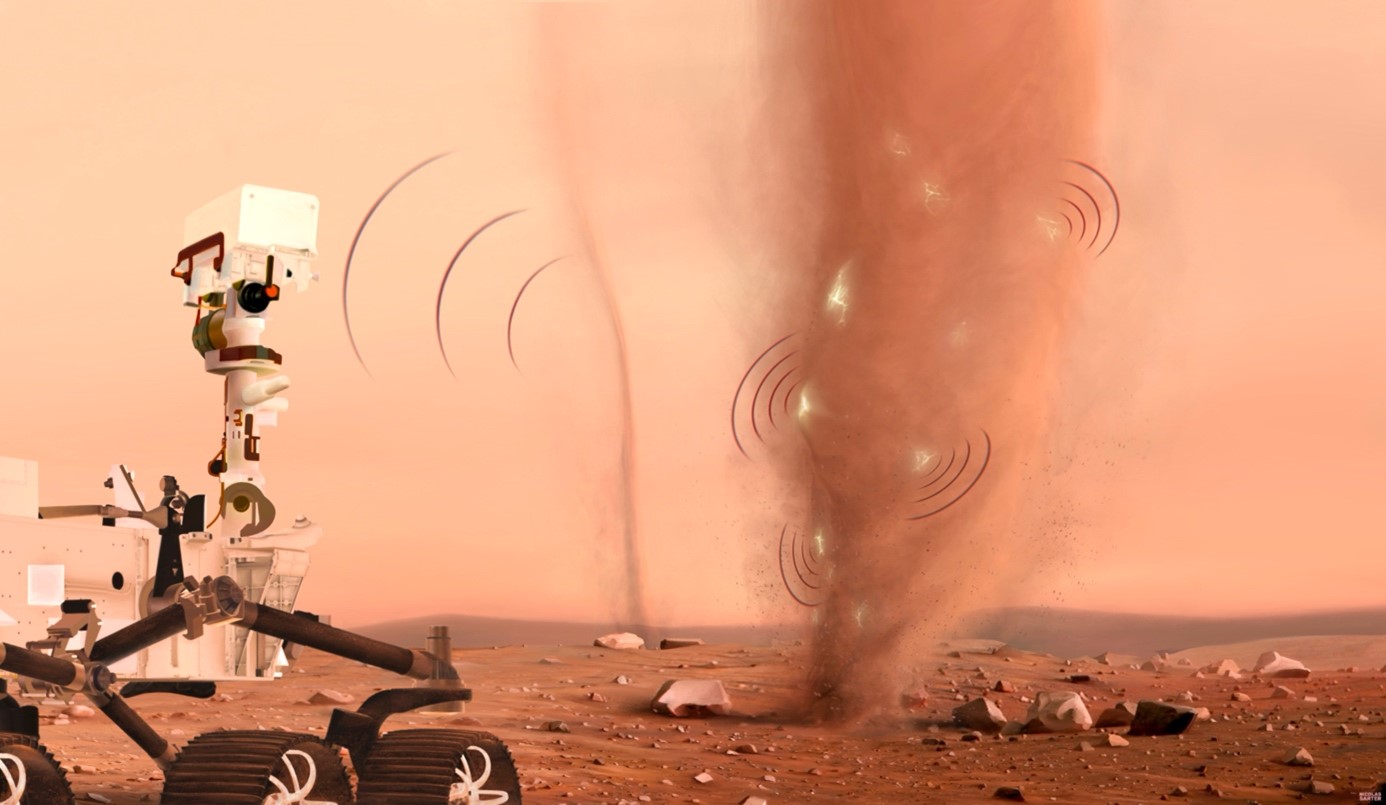
Martian winds constantly stir up whirlwinds of fine dust, which regularly appear in photographs taken by rovers exploring the Red Planet. Scientists have long suspected that these whirlwinds are capable of generating electrical charges. The mechanism of the phenomenon is as follows. As a result of friction between tiny dust particles, they become charged with electrons and then release their charge in the form of electric arcs several centimeters long, accompanied by audible shock waves.
It is well known on Earth that dust particles can become electrically charged, especially in desert regions, although this rarely leads to actual discharges. On Mars, due to its thin atmosphere, consisting mainly of carbon dioxide, the probability of this phenomenon occurring is much higher. This is because the amount of charge required to form sparks is much less than on Earth.
In order to confirm the existence of electrical discharges on Mars, a team of French scientists analyzed data collected by the microphone of the SuperCam instrument installed on board the Perseverance rover. They managed to identify electromagnetic and acoustic signatures comparable to small static electricity discharges that can be experienced on Earth by touching a door handle in dry weather. Their source was two dust devils.
The discovery of electrical discharges radically changes our understanding of the chemistry of the Martian atmosphere. It shows that the atmosphere of the Red Planet can reach a sufficient charge level to accelerate the formation of highly oxidizing compounds. Such substances can destroy organic molecules on the surface, as well as numerous atmospheric compounds, thereby profoundly disrupting the photochemical balance. The discovery may explain the surprisingly rapid disappearance of methane on Mars, which has been the subject of scientific debate for several years.
The electrical charges required for these discharges likely influence dust transport on Mars, playing a central role in the Martian climate, the dynamics of which remain largely unknown. They may also pose a risk to the electronic equipment of current robotic missions and create a hazard for potential future human missions.
According to CNRS

