
Elon Musk has repeatedly announced his ambitious plans to colonize Mars. According to the millionaire, Optimus humanoid robots should be the first to land on the Red Planet before the end of this decade. However, the scientific community is deeply skeptical about these predictions. Experts believe that modern technology is not ready for such a leap forward.
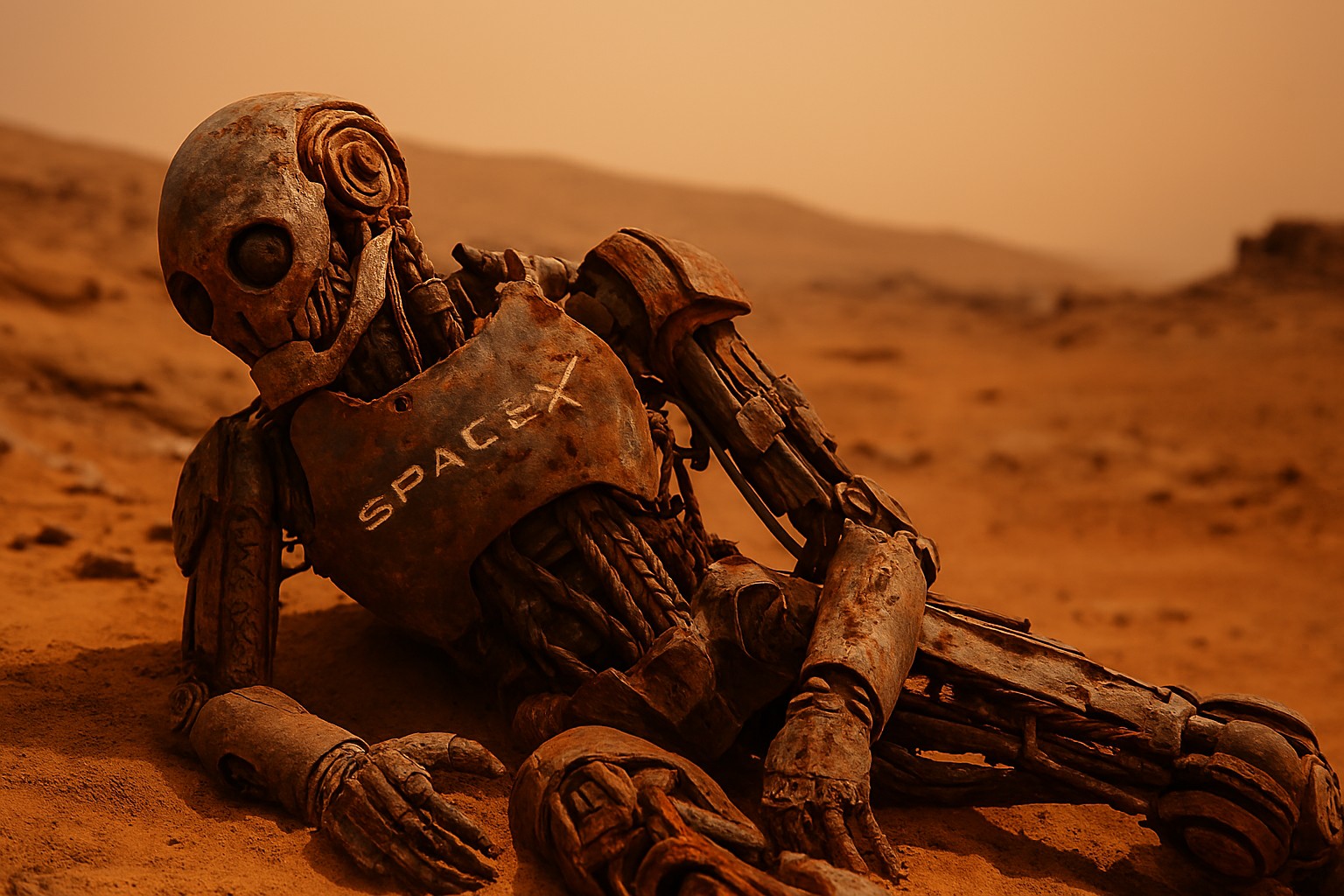
Christian Hubicki, head of the Optimal Robotics Laboratory at Florida State University, categorically does not believe in the success of this mission. In an interview with Forbes, he stated that Musk’s robots on Mars are doomed to quickly turn into scrap metal.
“Humanoids fall down. They break. Right now, they are not reliable enough to be autonomous even on Earth, let alone Mars,” the expert emphasized.
This undeniable problem is exacerbated by the hostile environment of a distant planet. An urgent problem is the inability to perform repairs quickly. On the International Space Station, robots such as NASA’s Robonaut are always repaired by astronauts. There is no one to rescue on Mars, and delivering spare parts would take months. Without someone nearby who could fix the inevitable malfunctions, the mission would quickly end in failure.
Technology gets in the way of ambition
The Optimus project itself raises many questions. Musk’s plan to produce hundreds of thousands of robots per year seems fantastical given the industry’s current capabilities. Despite progress, demonstrations of Optimus appear limited: the robot responds slowly, moves awkwardly, and is prone to technical glitches. This indicates that the technology is in its early stages of development.
At the same time, another key technology developed by Musk—self-driving cars—also does not appear to be ready for fully autonomous operation without constant human supervision. This calls into question the company’s ability to create a truly autonomous system for much more complex conditions.
An alternative route to the planets
Experts suggest a different approach. Instead of imposing a human form on robots, it is more effective to develop specialized models adapted to specific terrain. For example, NASA is already testing a snake robot to explore the ice caves of Enceladus, a moon of Saturn. Such unconventional designs may prove to be much more practical for Martian craters and deserts.
The conclusion of experts is clear: without a revolutionary breakthrough in reliability and autonomy, humanoid robots will not be able to survive on the Red Planet. The Martian dream may become a reality, but the first explorers should not be humanoid androids, but specialized missions with clearly defined tasks. For now, Musk’s technologies remain an exciting but unattainable fantasy.
Earlier, we reported on how Elon Musk proposed humanity survive the death of the Sun on Mars.
According to forbes.com

