

It would seem that nothing could be more stable than the length of a day on Earth. For many generations, 24 hours has remained an unchanging constant in life. However, modern science is forcing us to rethink this assumption. Recent studies by experts at the University of Vienna and the Swiss Federal Institute of Technology (ETH) in Zurich show that our planet is gradually slowing down its rotation. One of the factors of this process is climate change, specifically global warming, which is steadily melting the polar ice caps. Although the changes are not yet noticeable to humans and are measured in milliseconds, researchers emphasize that the rate of this process is the fastest it has been in the last 3.6 million years.
The planetary “figure skater effect”
The mechanism behind this phenomenon can be easily explained by the fundamental laws of physics. Due to the rapid rise in global temperatures, massive ice sheets in Greenland, Antarctica, and on mountain peaks are melting. Water previously concentrated at the poles in the form of ice is flowing into the world’s oceans and moving closer to the equatorial zone.
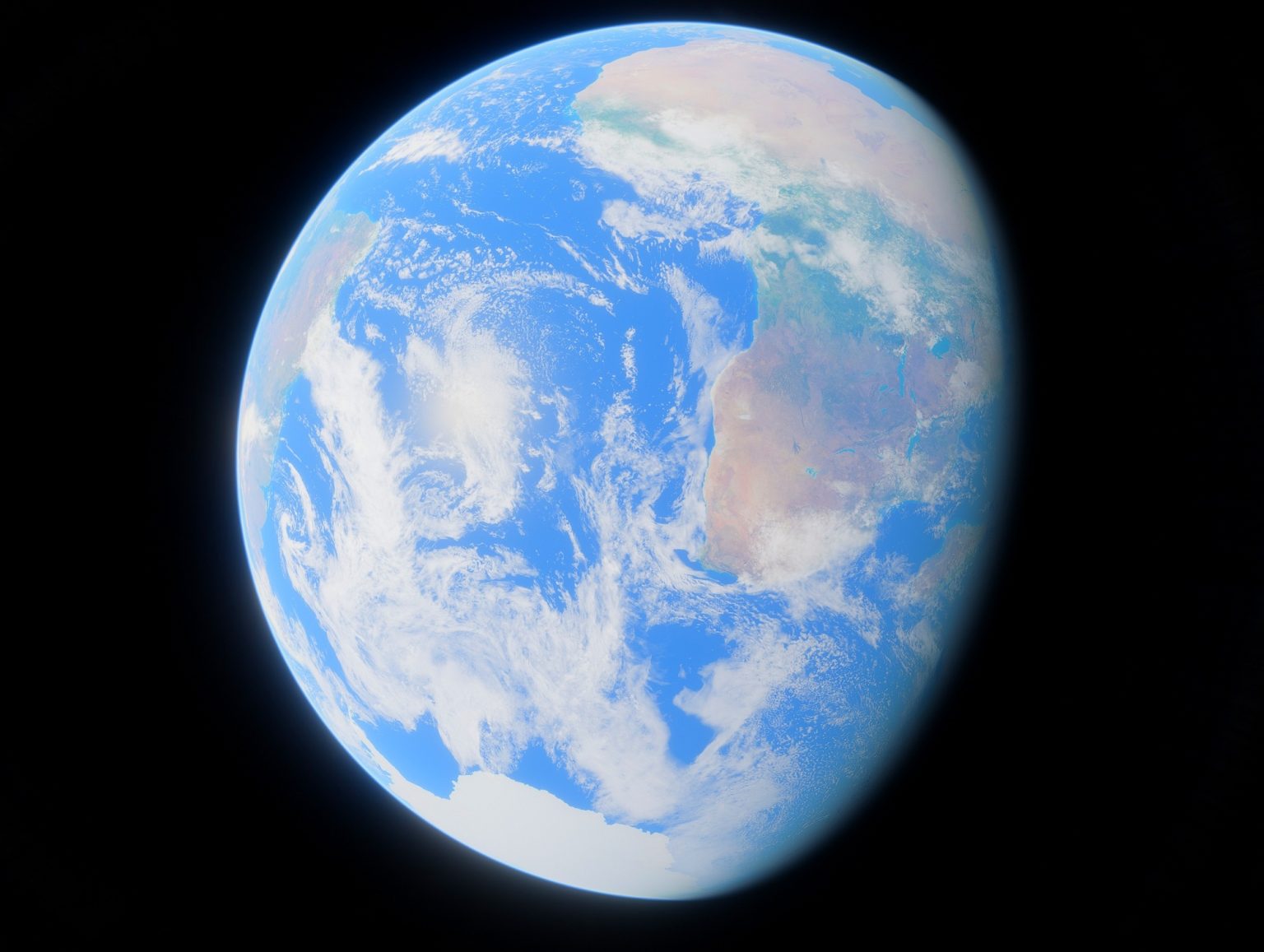
Scientists use a clear analogy involving a figure skater. When an athlete sharply extends their arms to the sides during a spin, their speed decreases. The Earth operates on a similar principle: the redistribution of water mass from the poles to the equator pulls it away from the axis. This inevitably slows the planet’s rotation, making the days slightly longer.
Scales that boggle the mind
Although the average person cannot physically perceive these shifts in time, the scientific calculations are striking. According to researchers’ estimates, the length of a day is currently increasing by approximately 1.33 milliseconds every century, precisely because of climate change.
According to Professor Benedikt Soja, a co-author of the study, an incredible amount of mass—about 1,000 gigatons of ice and water—would need to move from the polar regions into the oceans to trigger such a shift. To better grasp the scale of this, scientists compare the energy expended on such a transfer to the power of a devastating magnitude 9 earthquake.
Encrypted messages from the past
To determine whether Earth had experienced similar rapid changes in the past, scientists delved into the paleogeological record. The key to solving the mystery was the fossils of foraminifera—microscopic marine organisms. An analysis of the chemical composition of their shells has made it possible to reconstruct past sea levels and the dynamics of ice sheets from bygone eras.
By combining these paleontological records with modern climate data and machine learning algorithms, scientists have reconstructed the history of Earth’s rotation going back approximately 3.6 million years. Their conclusion is clear: the current slowdown stands out distinctly against the backdrop of geological history. Scientists have found only one similar episode of rapid glacial melt, which occurred about two million years ago. However, the current trend is highly unusual, as it is primarily driven by human-induced global warming.
Why milliseconds matter
In a person’s daily routine, a few milliseconds are of no consequence, but for today’s high-tech infrastructure, they are critical. The operation of satellite systems, GPS networks, and global telecommunications, as well as the coordination of space missions, depend entirely on time measurements of reference-grade accuracy.
Modern technologies require precision on the order of nanoseconds. Even the slightest deviations in the Earth’s rotational speed can cause serious problems in software and navigation. Scientists warn that if the climate crisis continues to worsen, its impact on the length of the Earth’s day could eventually surpass even traditional natural factors, such as the Moon’s gravitational pull, which has historically shaped our planet’s rotation.
We previously explained what the consequences would be if the Earth’s rotation were to speed up or slow down.
According to WSJ

