

On February 12, the most powerful version of the Ariane 6 rocket was launched from the Kourou spaceport in French Guiana. It successfully placed Amazon Leo satellites into orbit.

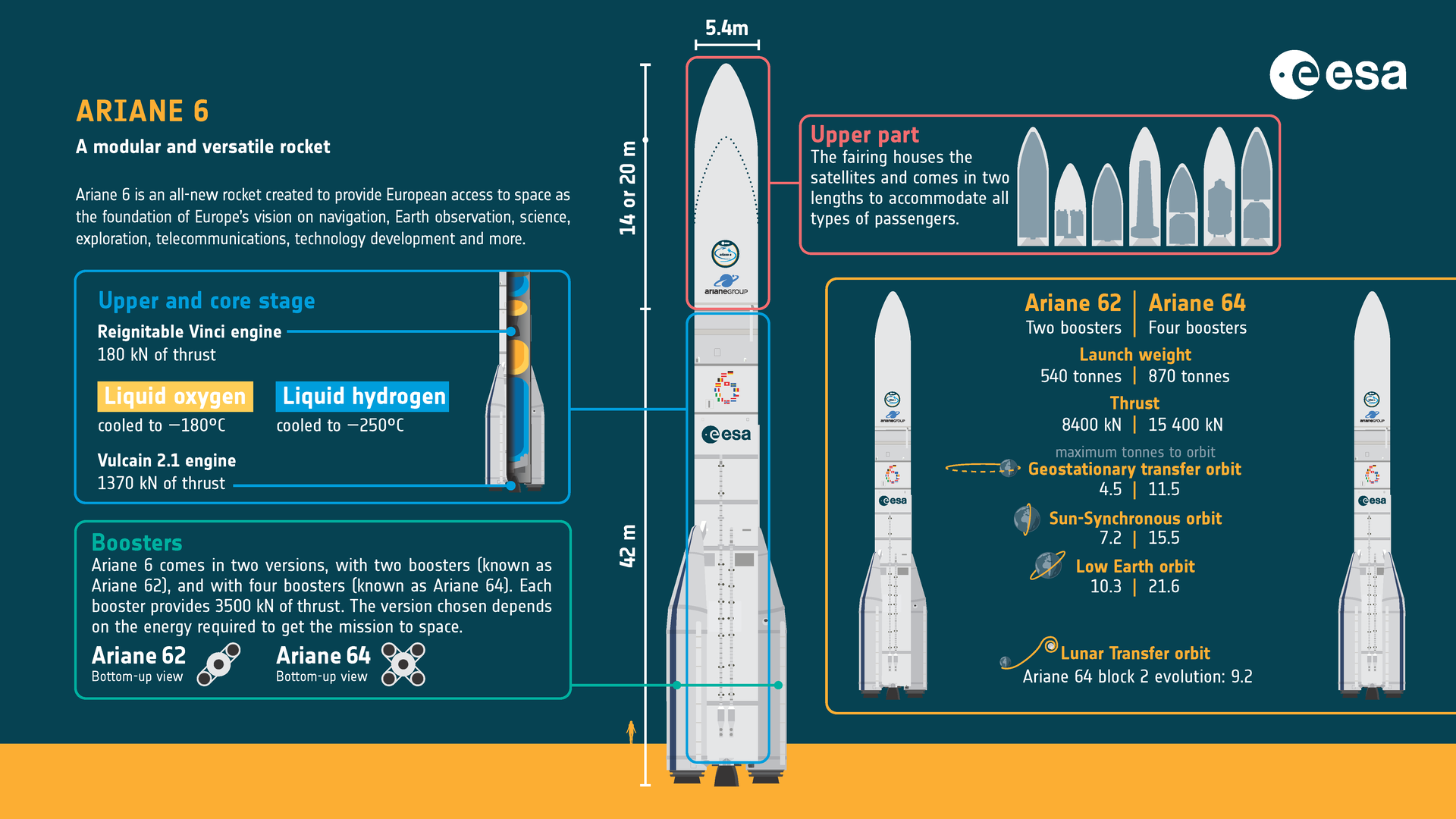
The Ariane 6 rocket has replaced the Ariane 5, which had long been Europe’s main workhorse. It comes in two versions: a medium-lift version (Ariane 62) and a heavy-lift version (Ariane 64) with a much greater payload capacity. Ariane 64 is equipped with four P120C solid rocket boosters, which have some of the most powerful engines in the world. Thanks to its additional thrust, it can deliver 21.5 tons of cargo to low Earth orbit and up to 11.5 tons to geostationary transfer orbit.
Ariane 62 debuted in 2024 and has completed five space missions to date. Ariane 64 had to wait two more years for its first flight. It took place on February 12, 2026, and was a success. The rocket launched 32 satellites from the Amazon Leo constellation into orbit, designed to provide global broadband internet service. It was carried out under a contract signed back in 2022. At that time, Amazon purchased 18 launches of the Ariane 6 rocket.
The successful launch of Ariane 64 was an important achievement for Europe. “This launch demonstrated Ariane 6 in its most powerful version. The first flight of Ariane 64 supports Europe’s autonomous access to space. We can transport small and large payloads to near and distant orbits using the full fleet of ESA Vega-C, Ariane 62, and Ariane 64 rockets,” said ESA Director of Space Transportation Toni Tolker-Nielsen.
At the same time, although Ariane 64 is in no way inferior (and even slightly superior) to Falcon 9 in terms of payload capacity, it is much more expensive. The cost of launching a European rocket is €115 million, while the new Falcon 9 costs $70 million (and even less when using boosters that have already flown). This is because Ariane 64 is a classic single-use launch vehicle. The next generation with a reusable first stage (Ariane Next) will debut no earlier than the 2030s. Therefore, it will be quite difficult for the European rocket to compete with SpaceX.

