

Safer helmets and softer landings: Engineers at the University of Wisconsin-Madison have created a new framework for rapidly designing shock-absorbing foam materials. Unlike the usual practice of considering only the mechanical properties of foam, this approach also takes into account geometry — the thickness and area of the overlay — and suggests how to achieve the necessary safety without unnecessary weight and volume. This cuts down on months of trial and error in the lab, and the range of applications expands from sports and military helmets to shock absorbers for spacecraft landing struts.
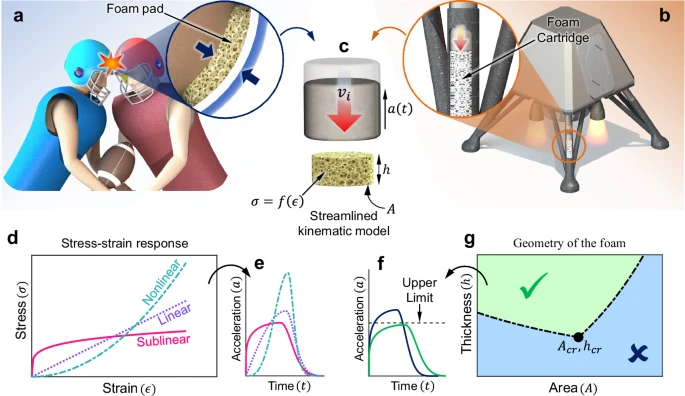
The team demonstrated that, in a number of scenarios, foams with a nonlinear stress-strain curve can outperform traditional materials that are oriented toward a deformation plateau, especially when thin and lightweight protective pads are required. The authors have compiled everything into convenient design maps, where, given specified acceleration/load limits, the framework provides optimal combinations of thickness, area, and material parameters.
To demonstrate the method, researchers optimized architectural VACNT foams (foams made of vertically aligned carbon nanotubes. These foams combine low density with high energy absorption and almost complete recovery after severe compression.
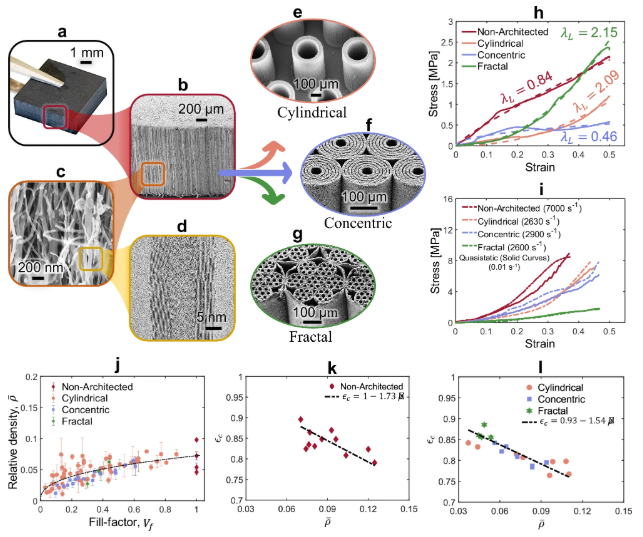
Landing supports for lunar rovers and probes, mounting assemblies for telescope optics and electronics, vibration isolation during orbital deployment — all these elements require a precise balance between mass, thickness, and level of protection. The new framework provides the ability to set acceptable peak accelerations and compression and obtain the thinnest/lightest inserts that can withstand landing impact or vibration loads during the launch. VACNT foams, which retain their properties over a wide range of deformation rates and temperatures, are particularly attractive for extreme space conditions.
For innovations such as shock-absorbing materials to truly fly into space, a perfect plan is needed — from the initial idea to launch and return. How do scientists set their goals, write requirements, undergo PDR/CDR, agree on launch windows, and prepare backup scenarios? Our material includes simple explanations, clear diagrams, and examples from NASA/ESA missions. Want to see how a space mission is actually born? Follow the link to the article “How space missions are planned: from concept to launch and return.”
According to nature, engineering.wisc, interestingengineering

