

Researchers have found that there may be channels at the base of Antarctic glaciers where warm water accumulates. This leads to their rapid melting and, as a result, rising sea levels.
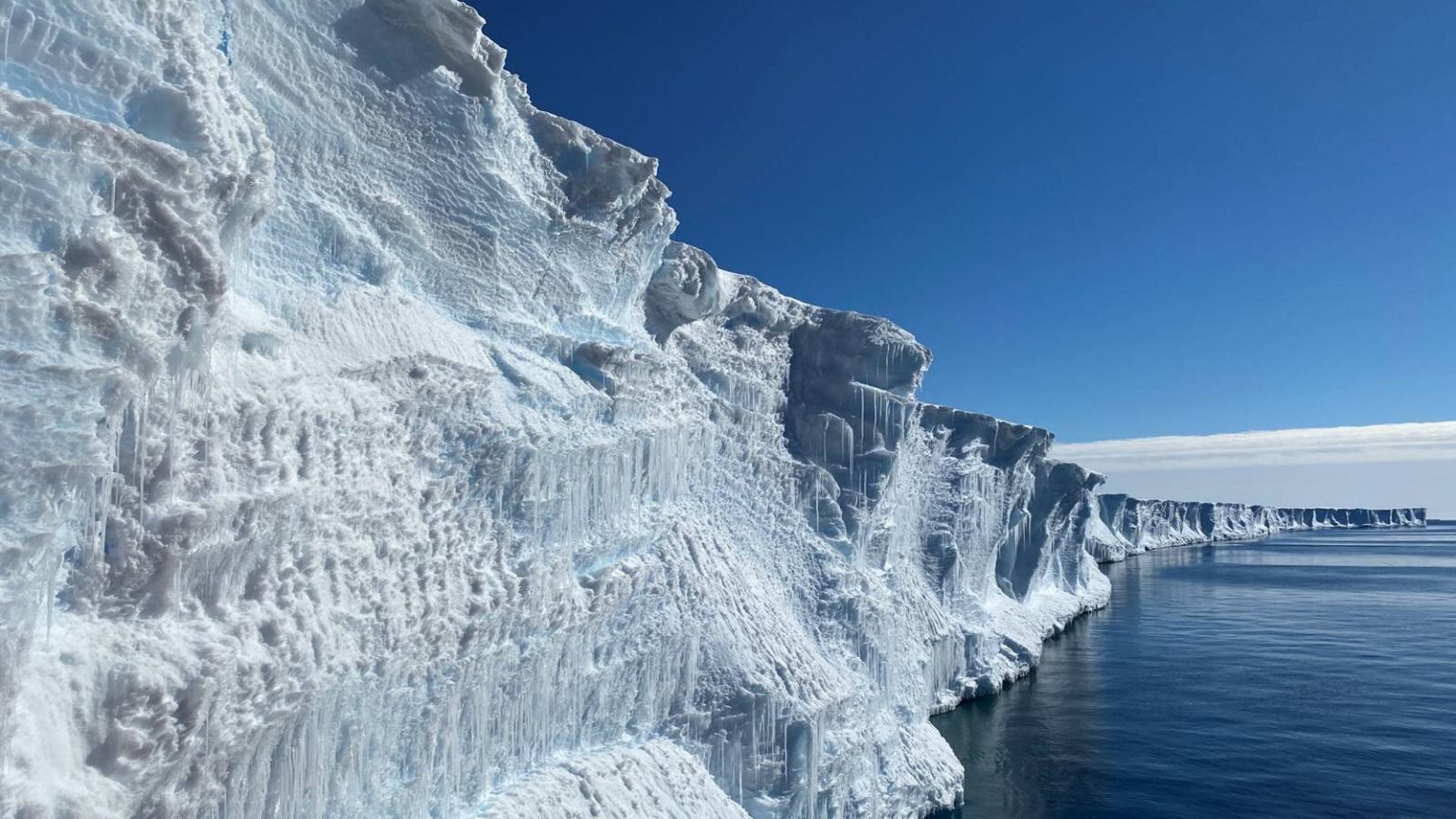
Shelf glaciers
Scientists have long anticipated that the melting of Antarctic glaciers could bring people a number of unpleasant surprises. However, a new study published by Norwegian researchers in the journal Nature Communications shows that the rise in sea levels caused by this process may be occurring even faster than previously thought.
Shelf glaciers, which are extensions of giant glaciers floating on the water’s surface, act as barriers that slow the flow of gigatons of ice into the sea. Now, Norwegian scientists have discovered that long, channel-like grooves on the underside of these ice shelves can trap relatively warm ocean water. This dramatically accelerates local melting.
This study is of global significance. If Antarctic ice shelves become thinner and weaker, the flow of ice behind them could accelerate, speeding up the process by which vast amounts of ice enter the ocean and causing sea levels to rise worldwide much faster than previously anticipated.
Such trends have already been observed in other parts of Antarctica. The Intergovernmental Panel on Climate Change (IPCC) has identified the instability of polar ice shelves as one of the key but understudied risk factors that could lead to sea-level rise that is much faster and more severe than most current models predict.
The geometry of a shelf glacier’s base affects its melting
Using the Fimbulisen Ice Shelf in East Antarctica as a case study, a research team found that the shape of an ice shelf’s base can significantly influence the movement of ocean water beneath it. In areas where the bottom surface is grooved, circulation can create small upwelling cells that trap warmer water beneath the ice, preventing it from passing through quickly.
In these channels, the melting rate can increase locally by a factor of about ten. Simply put, the geometry of the ice shelf determines where the ocean’s heat flows and how destructive it becomes.
“We found that the shape of the underside of the ice shelf is not just a passive feature. It can actively trap ocean heat precisely in the areas where additional melting is most critical,” explains lead author Tore Hattermann of the iC3 Polar Research Center in Tromsø, Norway. The Fimbulisen Ice Shelf is located in East Antarctica—a region that is colder and is therefore generally considered to be less at risk than the rest of the continent.
“We observed beneath the Fimbulisen Ice Shelf that even small amounts of warmer water can significantly accelerate melting inside the channels,” says Tore Hatterman. The scientist states that the process of melting and the expansion of these channels could undermine the stability of the entire ice shelf.
Comparison of mapping results
To reach these conclusions, the researchers combined a detailed map of the underside of the ice shelf with a high-resolution model of the ocean basin beneath Fimbulisen.
They compared models with a smoother ice surface and a more realistic one featuring channels, under conditions of both a cooler and a slightly warmer ocean. This allowed them to identify the impact of the channels on water flow, mixing, and melting.
The study also drew on the results of previous field observations in the region, demonstrating the benefits of combining long-term measurements with modeling, which makes it possible to identify fine-scale topographic features beneath the ice.
Implications of the discovery for climate models
The overall consequences are serious. Accelerated melting within the channels could lead to their deepening and widening, causing uneven thinning in the deeper parts of the ice shelf. This could reduce the structural integrity of the ice shelf and weaken its ability to contain the glaciers that feed it.
“Current climate models do not account for this effect,” warns Tore Hattermann. “This means that they risk underestimating the sensitivity of the ‘cold’ ice shelves along East Antarctica’s coastline to small changes or warming in coastal waters. Such changes have already been observed, and are projected to increase in the future.”
This is important for science, as ice sheet and climate models need to capture these fine-scale features more realistically. It is also important for policy, as decisions regarding coastal planning and adaptation depend on reliable sea-level projections. And this is important from an environmental perspective, as changes in the inflow of meltwater can affect ocean circulation and marine ecosystems around Antarctica.
According to phys.org

