

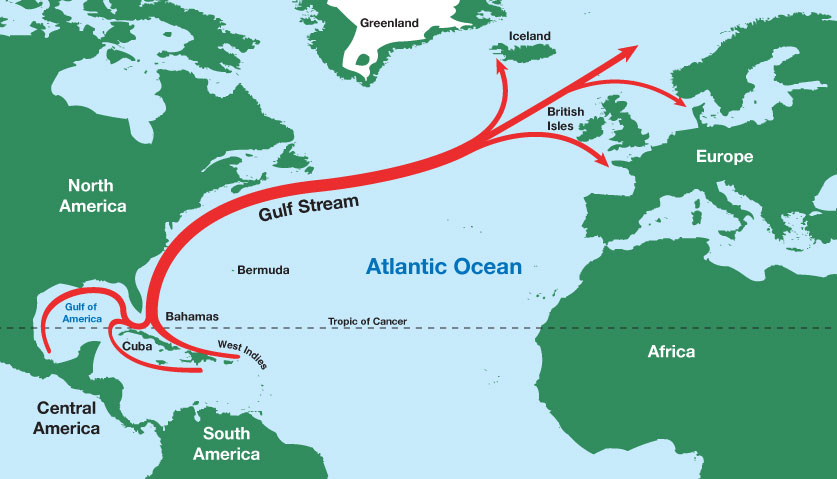
Research shows that global warming could lead to a complete halt in water circulation in the North Atlantic. This means, in particular, that the Gulf Stream could also disappear. And that means that instead of warming in Europe, we could see a significant cooling.
Ocean currents coming to rest
Under a high emissions scenario, the Atlantic meridional overturning circulation (AMOC), a key ocean circulation system that includes the Gulf Stream, could discontinue after 2100. This conclusion is contained in a new study, which the Potsdam Institute for Climate Impact Research has joined. The halt in circulation will lead to a reduction in heat input to the northern regions of the ocean, resulting in droughts in summer and severe winter extremes in northwestern Europe, as well as changes in tropical rain belts.
“Most climate projections stop at 2100. But some of the standard models of the IPCC—the Intergovernmental Panel on Climate Change—have now run centuries into the future and show very worrying results,” says Sybren Drijfhout of the Royal Netherlands Meteorological Institute. “The deep overturning in the northern Atlantic slows drastically by 2100 and completely shuts off thereafter in all high-emission scenarios, and even in some intermediate and low-emission scenarios. That shows the shutdown risk is more serious than many people realize.”
Disappearance of deep convection in winter as a breaking point
The AMOC transports sun-warmed tropical water northward near the surface and sends colder, denser water back southward at depth. This ocean conveyor belt helps maintain a relatively mild climate in Europe and influences weather conditions around the world.
In simulations, the break point causing the AMOC to stop is the collapse of deep convection in winter in the Labrador, Irminger, and North Seas. Global warming reduces heat loss from the ocean in winter because the atmosphere is not cool enough. This begins to weaken the vertical mixing of ocean waters: the sea surface remains warmer and lighter, making it less prone to sinking and mixing with deeper waters. This weakens the AMOC, resulting in less warm salt water flowing northward.
In northern regions, surface waters become cooler and less salty, and this decrease in salinity makes surface waters even lighter and less prone to sinking. This creates a self-reinforcing feedback cycle caused by atmospheric warming but amplified by weakened currents and water desalination.
After the tipping point, the cessation of the AMOC becomes inevitable due to self-reinforcing feedback. According to the study, the heat released in the northern Atlantic Ocean will decrease to less than 20% of its current level, and in some models, to almost zero.
Predictive models
To obtain these results, the research team analyzed CMIP6 (Coupled Model Intercomparison Project) simulations, which were used in the latest IPCC assessment report, with an extended time horizon to 2300–2500.
In all nine high-emission models, the models evolve toward a weak, shallow circulation state with the cessation of deep overturning; this result is also observed in some medium- and low-emission models. In each case, this change occurs after the collapse of deep convection in the northern waters of the Atlantic Ocean in the middle of the century.
“A drastic weakening and shutdown of this ocean current system would have severe consequences worldwide,” notes Potsdam Institute researcher Stefan Rahmstorf. “In the models, the currents fully wind down 50 to 100 years after the tipping point is breached. But this may well underestimate the risk: these standard models do not include the extra fresh water from ice loss in Greenland, which would likely push the system even further. This is why it is crucial to cut emissions fast. It would greatly reduce the risk of an AMOC shutdown, even though it is too late to eliminate it completely.”
According to phys.org

