
Astronomers working with the James Webb Space Telescope (JWST) have published an interesting image. It demonstrates a phenomenon known as gravitational lensing.
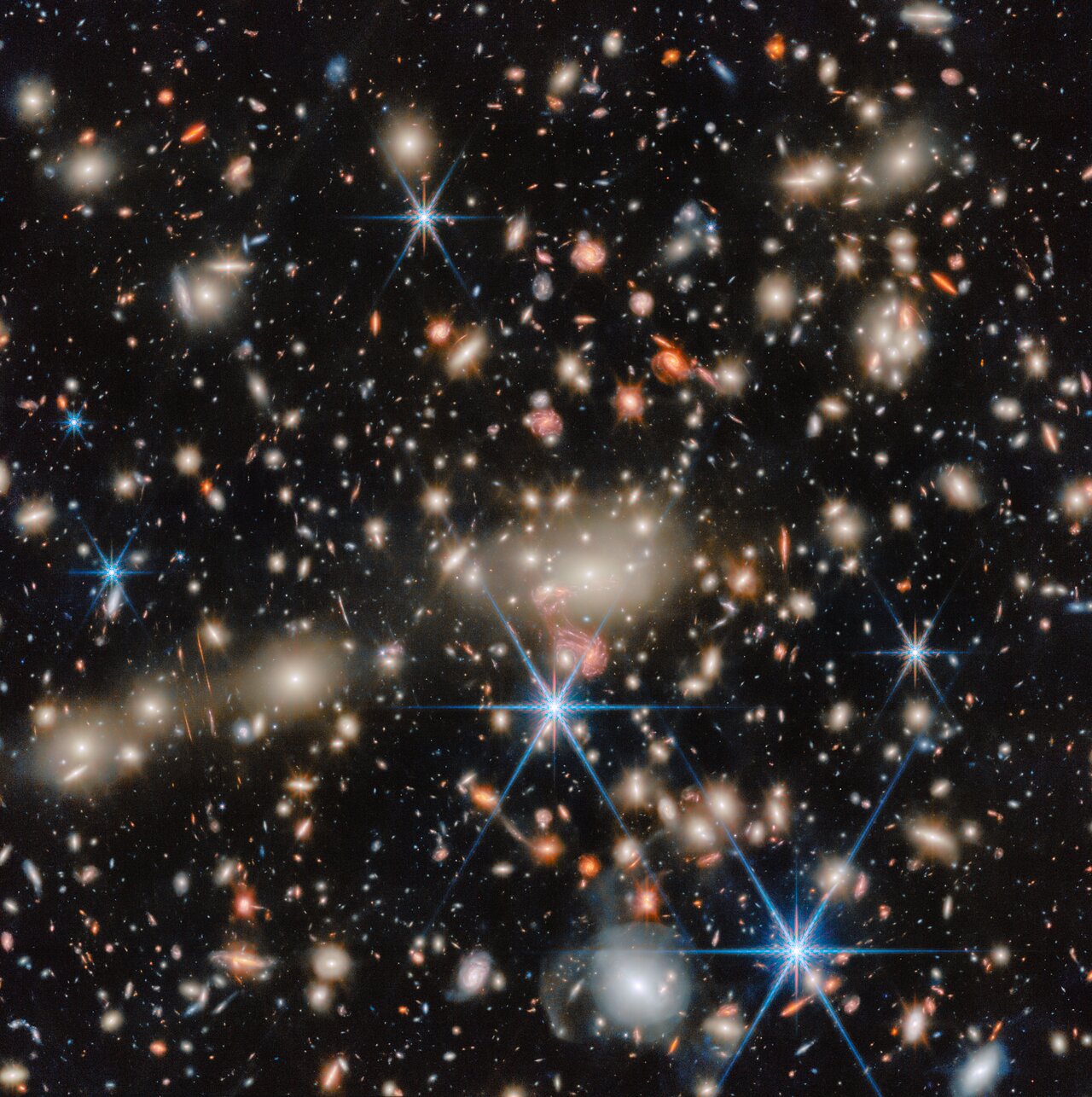
Galaxy clusters are the largest structures in the Universe, held together by gravity. This is precisely the type of object visible in the center of the JWST image. This is the MACS J1149.5+2223 galaxy cluster (MACS J1149 for short), located about 5 billion light-years from Earth in the direction of the constellation Leo. Astronomers have confirmed the presence of more than 300 galaxies within it and have identified several hundred more possible members.
The powerful gravity of MACS J1149 not only holds its galaxies together, preventing them from flying apart. It also bends the light from more distant background galaxies, leading to curious optical effects. This phenomenon is called gravitational lensing, and its result is clearly visible in the JWST image. Narrow strips of light and various strange objects are scattered throughout the image. In fact, there is nothing wrong with their shape. These are all more distant galaxies whose light has been bent by the cluster’s gravity. Their light has not only been distorted, but also amplified, allowing astronomers to see objects that even the JWST would not be able to see under normal circumstances.
A fantastic example of a gravitational lens can be seen in the center of the image, just below the bright elliptical galaxies. There, the image of a galaxy with distinct spiral arms has stretched into something resembling a pink jellyfish. This “deformed” galaxy is home to one of the most distant single stars ever discovered, as well as a supernova whose image has been “quadrupled.”
MACS J1149 has long been popular with astronomers. It is one of six galaxy clusters studied by the Hubble Telescope as part of the Frontier Fields program. They were chosen because of their gravitational lensing power and ability to warp space-time, which allows researchers to peer into the early Universe.
You can also read about how James Webb revealed the secrets of the Helix Nebula.
According to Esawebb

