

Scientists investigated the GW241011 event using gravitational wave detectors. As expected, its source was the merger of black holes. But this time, scientists noticed something interesting. Some of these objects may be second-generation black holes. That is, those that have already undergone one merger.
Physics of gravitational waves
In an article published in The Astrophysical Journal Letters, the international LIGO-Virgo-KAGRA collaboration reports the detection of two gravitational waves in October and November 2024 with unusual black hole spins. This observation adds important new information to our understanding of the most mysterious phenomena in the Universe.
Gravitational waves are “waves” in space-time that arise as a result of catastrophic events in deep space, with the strongest waves being formed by collisions between black holes.
Using complex algorithmic methods and mathematical models, researchers can reconstruct many physical characteristics of detected black holes based on the analysis of gravitational signals, such as their mass and distance from Earth, as well as their speed and direction of rotation around their axis, known as spin.
Merger of black holes
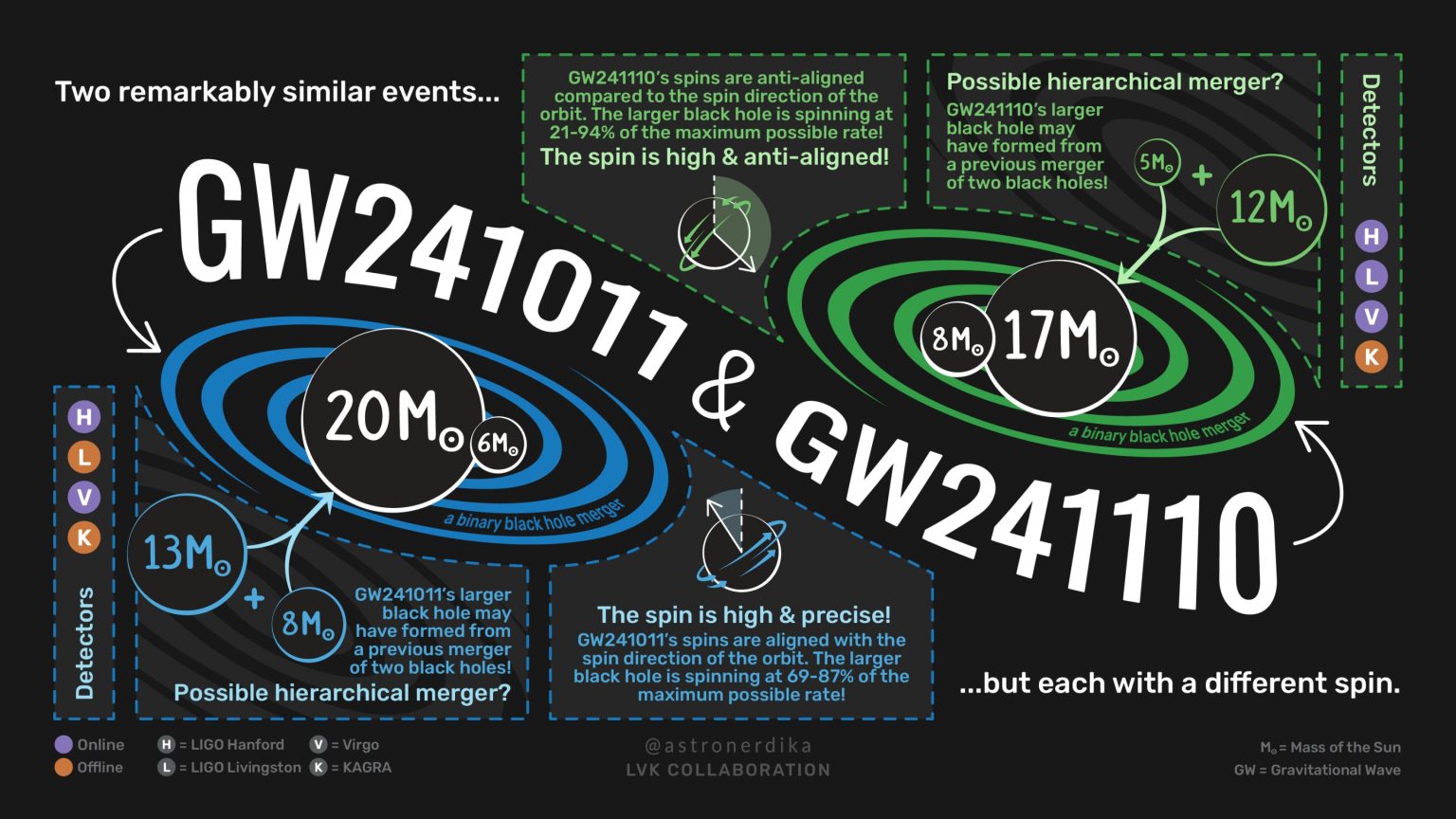
The first merger, discovered on October 11, 2024 (GW241011), occurred approximately 700 million light-years away and was the result of a collision between two black holes with masses of approximately 17 and 7 solar masses. The larger of the two black holes in GW241011 was recognized as one of the fastest-spinning black holes observed to date.
Almost a month later, on November 10, 2024, GW241110 was detected, coming from a distance of about 2.4 billion light-years and accompanied by the merger of black holes with masses approximately 16 and 8 times that of the Sun. Although most observed black holes rotate in the same direction as their orbit, it has been noted that the primary black hole GW241110 rotates in the opposite direction to its orbit, which is the first case of its kind.
“Each new discovery provides important information about the Universe, reminding us that every observed merger is not only an astrophysical discovery, but also an invaluable laboratory for studying the fundamental laws of physics,” says co-author Carl-Johan Haster, associate professor of astrophysics at the University of Nevada, Las Vegas (UNLV).
Such binary systems had been predicted based on previous observations, but this is the first direct evidence of their existence.
“Second generation” black holes
Interestingly, both discoveries point to the possibility of the existence of “second-generation black holes.”
Astronomers say that GW241011 and GW241110 are among the newest events among several hundred recorded by the LIGO-Virgo-KAGRA network. Since both events involve one black hole that is significantly more massive than the other and spins rapidly, they provide compelling evidence that these black holes were formed as a result of previous black hole mergers.
Scientists point to certain signs, like the difference in size between the black holes in each merger—the bigger one was almost twice as big as the smaller one—and the spin orientation of the bigger black hole in each event. The natural explanation for these features is that the black holes are the result of previous mergers.
This process, called hierarchical merging, suggests that these systems formed in dense environments, such as star clusters, where black holes are more likely to collide with each other and merge again and again.
These discoveries underscore the importance of international cooperation in uncovering the most unpredictable phenomena in the Universe.
Identifying hidden properties of black hole mergers
Gravitational waves were first predicted by Albert Einstein as part of his general theory of relativity in 1916. However, although their existence was proven in the 1970s, they were only directly observed by scientists 10 years ago, when the LIGO and Virgo scientific collaborations announced the detection of waves resulting from the merger of black holes.
Nowadays, LIGO-Virgo-KAGRA is a global network of modern gravitational wave detectors and is nearing the end of its fourth observation period, O4. The current observation period started at the end of May 2023 and is expected to last until mid-November this year. About 300 black hole mergers have been observed to date using gravitational waves, including candidates detected during the current O4 period that are awaiting final confirmation.
Moreover, in the case of the observation announced today, the accuracy of the GW241011 measurement also made it possible to test key predictions of Einstein’s general relativity theory under extreme conditions.
In fact, this phenomenon can be compared to Einstein’s predictions and mathematician Roy Kerr’s solution for rotating black holes. The rapid rotation of a black hole slightly deforms it, leaving a characteristic imprint in the gravitational waves it emits.
Analyzing GW241011, the research team found excellent agreement with Kerr’s solution and once again confirmed Einstein’s prediction, but with unprecedented accuracy.
Search for new elementary particles
Fast-spinning black holes, such as those observed in this study, have another application in particle physics. Scientists can use them to test whether certain hypothetical light elementary particles exist and what their mass is.
These particles, called ultralight bosons, are predicted by some theories that go beyond the Standard Model of particle physics, which describes and classifies all known elementary particles. If ultralight bosons exist, they can extract rotational energy from black holes. How much energy will be extracted and how much the rotation of black holes will slow down over time depends on the mass of these particles, which is still unknown.
The observation that the massive black hole in the binary system that emitted GW241011 continues to rotate rapidly even millions or billions of years after its formation rules out a wide range of masses for ultra-light bosons.
According to phys.org

