

The Local Group of galaxies comprises a few dozen star systems that are more or less gravitationally connected and are within a few million light-years of us. They can rightly be called “the guys from our neighborhood”.
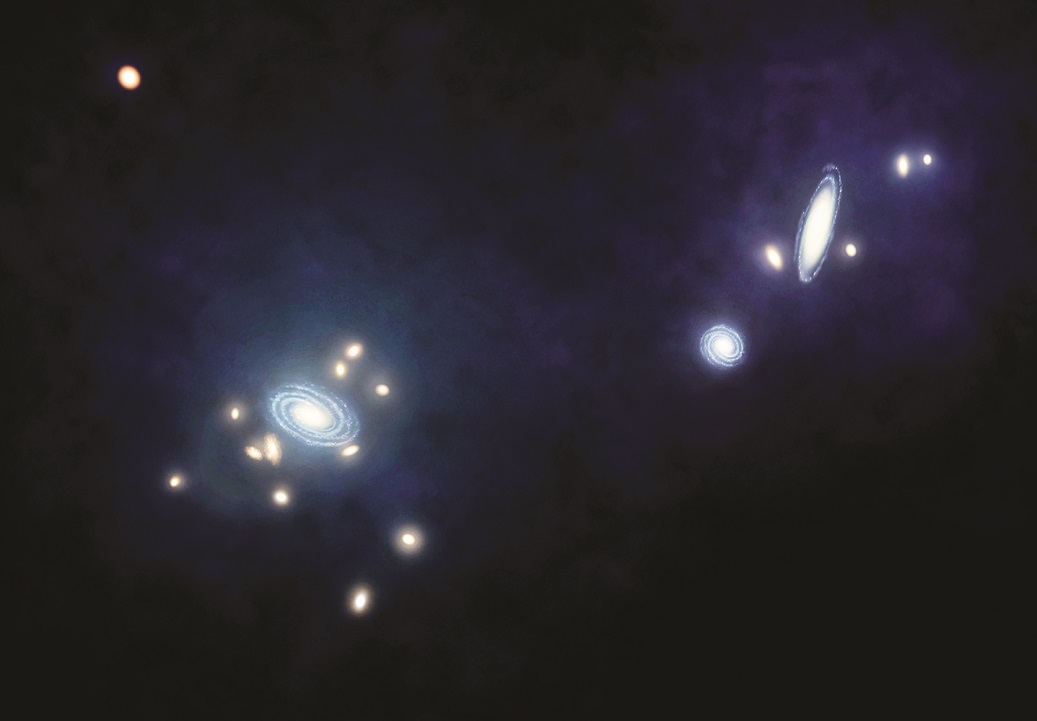
Galaxies around us
Who can we call “ours”, “our own”? It depends on the context. If we are talking about an apartment building, then we can use this word to describe the people who live in the same building. If we are talking about a city, then “ours” means not only the people from our neighborhood, but also “our” houses and trees.
If we turn to astronomy, then on the scale of the Solar System, we can call what is on Earth “ours”. If we go beyond its boundaries, then Uranus and Jupiter become “our guys”. Our psyche is such that when we increase the scale of the world, we unconsciously begin to divide it into what is more familiar and habitual to us and what is more distant and alien.
However, if we go beyond the Milky Way, we will see a world of hundreds of billions of galaxies, each of which seems so distant from us that there cannot be any “our own” among them.
However, this is not the case. Some galaxies can be seen with the naked eye in the Earth’s sky: the Large and Small Magellanic Clouds, M31 in Andromeda, and M33 in the constellation Triangulum. And let’s not forget about the Milky Way itself. We can rightly call them “ours” too.
They are part of what is called the Local Group. This is several dozen star systems located within a sphere with a diameter of about 10 million light-years and experiencing mutual gravitational influence.
The Milky Way and Andromeda
To be precise, two large spiral galaxies dominate the Local Group: the Milky Way and M31, also known as the Andromeda Galaxy. We still do not know the former as well as we would like, despite living inside it. This explains why we cannot see a certain part of it. It is hidden from us by a massive core surrounded by a spherical bulge consisting of millions of stars and large amounts of gas and dust.
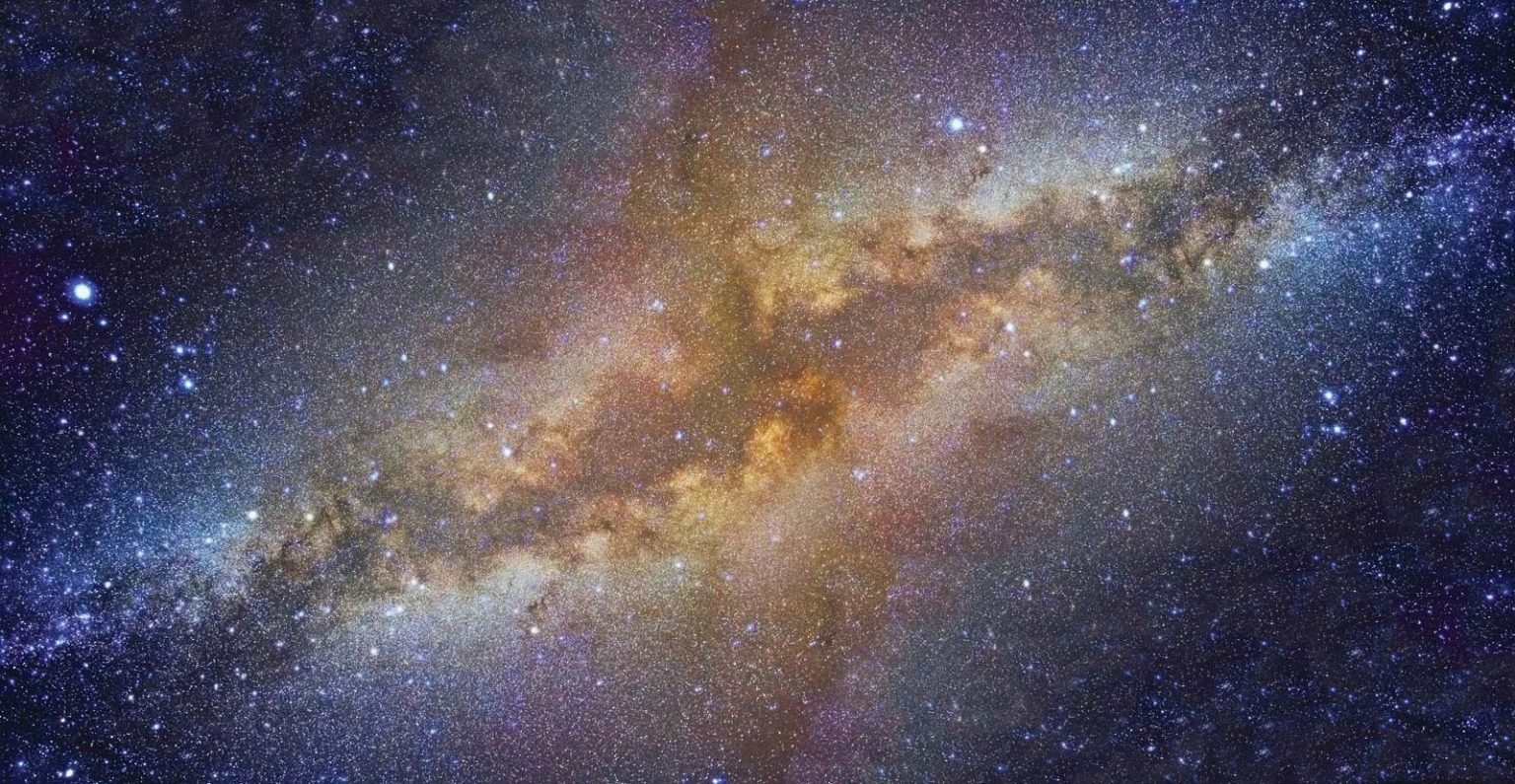
The diameter of the Milky Way is about 100,000 light-years, and the number of stars in it is estimated at 400 billion. It should be noted that the disk itself is located inside the halo – a much more diffuse spherical structure containing several globular clusters, each of which can essentially be considered a microgalaxy. The Solar System is located about 27,000 light-years from the center of the Milky Way in the Orion Arm.
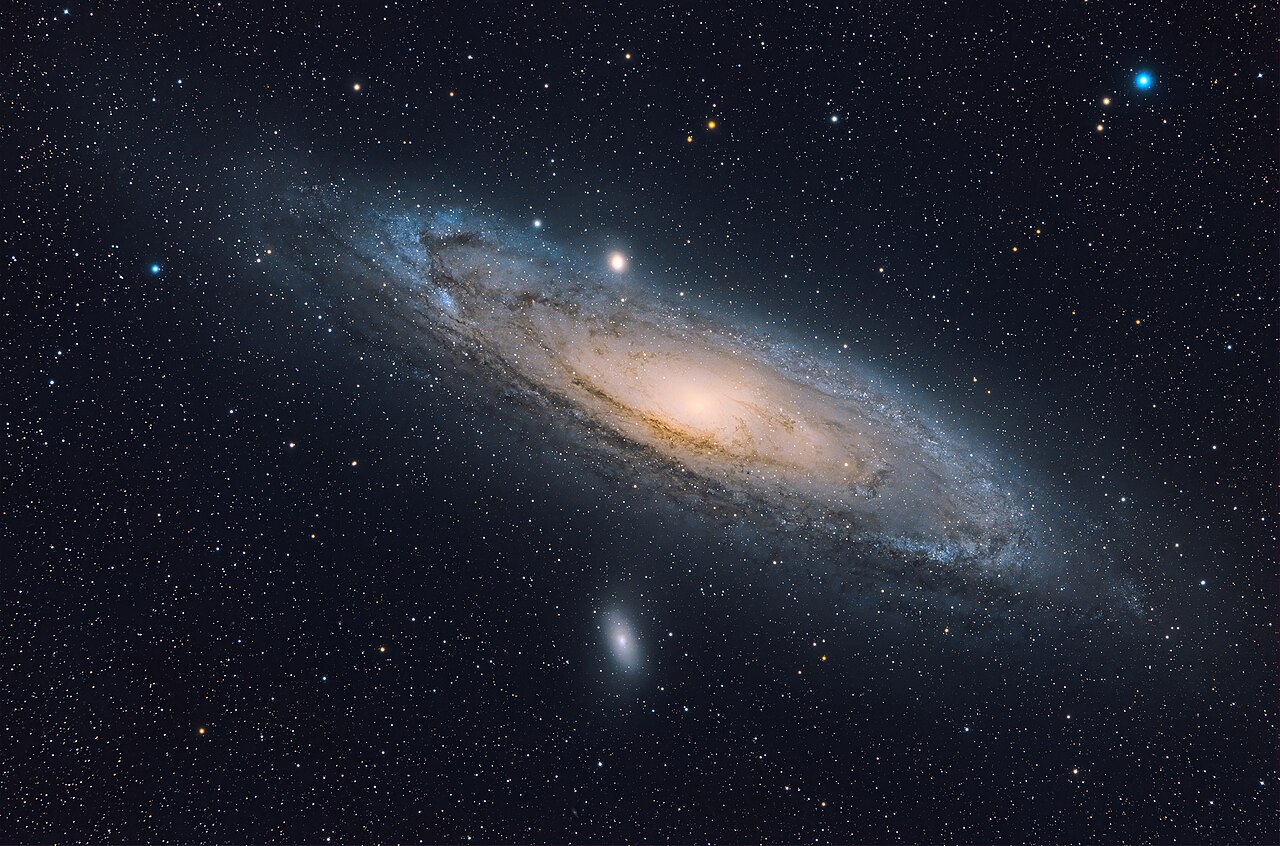
The Andromeda Galaxy is located 2.6 million light-years away from us. Its disk diameter is 153,000 light-years, which means it is significantly larger than ours, if we count only the stars, of which there are up to 1 trillion.
But in reality, each of these systems is surrounded by a halo of dark matter, and in the Milky Way, it is much larger, so in terms of mass, the Andromeda Galaxy is about the same as the Milky Way or even smaller than it.
Natural satellites of the Milky Way
At the same time, each of the two large galaxies is surrounded by many smaller natural satellites. The Milky Way, for example, has 61 of them, although recent simulations indicate that there should be significantly more, possibly up to a hundred. All of them fit within a sphere with a radius of up to 1.4 million light-years from the center of the Galaxy.
The largest of these is the Large Magellanic Cloud. It is visible in the southern hemisphere between the constellations Dorado and Mensa. Its actual diameter is about 13,000 light-years. It is a spiral galaxy with one arm of rather irregular shape. Its mass is estimated at 630,000 solar masses. The distance to it is 163,000 light-years, making it one of the closest galaxies.
The second-largest natural satellite galaxy of the Milky Way is called Antlia II. It has a diameter of about 9,500 light-years and a mass of about 880,000 solar masses. Despite this, it was only discovered in 2018. There are two reasons for this. The first is that it is 470,000 light-years away.
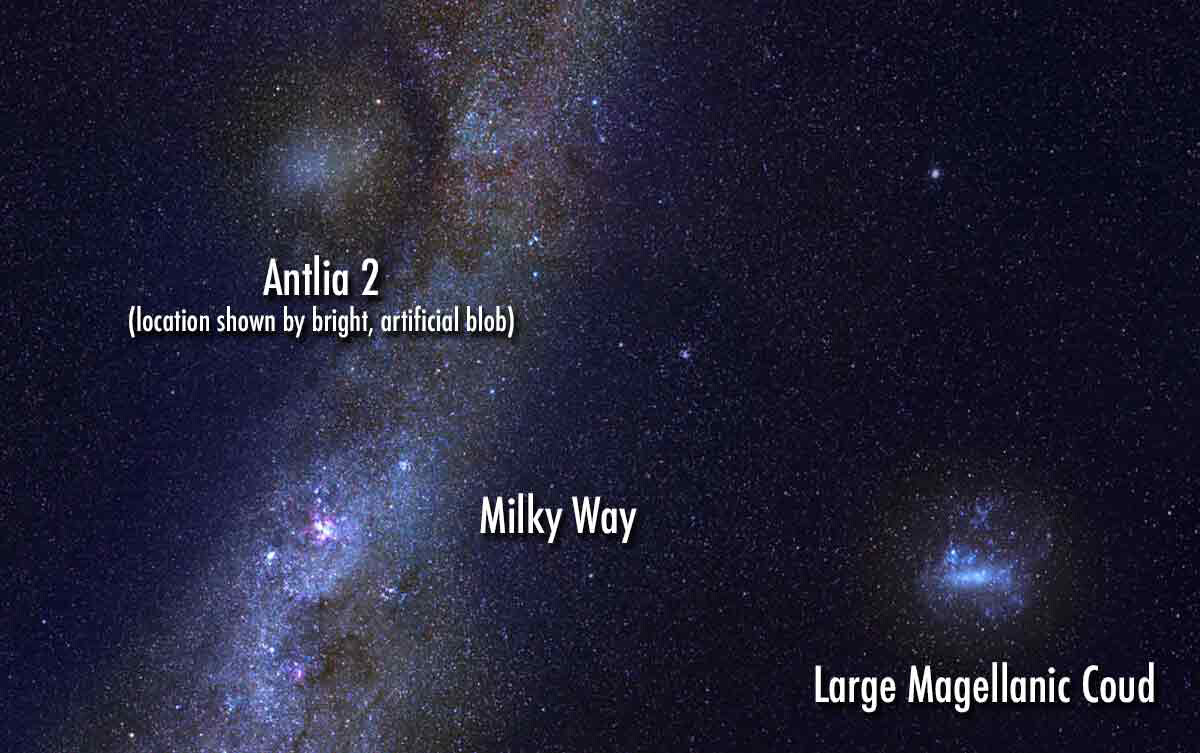
The second reason is that Antlia II is 10,000 times dimmer than the Large Magellanic Cloud. This is because, of all known galaxies, it has the lowest density. It consists mainly of very old stars.
The third largest companion to the Milky Way is a dwarf elliptical galaxy in Sagittarius. Its diameter is 8,500 light-years. At the same time, the distance to it is only 65,000 light-years.
However, this dwarf galaxy was only discovered in 1994. The main reason for this was that it is located above the center of the Milky Way and slightly behind it, when viewed from Earth. This star system is currently falling toward the center of our galaxy.
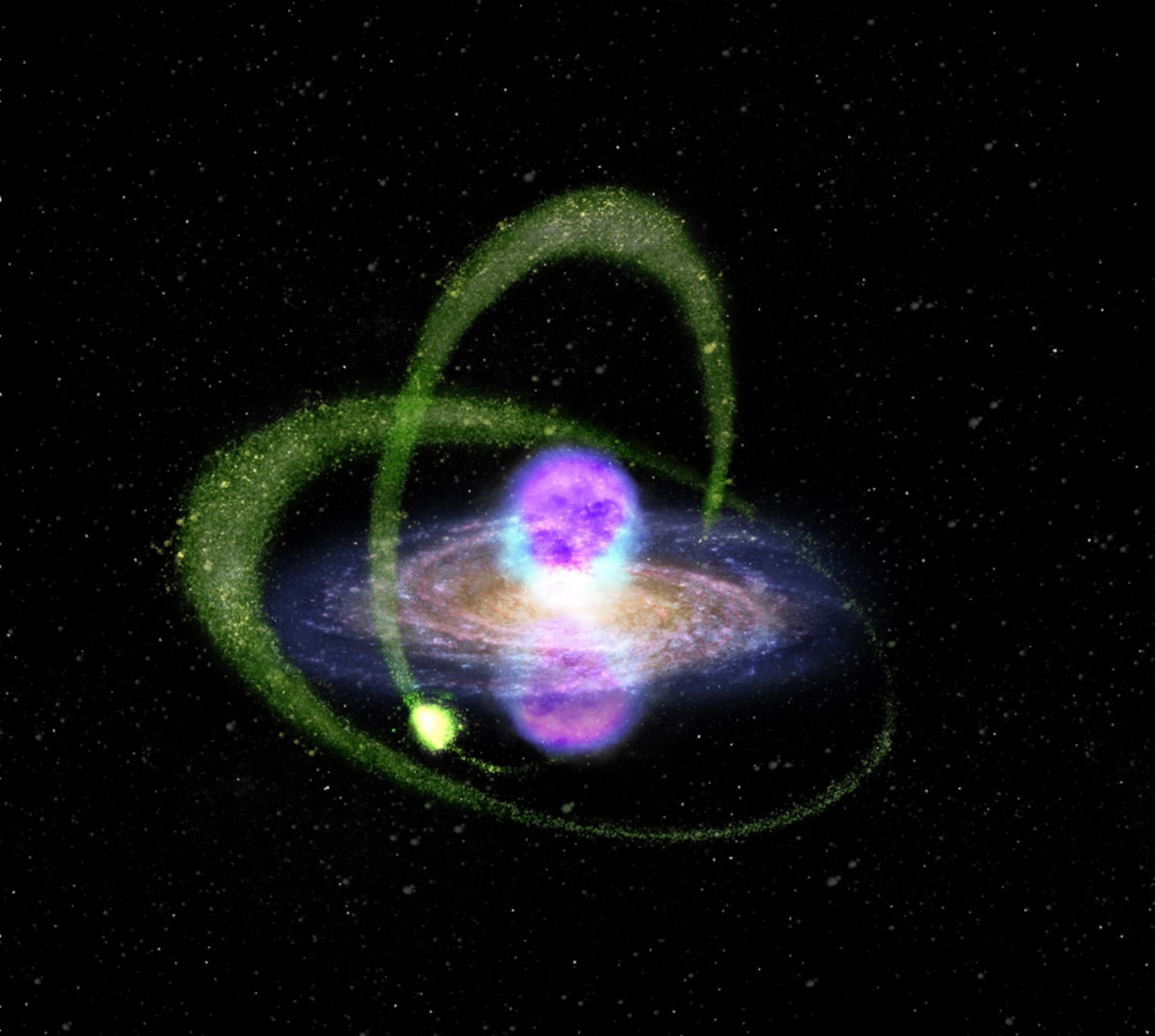
It is often believed that the spherical galaxy in Sagittarius is the closest companion to the Milky Way, but this claim is currently under debate. In 2003, scientists reported that they had discovered an excess of red giants in the constellation Canis Major, 25,000 light-years away from us. Since then, there has been debate as to whether this is another dwarf system or simply an observation artifact.
If the former is true, then the dwarf galaxy Canis Major is the closest to us, with its distance from Earth even less than that to the center of the Milky Way. Its diameter is about 4,000 light-years, and the number of stars can reach a billion.
However, it is quite possible that the dwarf galaxy in Sagittarius is not even the second, but the third, in terms of distance from us. In 2023, scientists discovered an extremely dim group of stars, which was named Ursa Major III. It is believed that this is also a companion to the Milky Way, but it has lost most of its stars, and those that remain are extremely dim.
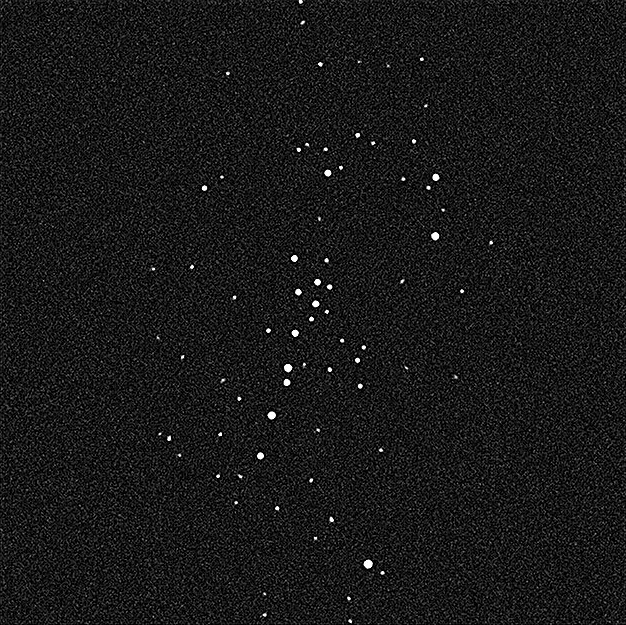
The diameter of Ursa Major III is only 19.6 light-years, and it contains only 60 star systems. Nevertheless, at a distance of about 32,600 light-years, it is one of the closest natural satellites of the Milky Way to us.
Natural satellites of the Andromeda Galaxy
Currently, 35 natural satellites are known to exist in the Andromeda Galaxy. This does not mean that there are fewer than in the Milky Way, as it is quite possible that we simply cannot see most of them. The two largest ones, M32 and M110, are located very close to it in the sky and are therefore fairly well studied.
M32 is an irregular dwarf galaxy with a diameter of about 8,000 light-years and a mass of about 30,000 solar masses. It is believed that about 800 million years ago, it passed through the Andromeda disk, and we can still see the curvature of our neighbor’s structures caused by this event.
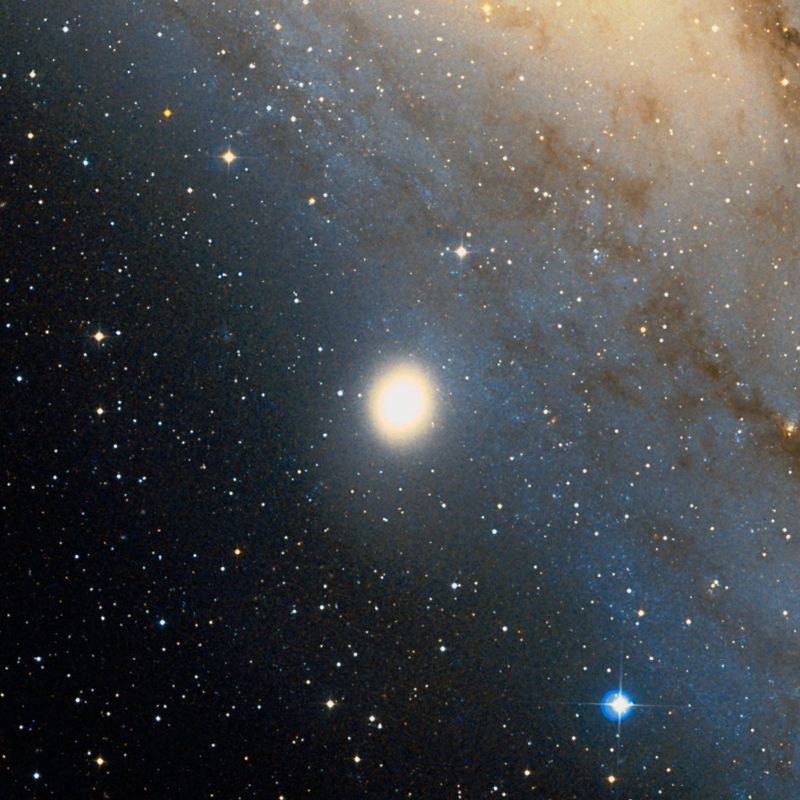
There is an interesting story associated with M110. Charles Messier observed this galaxy in 1773, but for some reason did not include it in his famous catalog. It was only added in 1967, as a result of which it occupies the last place in the catalog.
Other well-known natural satellites of the Andromeda Galaxy are NGC 185 and NGC 147. They form a pair located quite far from M31. These are small star systems with a diameter of only a few thousand light-years.
Other members of the Local Group
Among the rest of “our guys”, the galaxy M33, located in the constellation Triangulum, stands out. It is also a spiral system, but it is much smaller than the Milky Way or Andromeda. Its diameter is only 60,000 light-years, and it contains 40 billion stars.
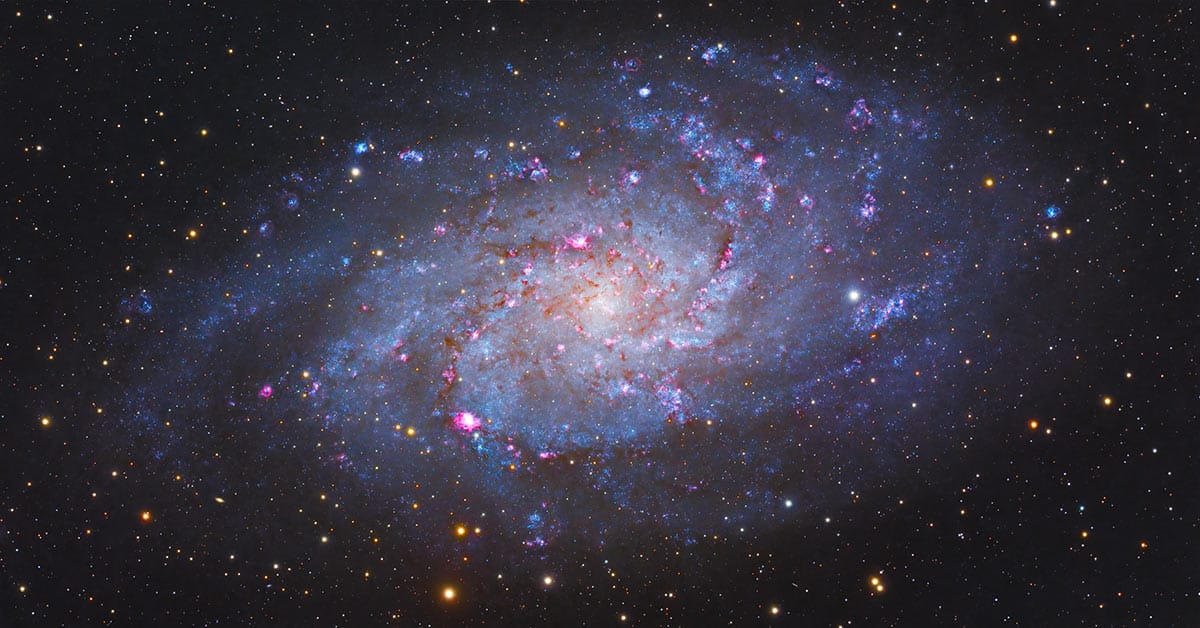
The distance from the Milky Way to the Triangulum Galaxy is 3.2 million light-years. Only people with sharp eyesight can see it with the naked eye, and only in the absence of light pollution.
The Triangulum Galaxy is interesting in that it lacks a bar – a structure that appears to pass through its core. Its spiral arms extend directly from the center. Also, unlike most large galaxies, no supermassive black hole has been detected at its center.
Another interesting member of the Local Group that is not a companion to the two largest galaxies is IC 10. This object was discovered in 1887, but it was not until the 20th century that it became clear that it is not located within the Milky Way and is a separate galaxy.
IC 10 is located in the constellation Cassiopeia. It is 2.2 million light-years away. It is an irregular galaxy with a diameter of about 5,000 light-years. Despite this, it is the fifth brightest galaxy in the Local Group, surpassed only by three large spiral systems and the Large Magellanic Cloud.
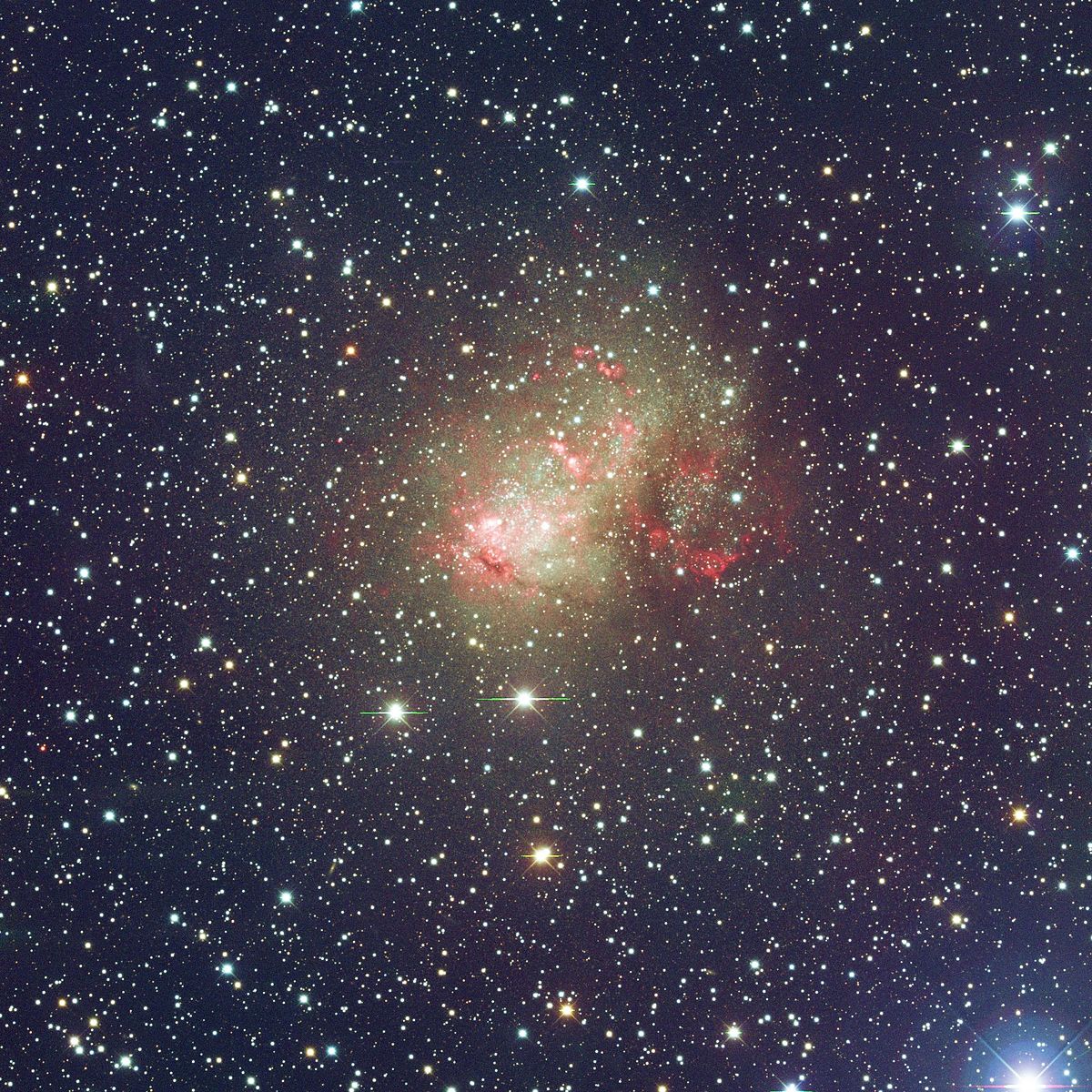
The reason for this situation is that among all members of the Local Group, IC 10 has the highest star formation rate. Therefore, it contains many bright and hot young stars.
Another notable object in the Local Group is NGC 6822, also known as Barnard’s Galaxy. It is located 1.3 million light-years away from us and has a diameter of about 9,200 light-years. It was formally the third object in the sky that was proven to be outside the Milky Way.
The Local Group also includes galaxies such as IC 1613, Wolf-Lundmark-Melotte, NGC 6822, and dwarf galaxies in Fornax and Pegasus. All of these are relatively small systems with a mass estimated at several million solar masses.
Controversial members of the group
Astronomers still have not figured out where the Local Group ends. Because of this, there are a bunch of galaxies that might be part of it, or maybe not. This is especially true for the Antlia-Sextants group. It is about 4.3 million light-years away from us. Currently, it includes six star systems: NGC 3109, Sextans A, Sextans B, Antlia, Leo P, and Antlia B. The membership of the Leo A galaxy remains controversial.
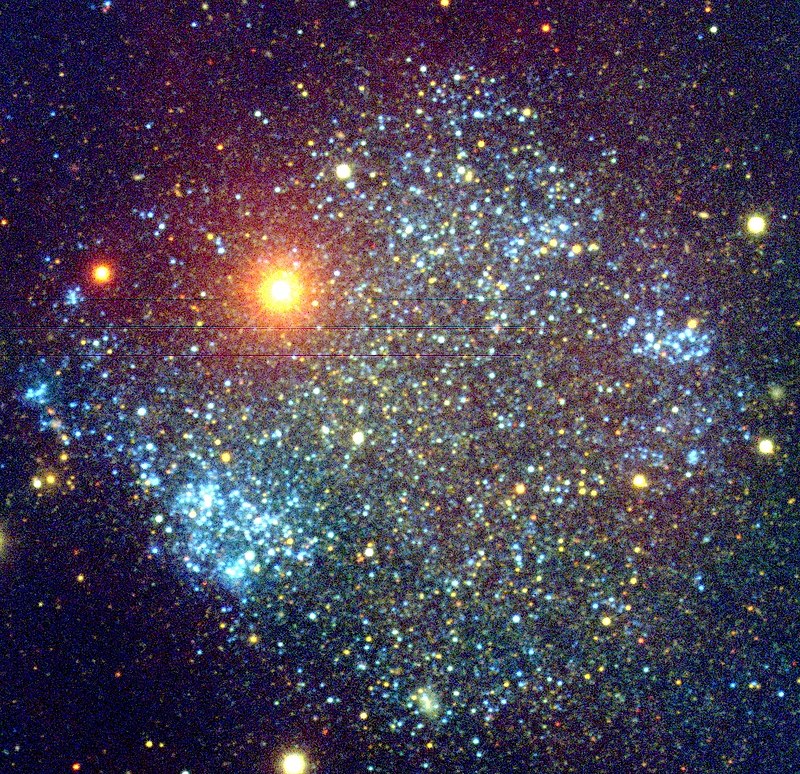
Perhaps all these galaxies are the closest group to us, or perhaps they are from our neighborhood. The nature of their movement has not yet been sufficiently studied to draw such conclusions.
The status of galaxies NGC 300 and NGC 55 also remains controversial. Both are located somewhere between the Local Group and the neighboring Sculptor Group.
In general, it is quite difficult to count the number of objects that belong to the Local Group. Not all objects that belong to it can be classified as galaxies. Some of the objects that were previously considered as such are isolated globular clusters.
There are also streams – ribbons stretched by gravity from stars that were once dwarf systems, but how to classify them now is a matter of debate. In any case, the Local Group is a region of the Universe rich in various curiosities.

