

Salar de Pajonales in the South American Andes is a huge gypsum plateau that is virtually devoid of water. It preserves the oldest traces of life on our planet. Since this place most closely resembles Mars, it is of great interest to those searching for signs of life on the Red Planet.
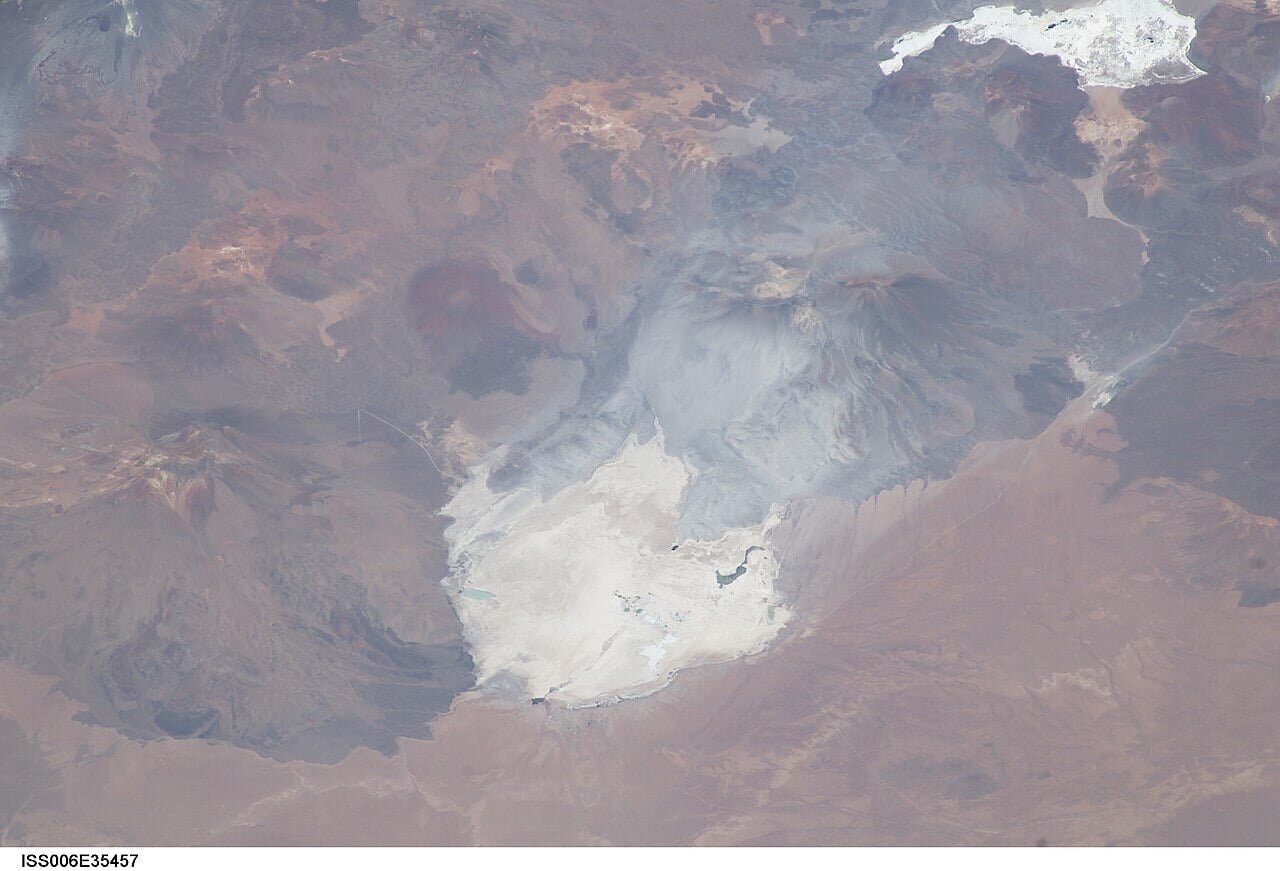
Salt flat in the Andes
The highlands of the South American Andes hold a special place in astronomy. Right here, in one of the clearest and most space-friendly places on Earth, stand the largest optical and radio telescopes on our planet. But, as it turns out, there is another site nearby that is of great interest to scientists.
We are talking about the Salar de Pajonales, located at an altitude of 3,500 meters above sea level. Generally speaking, salt flats are areas of land that are the remains of bodies of water; the water there gradually became saltier and saltier, and then the sun evaporated it all. And all that remained was a flat, very salty surface with nothing growing on it.
However, even among salt flats, Salar de Pajonales is unique—and not because of the winds that blow over it at speeds of 100 m/s, nor because of the temperature fluctuations ranging from −23 °C to +26 °C. The main thing is that it consists of gypsum and is extremely ancient. Microscopic algae and stromatolites have been preserved in it for several thousand years.
A salt flat on Mars
The traces of life preserved in the gypsum at the Salar de Pajonales are of interest to scientists in their own right. But what’s even more interesting is that, overall, this entire area is one of the few places that closely resembles Mars in terms of its conditions. It also has plenty of sulfate-bearing rocks.
For example, the Perseverance rover is actively studying them in Jezero Crater. And once upon a time, it was the bottom of a lake, back when Mars was much warmer than today and liquid water existed on its surface. However, that was several billion years ago.
But stromatolites—tiny bacterial mats—already existed on Earth at that time. The very same ones found in the samples from the Salar de Pajonales. Therefore, scientists are hopeful that the same thing can be found in Martian sulfates. And then it will be possible to prove the existence of life on the Red Planet, at least in the past.
According to phys.org

