

At the 57th Lunar and Planetary Science Conference in Texas, an international team of researchers presented groundbreaking findings. While exploring an ancient impact crater dating back 4 billion years, the Perseverance rover stumbled upon an unusual cluster of pale rocks. These rock fragments do not match the surrounding landscape, which means they were deposited there as a result of powerful geological shifts, meteorite impacts, or ancient water currents.

To determine the composition of the find, the scientists used the rover’s main instrument—SuperCam. A green laser mounted on the spacecraft’s mast “fired” at the samples, causing the minerals to emit light at specific wavelengths. Spectral analysis revealed that the three rocks contain corundum with chromium impurities. Chemically, this is the perfect description of rubies.
However, scientists remain cautious. The crystals are so small (less than 0.2 mm) that they cannot be seen even through the rover’s high-resolution cameras. Since the exact composition of the minerals has to be checked, the researchers suggest that these may include not only rubies but also other types of corundum, such as sapphires.
Ruby or sapphire
Corundum is one of the hardest natural substances, second only to diamond in hardness. Purified corundum is colorless, but the “magic” begins with impurities:
- Chromium transforms corundum into a brilliant red ruby.
- Iron and titanium create the deep blue hues characteristic of sapphires.
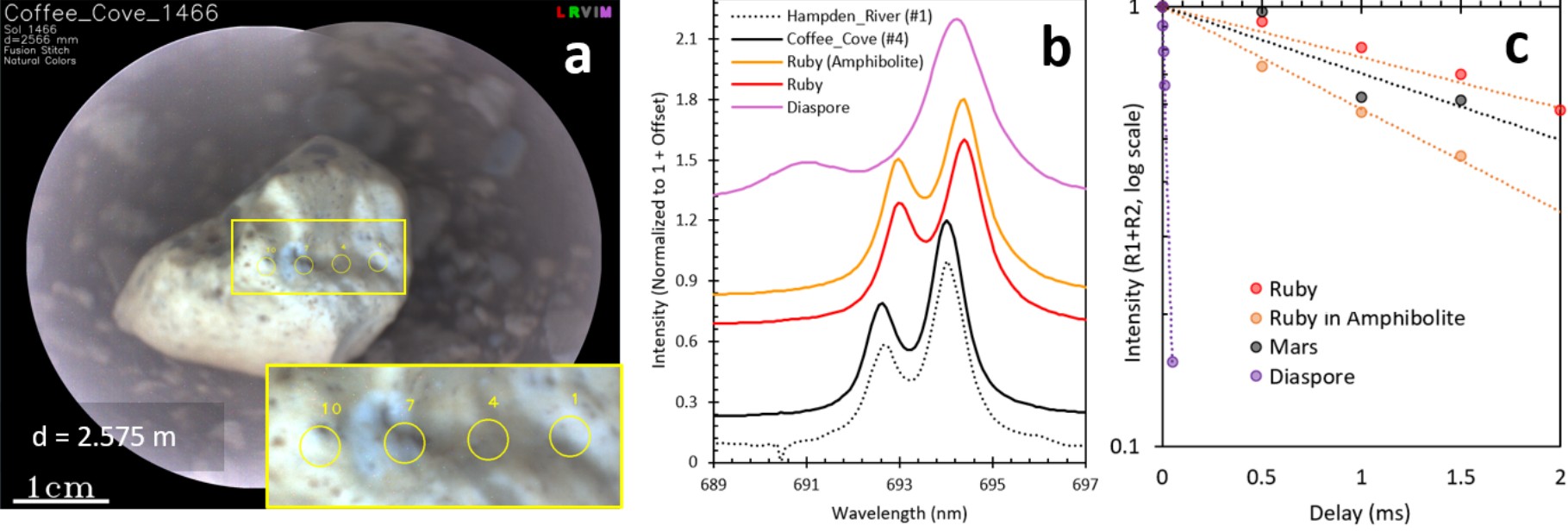
At this point, geologists have classified the find as “corundum,” pending the results of more detailed chemical tests that will allow them to accurately determine the name of the precious mineral.
Where do the gemstones on Mars come from?
The origin of these crystals on Mars is a real mystery. On Earth, gemstones are usually formed as a result of plate tectonics: the immense pressure and temperature deep within the planet transform ordinary rocks into gemstones. But there is no plate tectonics on Mars.
Scientists have proposed a hypothesis: Martian “rubies” may have been formed as a result of cosmic impacts. The energy released by falling meteorites generates instantaneous heat and pressure sufficient to form corundum crystals. In addition, the hot hydrothermal fluids produced by the collisions may have helped these minerals to form within the rock fractures.
Planet of treasure
Although the “jewelry fragment” found is too small even for a ring, it is an invaluable source of information about the planet’s past.
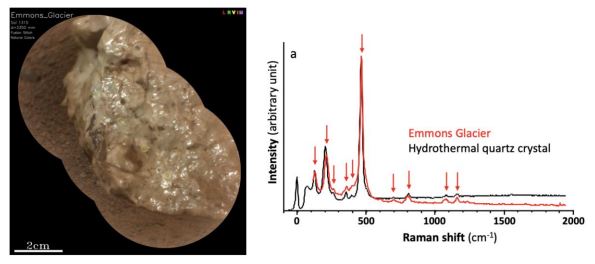
This isn’t the first discovery of its kind: traces of quartz, opal, and agate have been found on Mars before. Each such discovery confirms that the Red Planet was far more complex and active than we had previously thought.
Mars is a veritable natural laboratory for gemstones, where the cosmos has taken on the role of “jeweler” in place of tectonics.
Earlier, we shared 12 interesting facts about Mars.
According to livescience.com

