

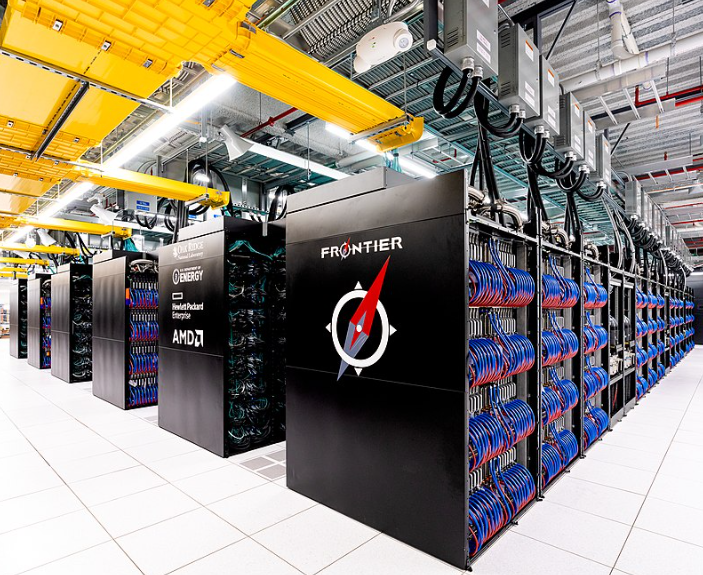
One of the world’s most powerful computers—the exaflop Frontier at Oak Ridge National Laboratory (ORNL)—has helped astronomers model how supermassive black holes control energy in the centers of galaxies and entire clusters. The xMAGNET team recreated the evolution of a cluster with a mass of ~10¹⁵ (quadrillion) suns and a black hole of ~10⁹ M☉ (billion solar masses) over billions of years, tracing the cycles of jets that heat and excite intergalactic plasma.
For the first time, simulations have recreated the formation of cold gas filaments similar to structures in Perseus and demonstrated the key role of magnetic fields in the long-term stability of these systems. The calculations used the open source AthenaPK code based on the Parthenon framework; the run lasted ~700,000 node-hours and involved 17,088 GPUs, and the jet speed had to be artificially limited to ~5% even on Frontier with a peak performance of almost 2 exaflops.
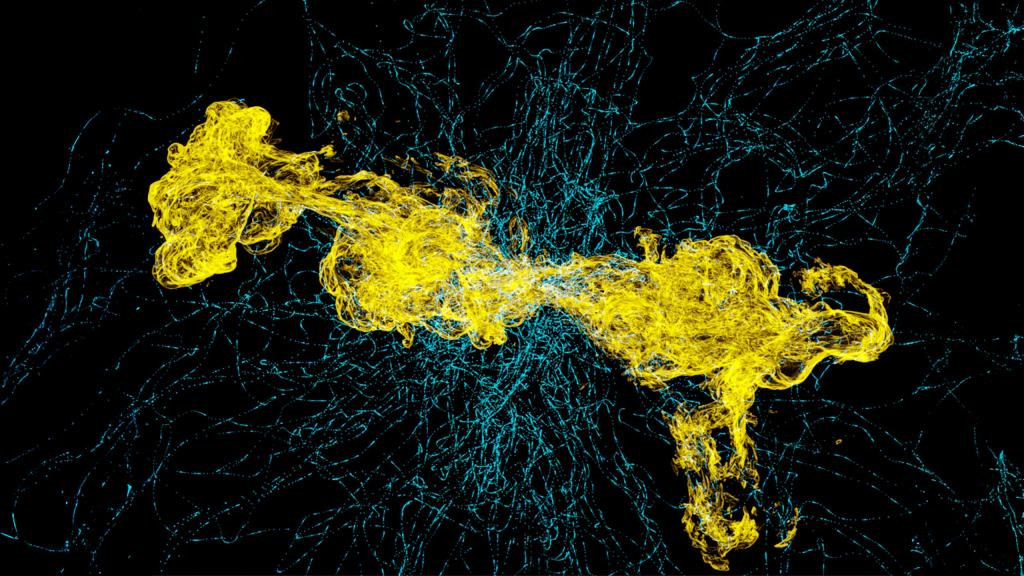
These models help explain how active galactic nuclei stabilize the largest structures in the universe, preventing gas from collapsing into uncontrolled cooling. This work sets a new standard for computational astrophysics at the exaflop level.
xMAGNET published a review with preliminary results in peer-reviewed journals (The Astrophysical Journal; Astronomy & Astrophysics) and made visualizations and descriptions of the methodology open-access. This facilitates the verification and further development of models that take into account cosmic rays and additional plasma physics.
How does it work? The simulation works as follows: researchers build a digital copy of a piece of the universe—a cluster of galaxies—and divide it into billions of microcells. For each cell, the supercomputer calculates how the rarefied gas moves, how it is attracted by gravity, how it is enveloped by magnetic fields, and how jets from the edges of the black hole heat and excite the medium.
The secret lies in two things: the enormous parallel power of the exascale Frontier (thousands of GPUs computing simultaneously) and smart numerical algorithms that divide the work and take very short steps without failures. Together, this allows us to see both small details and slow evolution over billions of years.
Why is this important? Accurate GR(M)HD simulations of galactic nuclei are a bridge between observations (radio, optical, X-ray) and theory. They provide predictable signatures of turbulence, temperatures, and magnetic fields, helping to interpret telescope data and calibrate galaxy formation models. Understanding the balance between heating and cooling in clusters directly affects estimates of star formation rates, galaxy evolution, and planning for future sky surveys. For engineering applications in space physics, these results are also important as validation of computational approaches to turbulence and magnetic dynamics in rarefied plasmas.
Want to quickly boost your space knowledge not only about black holes, but also about the most amazing celestial bodies near us? Take a look at the selection “5 Amazing Stars of the Milky Way: Fascinating Facts”: there you will find magnetars with insane fields, supergiants shedding their shells, and other record-breakers of the Galaxy, presented briefly, with figures and vivid facts!
According to ornl, interestingengineering


#/media/File:Frontier_Supercomputer_(2).jpg)