

A satellite has detected a large heat wave in the Pacific Ocean moving toward the coast of South America. NASA considers this an early sign of El Niño, a climate phenomenon capable of altering weather patterns across much of the planet.
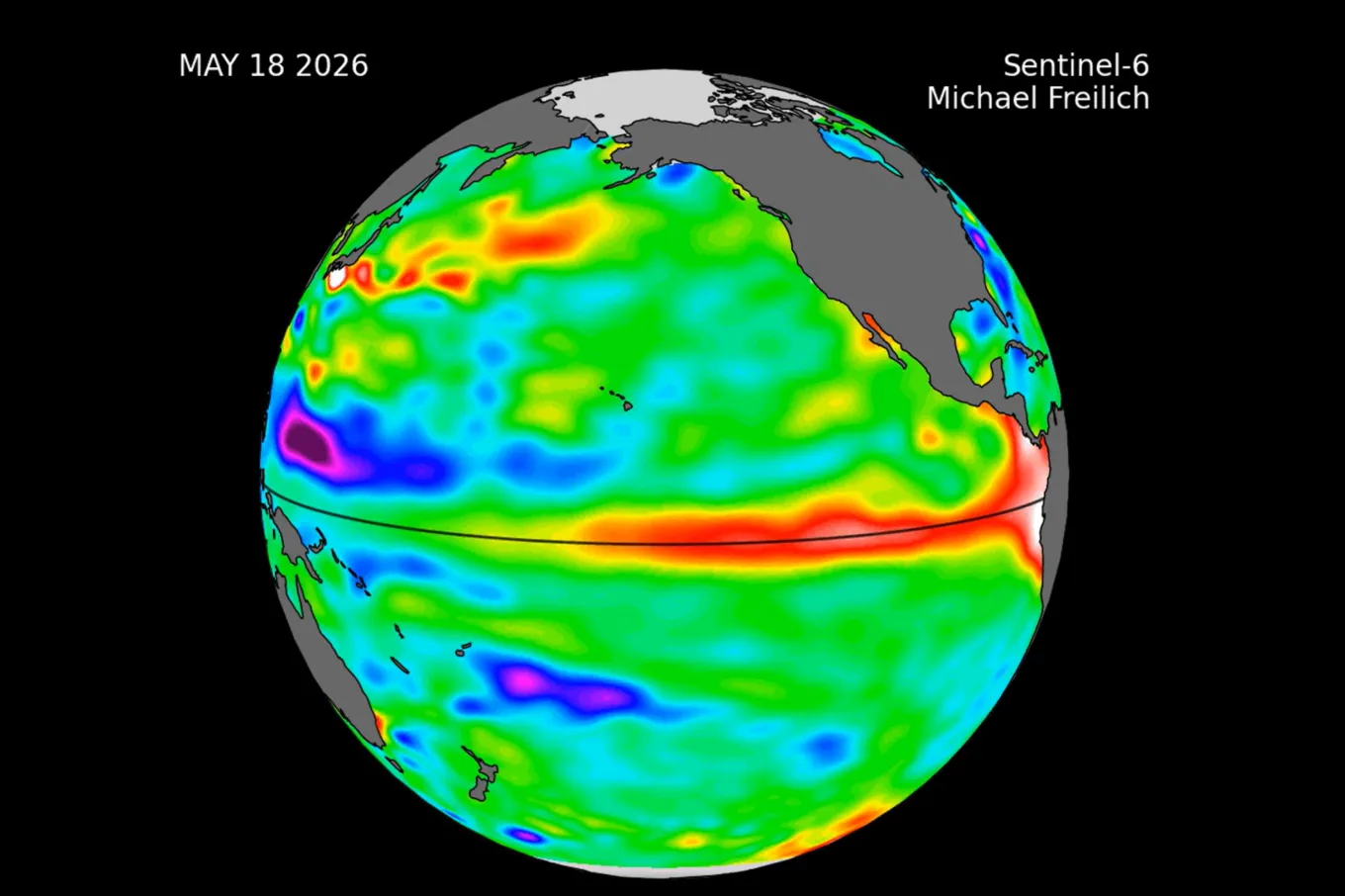
A wave traveling across the ocean
Scientists are tracking so-called Kelvin waves—large pulses of warm water that move along the equator from west to east. These waves form when the trade winds over the western Pacific Ocean weaken or change direction. Warm water then accumulates and forms a wave that travels toward South America for several weeks.
This is precisely the process that Michael Freilich observed using the Sentinel-6 satellite in 2026. Initially, a small wave formed near Micronesia in late January and dissipated in mid-February. A new one appeared in March, and by May, sea levels off the coast of Peru were 15 centimeters above the long-term average.
Why is sea level rising?
Measuring sea level is more than just observing the water. When water heats up, it expands and takes up more space, so a rise in sea level directly indicates a rise in temperature. This principle makes it possible to detect thermal anomalies even before their effects become noticeable in the atmosphere.
The Sentinel-6 Michael Freilich satellite maps the surface elevation of the entire world’s oceans every 10 days with centimeter-level accuracy. Launched in 2020 by NASA and ESA as part of the European Copernicus program, it continues to maintain a continuous global record of sea-level changes.
What does this mean for the weather?
El Niño develops when several Kelvin waves occur over the course of several consecutive months, causing warm water to accumulate off the coasts of Colombia, Ecuador, and Peru. “This year’s event started a little later than the major El Niños of 2015 and 1997, but it’s starting to catch up,” said researcher Josh Willis of NASA’s Jet Propulsion Laboratory.
Strong El Niño events can lead to droughts and floods in various regions, as well as influence the number of tropical storms in the Atlantic and Pacific Oceans. According to researcher Severine Fournier, such events “almost always make the year hotter and cause significant changes in precipitation in different parts of the world.” The phenomenon usually peaks in November and January, so the most noticeable effects will become apparent later.
According to jpl.nasa.gov

