

Scientists from the University of Liverpool have reported finding evidence of two giant super-hot mountain structures located at the base of the mantle. These structures influence the Earth’s magnetic field.
A sensational discovery
Exploring the Earth’s interior is a much more difficult task than exploring the Solar System. While the Voyager 1 probe has already traveled 25 billion kilometers away from our planet, the deepest borehole has only reached a depth of 12 kilometers. As a result, very little is known about the conditions existing at the boundary between the mantle and the core. But this is a very important place of interaction in the Earth’s interior, where recent studies have revealed interesting magnetic activity.
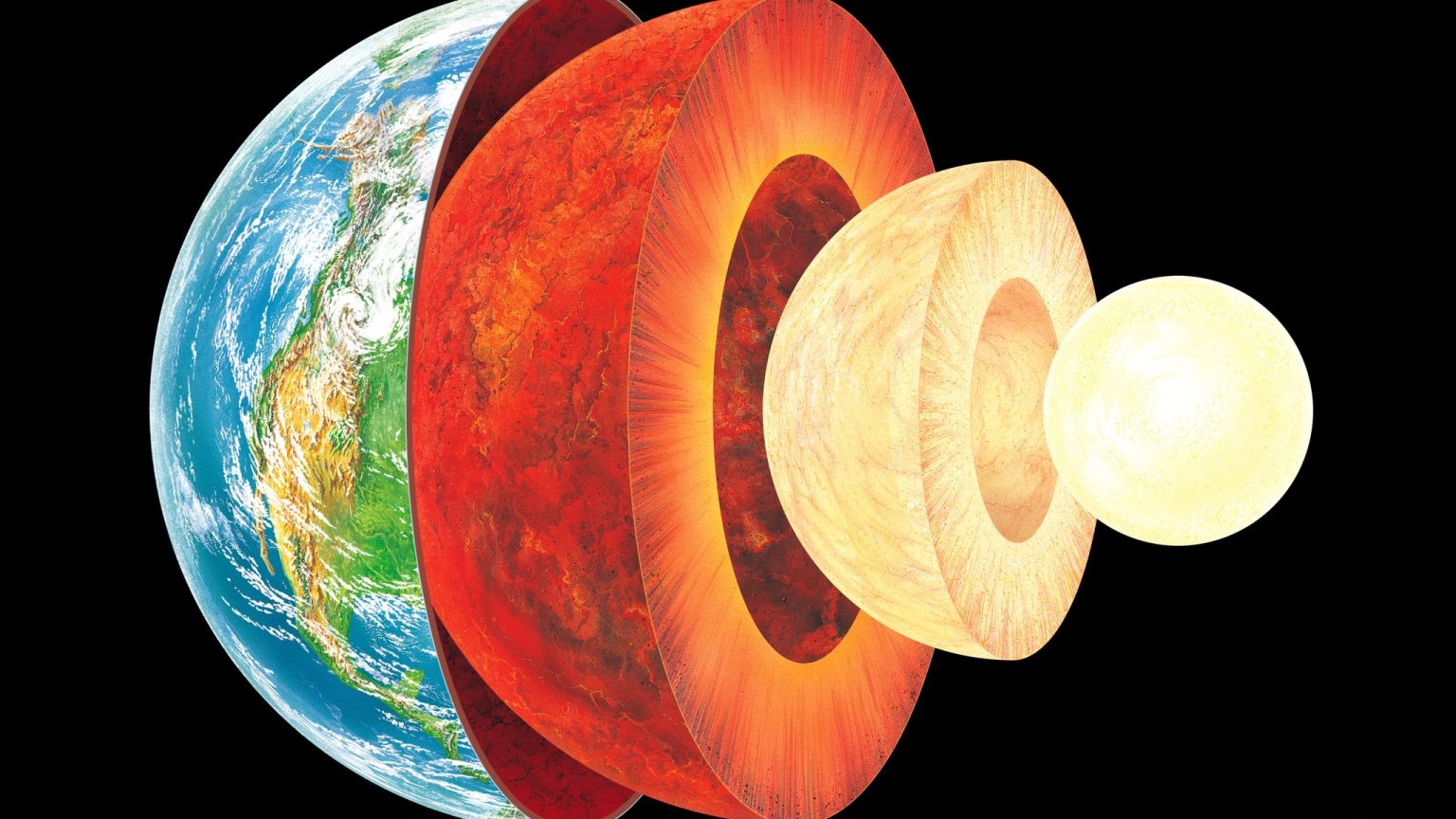
In a study published in the journal Nature Geoscience, scientists from the University of Liverpool presented evidence of the existence of two enormous super-hot mountain structures in this region. They are located at the base of the Earth’s mantle at a depth of about 2,900 km beneath Africa and the Pacific Ocean. Research shows that these huge chunks of solid, superheated material, surrounded by a ring of cooler rock from pole to pole, influence the underlying liquid outer core, shaping the Earth’s magnetic field over millions of years.
Reconstruction of the ancient magnetic field of the Earth
Both measuring ancient magnetic fields and simulating the processes that generate them are technically challenging tasks. To explore the Earth’s interior, the research team combined paleomagnetic observations with advanced computer simulations of the geodynamo — the flow of liquid iron in the outer core that generates the Earth’s magnetic field, much like a wind turbine generates electricity.
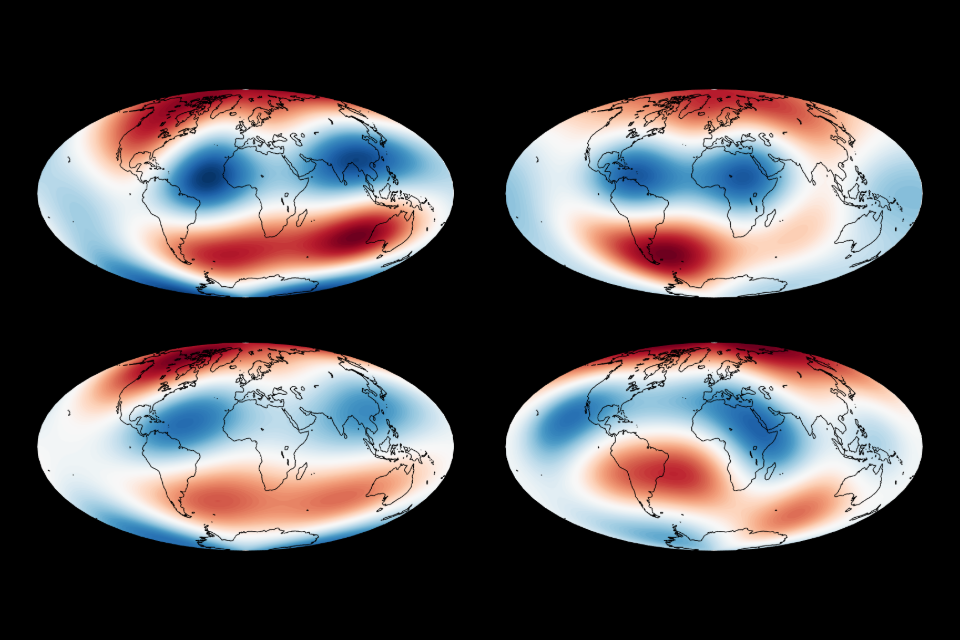
Numerical models have enabled scientists to reconstruct key observations of magnetic field behavior over the past 265 million years. Even with the help of a supercomputer, conducting such simulations, especially over long periods of time, is a huge computational task.
The results show that the upper boundary of the outer core is far from homogeneous in temperature. On the contrary, it exhibits strong thermal contrasts with localized hot spots covered by continent-sized mountain structures.
It has also been demonstrated that some parts of the magnetic field appear to have remained relatively stable for hundreds of millions of years, while others have changed significantly over time.
Earth’s magnetic field and ancient climate
Andy Biggin, a professor of geomagnetism at the University of Liverpool, commented on the study as follows:
“These findings suggest that there are strong temperature contrasts in the rocky mantle just above the core and that, beneath the hotter regions, the liquid iron in the core may stagnate rather than participate in the vigorous flow seen beneath the cooler regions. Gaining such insights into the deep Earth on very long timescales strengthens the case for using records of the ancient magnetic field to understand both the dynamic evolution of the deep Earth and its more stable properties.”
The findings are also important for questions related to ancient continental configurations, such as the formation and breakup of Pangaea, and may help resolve longstanding uncertainties in the fields of paleoclimate, paleobiology, and natural resource formation. Previously, it was believed that the Earth’s magnetic field, on average over long periods, behaved like an ideal bar magnet aligned with the planet’s axis of rotation. Now it has become clear that this may not be entirely true.
Earlier, we reported on the expansion of the South Atlantic Anomaly.
According to University of Liverpool

