

Our planet has invisible protective armor—a magnetic field that shields all life on Earth from dangerous solar radiation. But this shield has a weak spot, and it is growing. Known as the South Atlantic Anomaly, this phenomenon poses a threat to satellites and astronauts. New data confirms that it is growing.
What is the South Atlantic Anomaly?
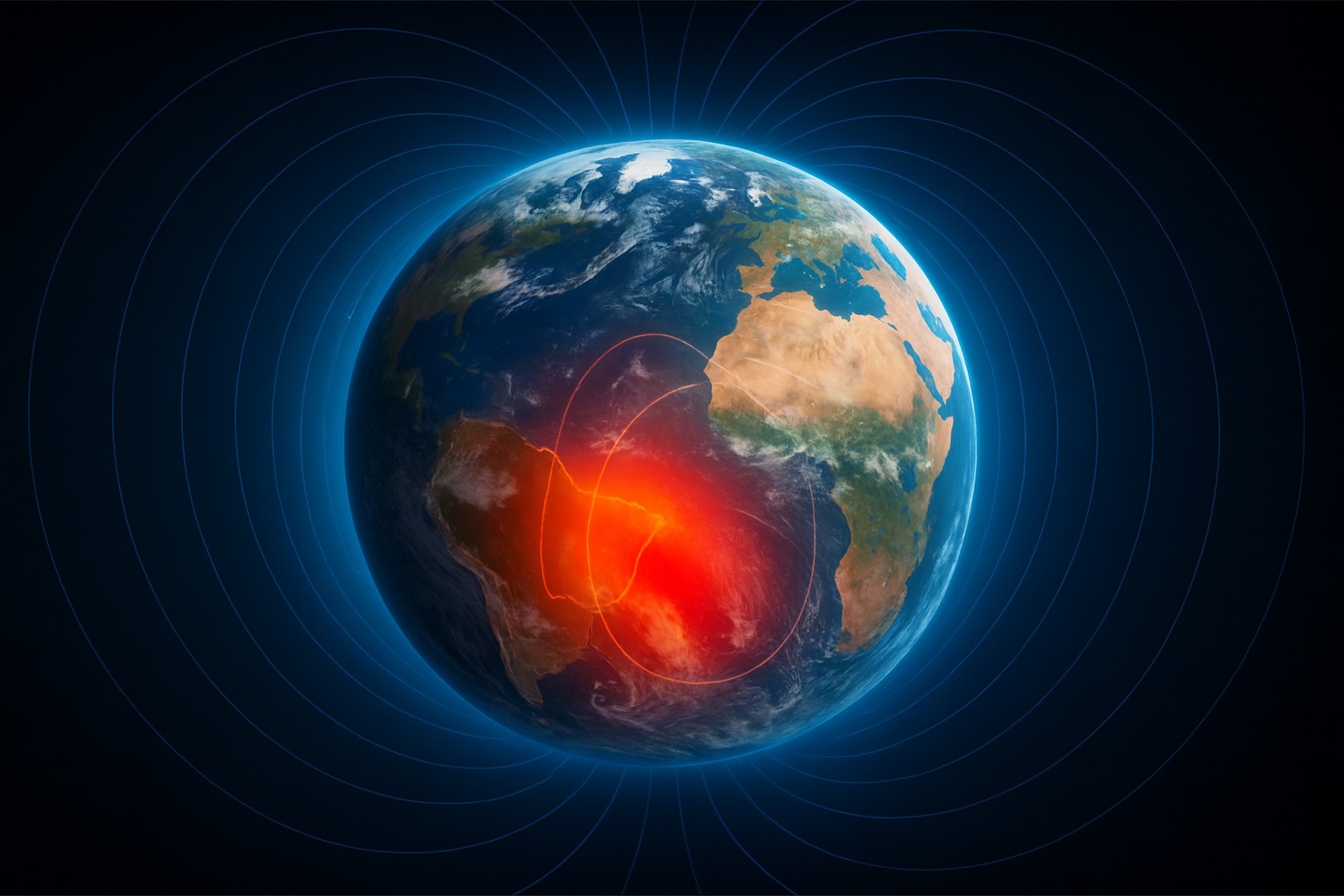
The South Atlantic Anomaly is a huge region over South America and the Atlantic Ocean where the Earth’s magnetic field is significantly weaker than in other areas. Imagine a protective dome over the planet with a hole in it. It is through this hole that charged particles from space can penetrate deeper into the atmosphere than anywhere else.
Three European Space Agency Swarm satellites, launched in 2014, are constantly monitoring the magnetic field. Their data show that over the past decade, the area of the anomaly has increased to a size comparable to half of Europe.
“The region of weak magnetic fields has continued to grow in size over the past 11 years,” confirms Chris Finlay, a geomagnetism researcher at the Technical University of Denmark.
Why is this dangerous?
The magnetic field is a natural protective shield. When it weakens, the level of solar radiation increases. For satellites in low Earth orbit, including the ISS, passing through the anomaly is like traveling through a high-risk zone.
This radiation can:
- damage satellite electronics, causing malfunctions or even complete shutdown;
- negatively affect the health of astronauts, damaging DNA and increasing the risk of cancer in the future.
“The main consequences will be for our satellite infrastructure,” Finlay notes. Although people are protected on the Earth’s surface, prolonged exposure to high levels of radiation in orbit carries risks.
Anomalies in the Northern Hemisphere
Swarm data revealed even more interesting changes in other parts of the planet. In addition to the growth of the South Atlantic Anomaly, scientists also recorded a weakening of the magnetic field over Canada and a strengthening of it over Siberia.
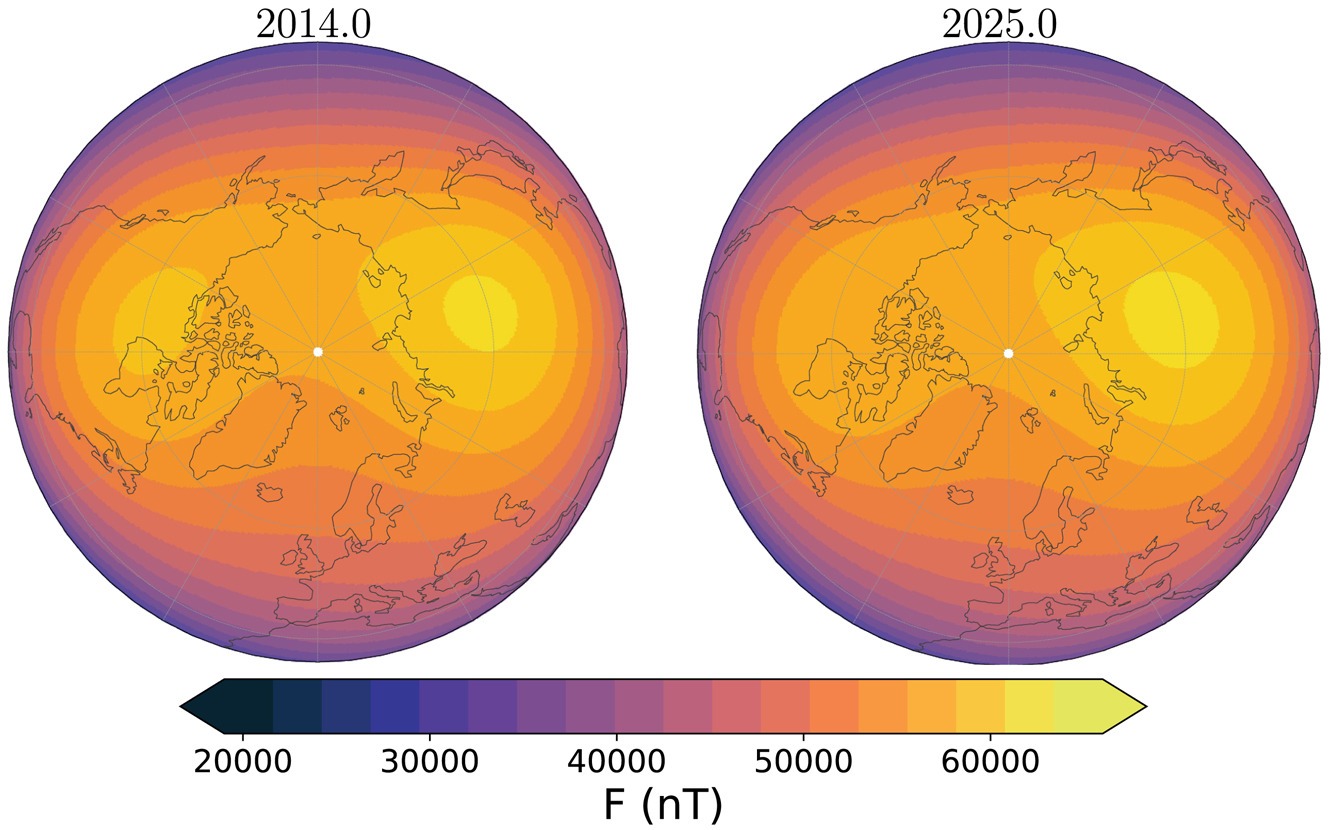
These changes in the Northern Hemisphere came as a surprise to scientists. Finlay explains that they are linked to the circulation of molten iron in the Earth’s core, but the exact causes of such fluctuations are not yet understood.
Should we expect a pole shift?
Some may think that such events are a sign of an inevitable reversal of the magnetic poles, when the north and south magnetic poles switch places. However, research does not support this theory.
Although a complete pole reversal is not expected, the expansion of the South Atlantic Anomaly is a reality that has to be taken into account. Scientists are convinced that future space missions must take this factor into consideration.
Engineers will have to develop more secure electronics for satellites, and flight planners will have to carefully calculate routes to minimize risks to astronauts. Our protective armor is changing, and we have to learn to live with these changes.
We previously reported on why the Earth’s magnetic field once “went crazy.”
According to livescience.com

