

An international team of researchers led by Yale University has explained a mysterious anomaly in Earth’s magnetic field that has puzzled scientists for decades. They concluded that the strange behavior of the magnetic field 550 million years ago was not the result of continental drift, but rather the result of chaotic changes in the field itself. The corresponding study was published in the journal Science Advances.
The magnetic field is the Earth’s invisible shield that protects us from cosmic radiation and charged particles from the Sun. It is usually stable, but in ancient times its strength and direction sometimes changed dramatically.
One such mysterious period was the Ediacaran, an era that lasted from approximately 630 to 540 million years ago. It was during this time that the first complex living organisms appeared on Earth. However, for a long time, geologists could not explain why the magnetic “traces” in the rocks of that time looked as if the continents were moving at a speed that violated all the laws of physics.
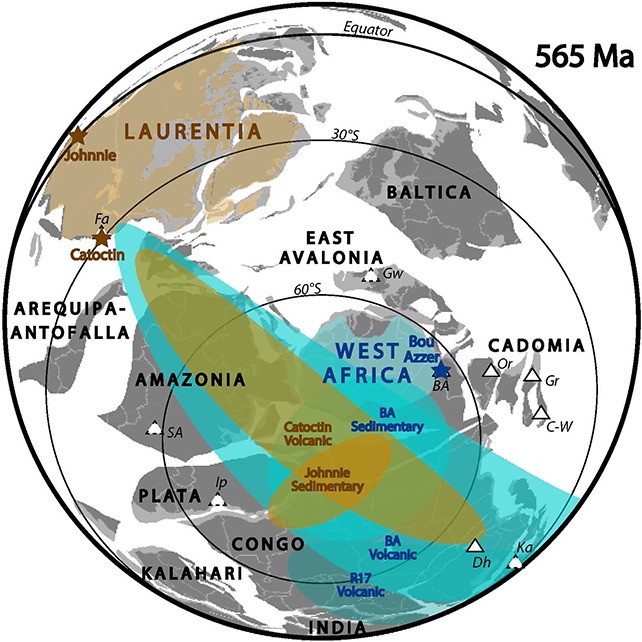
To find the answer, a team from Yale studied ancient volcanic rocks from the Anti-Atlas mountain region in Morocco. The scientists analyzed in detail the layers of ancient lava in which the directions of the magnetic field were “frozen.” The simulation results showed that the changes did not occur over millions of years, as previously thought, but over thousands. This is incredibly fast, and it indicates that the continents remained in place, but the magnetic field itself behaved unpredictably, as if it had lost its course.
“We propose a new model of the Earth’s magnetic field that shows that even in its variability there is a certain structure; it is not just chaos,” explains geologist David Evans of Yale University.
The probable cause of this “storm” lies deep within the planet — in the process of its core formation. At that time, the inner core was still forming, and it was precisely this phase of its crystallization that could have led to instability in the magnetic field. Changes in the movement of molten iron in the outer core, which generates the magnetic field, caused short-term but powerful fluctuations in its strength and direction. This, in turn, could have affected conditions on the planet’s surface, altering the level of protection from cosmic radiation and the flow of charged particles from the Sun. Such periods of instability probably created a more complex but at the same time more dynamic environment in which the first complex living organisms, the Ediacaran biota, formed.
The results not only reveal an ancient mystery, but also help to create the most accurate model to date of the Earth’s magnetic field behavior over hundreds of millions of years. In the future, this may allow us to understand exactly how the magnetic field supported the development of life on our planet.Moreover, if the new analysis methods are confirmed, scientists will be able to create a unified map of continental movement and magnetic field changes from the earliest geological formations to the present day.

