

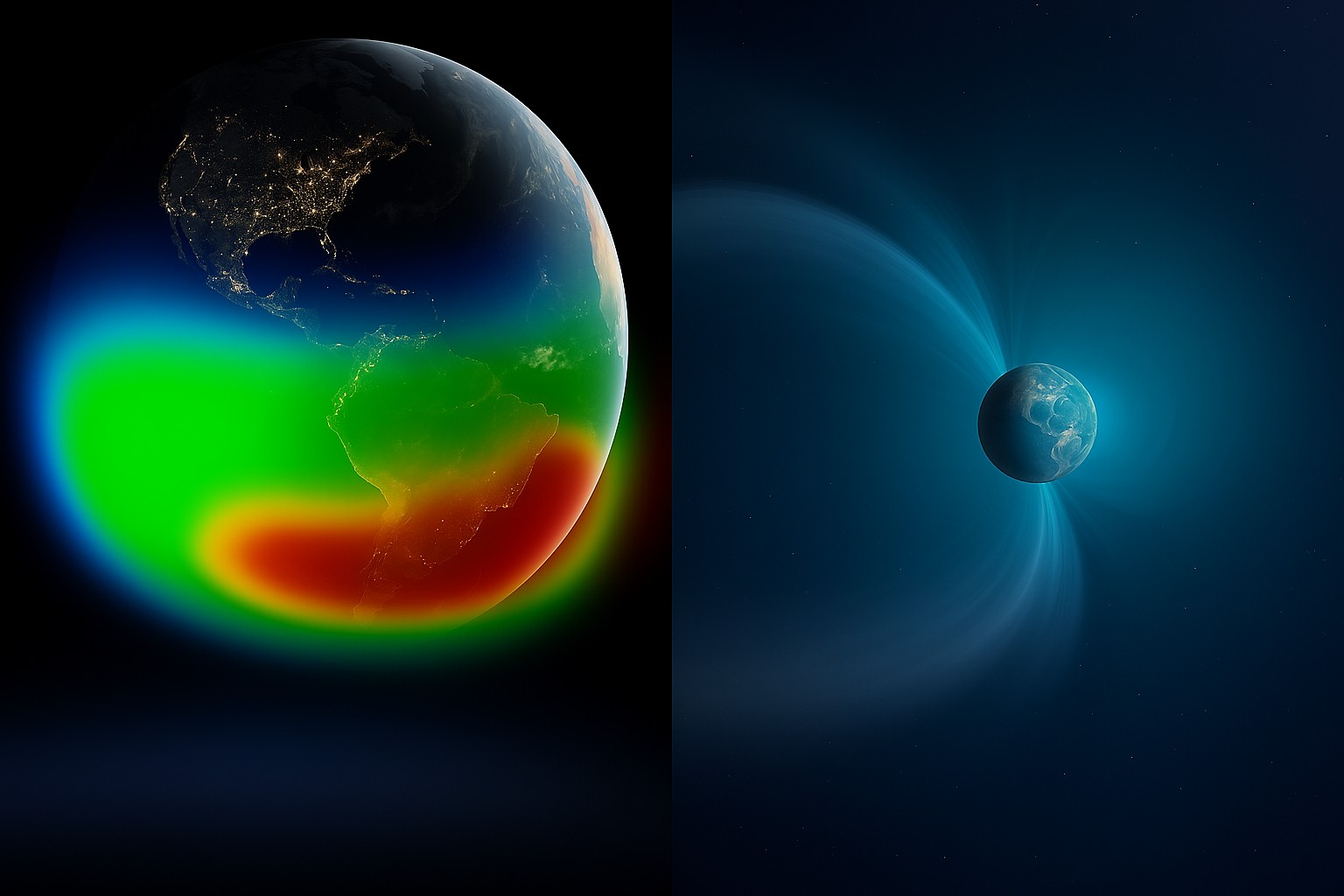
For decades, NASA scientists have been observing a strange area in our planet’s magnetic field with both surprise and concern. A giant zone with abnormally weak magnetic intensity stretches across South America and southwestern Africa — the South Atlantic Anomaly (SAA). This mysterious “breach” in our magnetic shield has become the subject of active research.
Danger to space devices
Fortunately, the anomaly has no effect on living organisms. However, SAA poses a serious threat to satellites and space stations, especially in low Earth orbits. Here, the Earth’s protective magnetic shield is significantly weaker, allowing streams of high-energy solar particles to penetrate deeper. This can cause short circuits, equipment malfunctions, data loss, or even irreversible damage. To prevent disaster, operators often shut down key systems before spacecraft enter the anomaly zone. That is why NASA monitors the SAA so closely.
Magnetic dent
What causes this global “dent”? The main magnetic field is generated by the movements of molten iron in the Earth’s outer core. However, this process is not uniform. Scientists believe that a huge accumulation of dense rocks deep beneath Africa, known as the African Large Low Shear Velocity Province, disrupts the normal circulation of magma. This, together with the tilt of the magnetic axis, leads to a sharp weakening of the field in the SAA region.
“The local field with reverse polarity grows strongly here, making it much weaker than its surroundings,” explains NASA geophysicist Weijia Kuang.
SAA is not a static phenomenon. Observations, in particular a 2016 study led by Ashley Greeley and subsequent data from CubeSats, have confirmed its slow drift.
Even more surprising is that the anomaly appears to be splitting in half. In 2020, NASA scientists discovered two separate centers of minimum magnetic intensity within the larger SAA zone.
Centuries-old phenomenon
A 2020 study showed that similar anomalies existed 11 million years ago. This suggests that the South Atlantic anomaly is probably not a precursor to a global inversion of the Earth’s magnetic field, which occurs periodically.
Recent studies in 2024 have even revealed the influence of magnetic anomalies on the visibility of polar auroras. Although many questions remain, NASA continues to conduct intensive observations. This cosmic “pothole” remains one of the most intriguing magnetic mysteries of our planet.
We previously reported on how temperature distribution inside the Earth caused magnetic anomalies.
According to Science Alert

