
An international group of astronomers used the ALMA radio telescope to study a well-known quasar. During observations, an ultra-bright infrared galaxy hidden behind it was accidentally discovered.
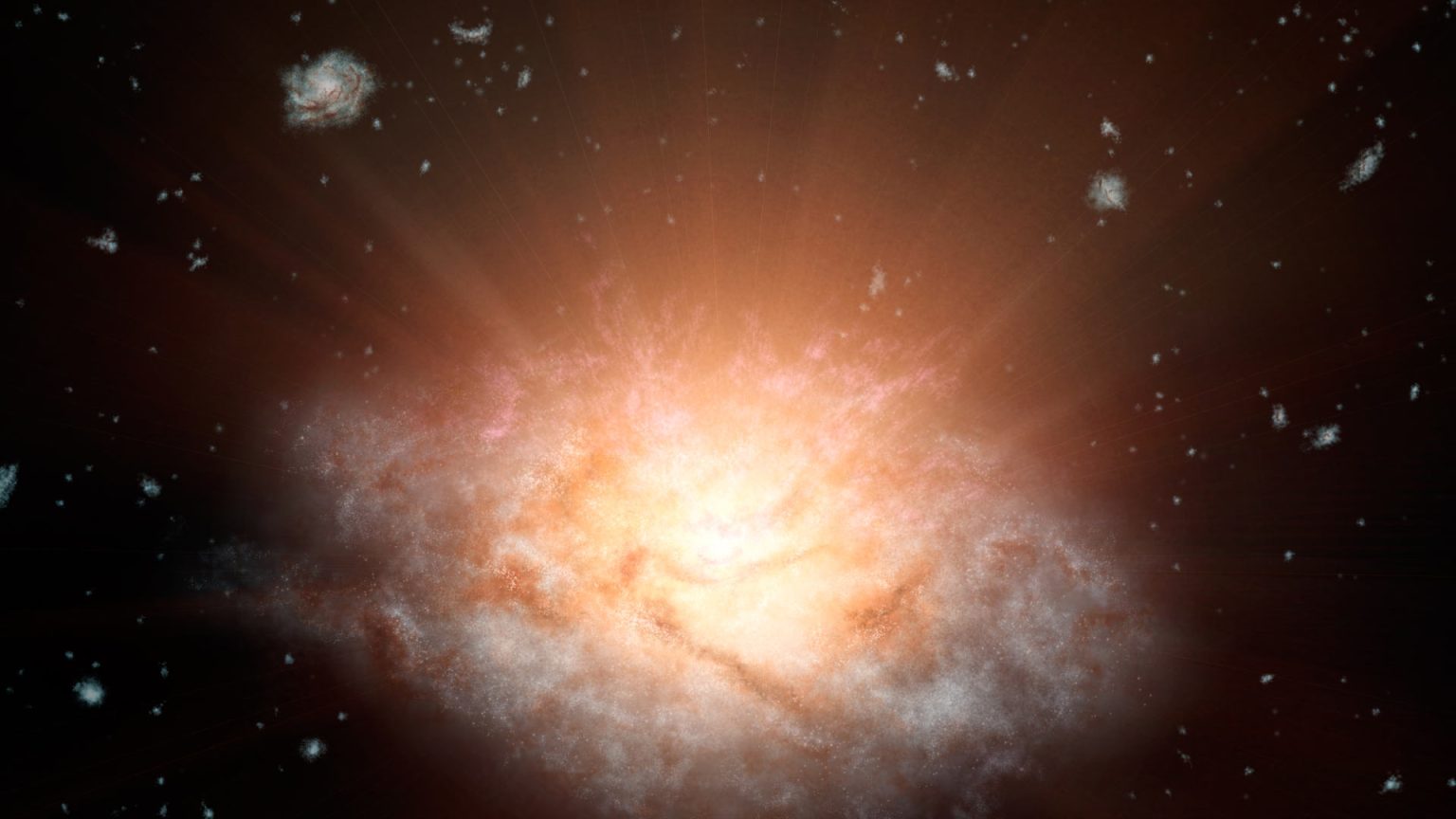
Ultra-luminous infrared galaxies (ULIRGs) have infrared luminosities greater than a trillion solar masses and star formation rates ranging from 100 to 1,000 solar masses per year. This makes them the objects with the most intense star formation in the local Universe. Therefore, the discovery of new galaxies of this type may be important for improving our understanding of star formation and evolution.
Recently, a new object has been added to the list of ultra-bright infrared galaxies known to astronomers. The discovery was made during the study of quasar H1413+117, also known by its unofficial nickname, Cloverleaf. This object is well known to astronomers. The quasar was discovered back in 1984, and its distance is 11 billion light-years.
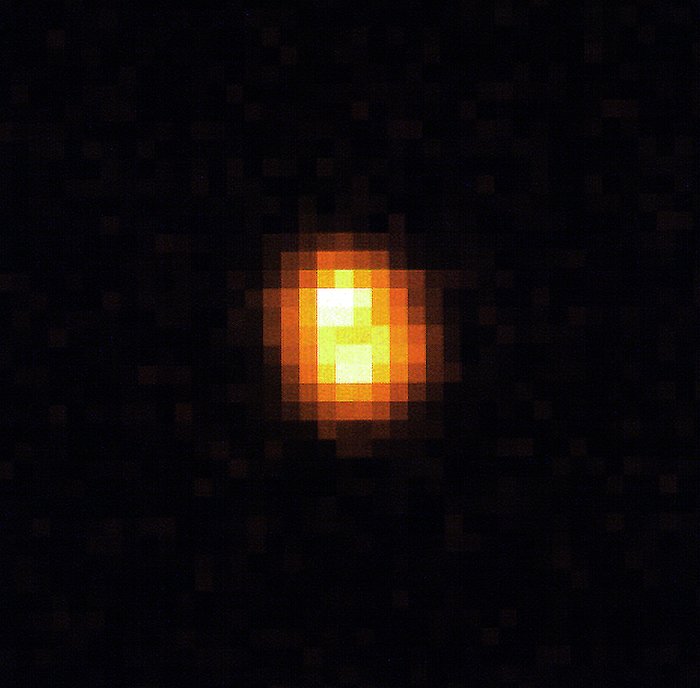
The researchers were even more surprised when, during apparently routine observations of H1413+117 with ALMA, they discovered a previously unknown galaxy hidden behind it. It is practically aligned with the quasar in relation to Earth, which explains why astronomers have only just discovered it.
The molecular mass of the newly discovered galaxy ranges from 40 to 230 billion solar masses, and the mass of the black hole at its center is estimated to be approximately 0.1 billion solar masses. The total infrared luminosity of the galaxy is 2.8 times greater than that of the Sun. In the optical range, however, this system is dark and appears to be heavily obscured.
The study shows that the molecular gas in this galaxy has not yet stabilized dynamically, probably due to the merger of gas-rich large galaxies in the early stages. Therefore, astronomers predict that star formation will likely continue there.
It is also possible that this galaxy is in the progenitor stage of the hot dust-obscured galaxy phase. It may then evolve into a galaxy with an exposed active core, and then into an elliptical galaxy. However, further observations are needed to draw definitive conclusions.
According to Phys.org

