

Physicists at Rice University have made a breakthrough in understanding the first moment after the birth of the Universe as a result of the Big Bang. For the first time, scientists have managed to measure the temperature of quark–gluon plasma (chromoplasma) — an ultra-hot state of matter that, according to theory, filled space-time during the earliest stages of its evolution. This discovery brings science closer to uncovering what the Universe looked like in the first microseconds of its existence.

What is quark-gluon plasma?
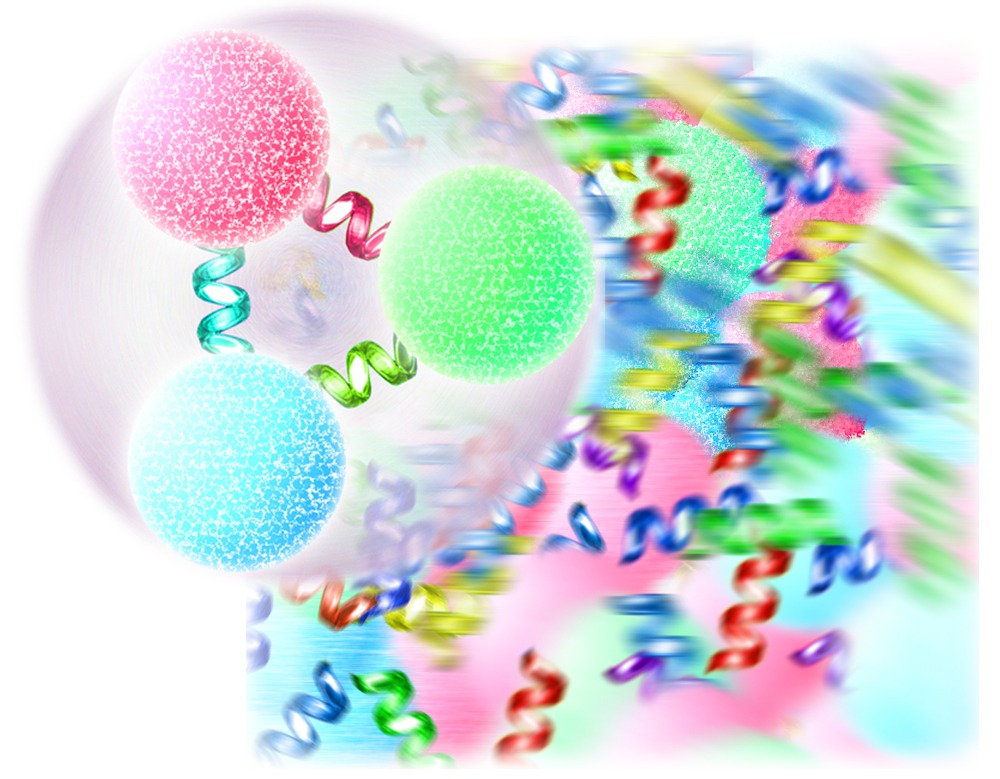
Chromoplasm is an exotic state of matter in which quarks and gluons, normally bound together in protons and neutrons, are in a free state. This state occurs only at extremely high temperatures—trillions of kelvins. It is believed that this was the state of matter immediately after the Big Bang, before it cooled and formed atoms.
The existence of quark-gluon plasma was first experimentally confirmed in 2000 at CERN. Although it had been theoretically predicted as early as the 1970s. However, it remained a mystery how hot this plasma was and how its temperature changed.
How was the temperature measured?
A team of researchers used the Relativistic Heavy Ion Collider (RHIC) in the United States. They observed collisions of heavy nuclei that, for a fleeting moment, recreate conditions similar to those that existed just after the Big Bang. Their focus is on rare electron–positron pairs produced during these collisions.
Unlike quarks, these particles interact very weakly with the plasma, so they carry “clean” information about its temperature. Their energy distribution makes it possible to determine how hot the plasma was at different stages of its evolution.
Technical challenges
The measurements turned out to be extremely challenging. Electron–positron pairs are exceedingly rare among the millions of other particles produced in the collisions. To detect them, the team used a specially calibrated detector system capable of identifying these signals with unprecedented precision.
In addition, they had to deal with background processes that could mimic thermal signals, which required complex data analysis and noise reduction procedures.
Heat of the first microseconds
Researchers have determined two average temperatures for quark-gluon plasma:
- 2.01 trillion K for pairs with lower mass, corresponding to a later stage of plasma cooling.
- 3.25 trillion K for pairs with higher mass, which arose at an earlier, hotter stage.
These data confirm theoretical models and provide deeper insight into how the state of matter changed during the first moments after the Big Bang.
The next step will be to construct a complete phase diagram of QCD — quantum chromodynamics — which describes the behavior of matter under extreme temperatures and densities. This will not only help us better understand the early Universe but also shed light on the processes occurring in neutron stars and other extreme cosmic objects.
Earlier, we explained what happened before the Big Bang.
According to Big Think

