

Astronomers working with the Hubble Space Telescope have published a new image. It shows the galaxy NGC 1309. In recent years, a pair of supernovae have exploded in it.
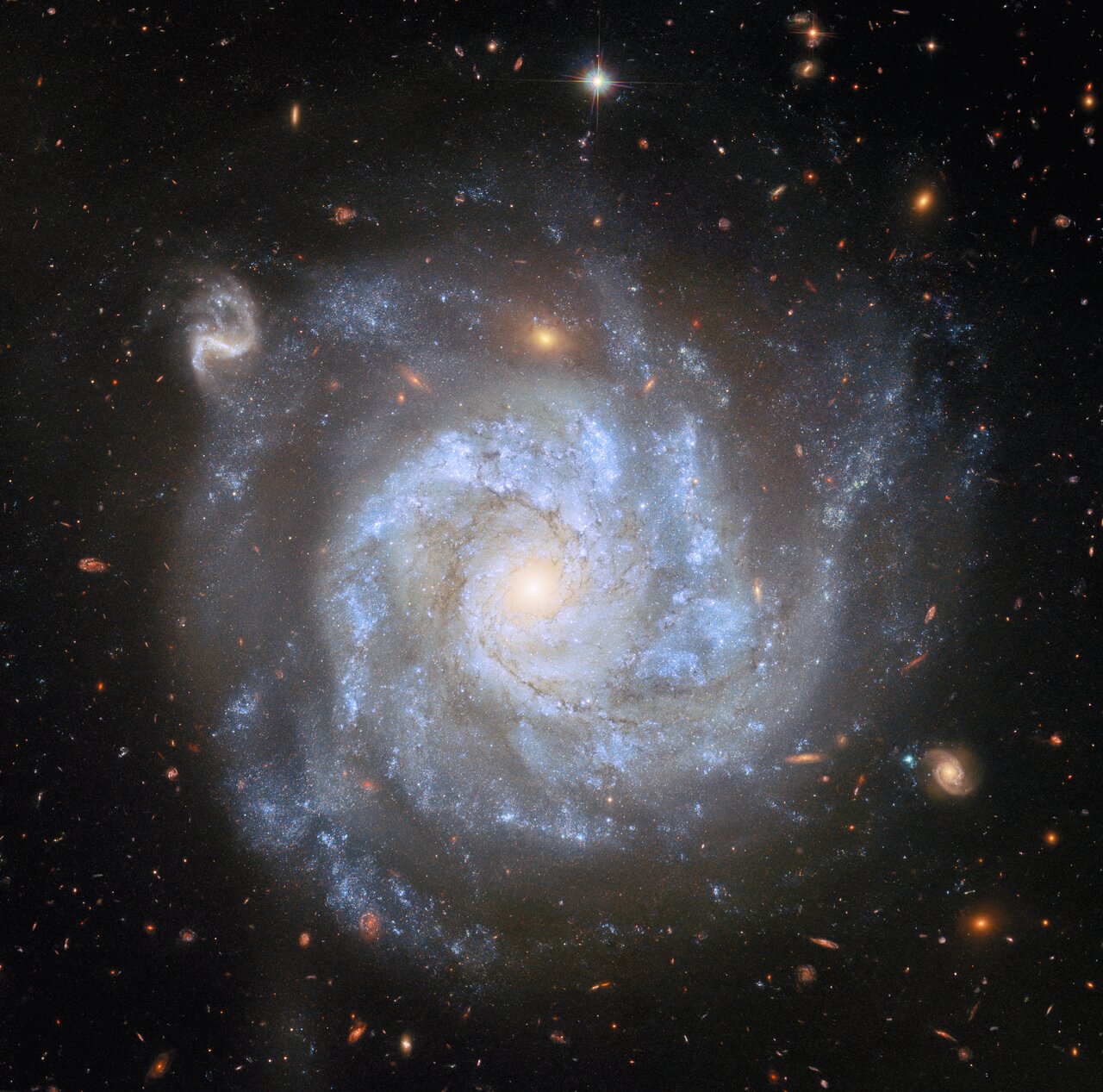
NGC 1309 is located about 100 million light-years from Earth in the direction of the constellation Eridanus. Like our Milky Way, it is a spiral galaxy. The Hubble photo shows its bluish stars, dark brown gas clouds, and pearly white center.
In the background, you can see hundreds of spots, streaks, and blobs of light. Almost every one of them is a separate, more distant galaxy. The only exception is the star at the top of the frame, which can be identified by its diffraction spikes. It is located very close, just a few thousand light years away from us in the Milky Way.
Hubble has turned its attention to NGC 1309 several times. Its previous images were obtained by the telescope in 2006 and 2014. Most of the scientific interest in NGC 1309 is related to two supernovae: SN 2002fk, which exploded in 2002, and SN 2012Z, which exploded in 2012.
SN 2002fk was a perfect example of a Type Ia supernova, which occurs when a white dwarf exceeds the theoretically possible mass limit and explodes. Astronomers use such explosions as standard candles to determine distances in the universe.
SN 2012Z, on the other hand, was somewhat atypical. It was classified as a Type Iax supernova: although its spectrum resembled that of a Type Ia supernova, the explosion was not as bright as expected. Hubble observations showed that in this case, the supernova did not completely destroy the white dwarf, leaving behind a “zombie star” that shone even brighter than before the explosion. After studying images taken by the telescope several years before the explosion, astronomers were able to identify the white dwarf progenitor for the first time.
We previously wrote about how Hubble created a portrait of a massive galaxy cluster.
According to Esahubble

