

The Hubble Telescope photographed the distant galaxy cluster Abell 209. It is so massive that its gravity distorts the fabric of space-time, creating bizarre mirages.
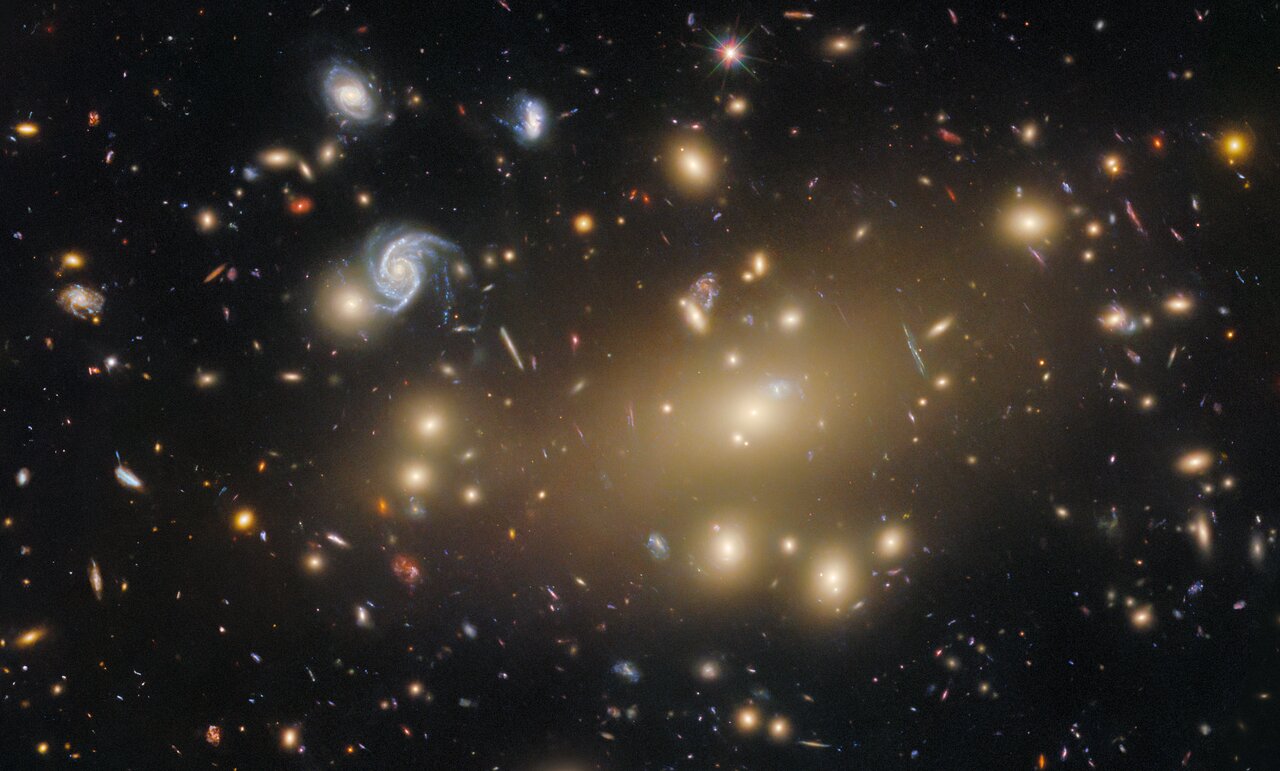
The Abell 209 cluster is located 2.8 billion light-years from Earth in the direction of the constellation Cetus. The photo shows over a hundred galaxies that make up the cluster. But in reality, this is just the tip of the iceberg, and there is much more in the cluster that even Hubble cannot see.
For example, the galaxies in Abell 209 are separated by millions of light-years, and the seemingly empty space between them is actually filled with hot diffuse gas that can only be seen in the X-ray range. An even more elusive inhabitant of the cluster is mysterious dark matter: a form of matter that does not interact with electromagnetic radiation. It is believed that the Universe consists of 5% ordinary matter, 25% dark matter, and 70% dark energy.
Hubble observations like those used to create this image can help astronomers answer fundamental questions about our Universe, including the mysteries surrounding dark matter and dark energy. In addition, the enormous mass of the cluster distorts the very structure of space-time, creating distorted and magnified images of background galaxies and stars in a process called gravitational lensing. Scientists actively use this phenomenon to study objects at the edge of the Universe that are too dim to be photographed even by the most powerful telescopes.
Although Hubble’s image lacks the characteristic effects of gravitational lensing, such as Einstein rings or crosses, Abell 209 still shows faint signs in the form of striped, slightly curved galaxies in the golden glow of the cluster. By measuring the distortion of these galaxies, astronomers can map the distribution of mass within the cluster and determine the location of dark matter. This information is crucial for testing theories about the evolution of our Universe.
According to Esahubble

