

Usually, when scientists study exoplanets, they look for water, as it is a substance that is absolutely necessary for life to exist. However, scientists have recently expressed the opinion that it is also important to detect land on the planet. And they know how to do it.
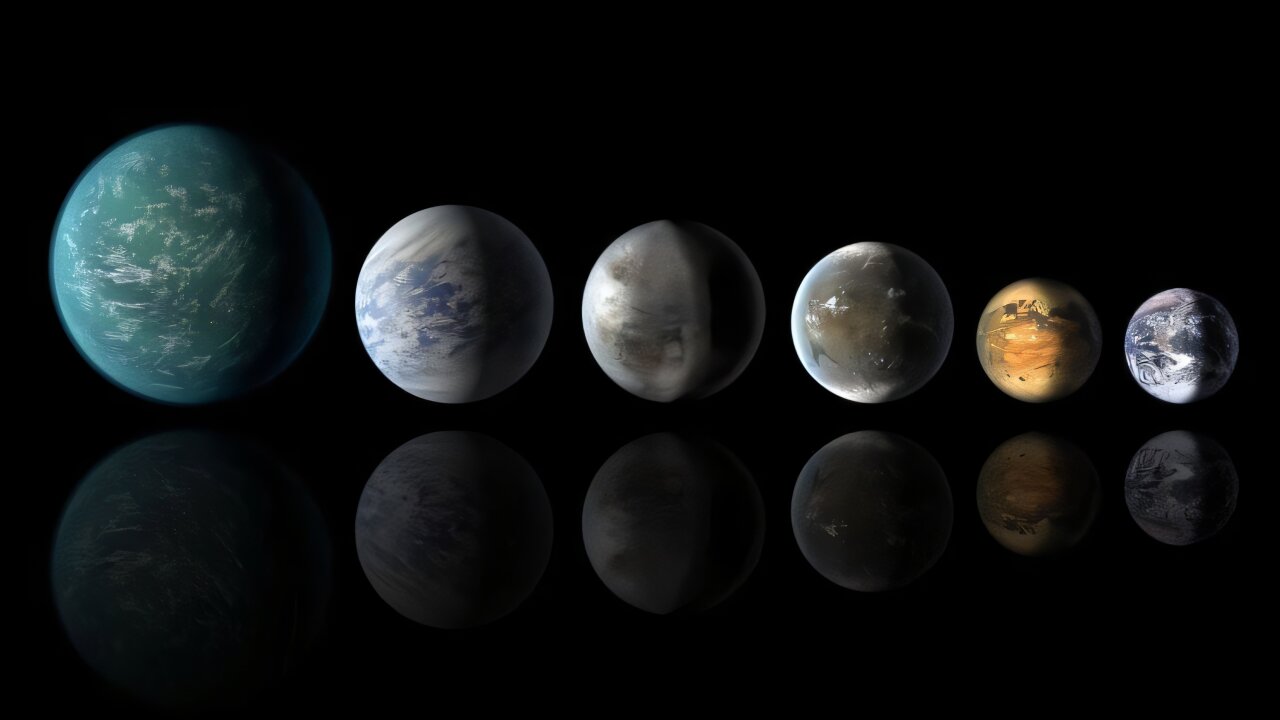
Water and land
Recently, an article by a group of American researchers appeared on the arXiv preprint server, addressing the question of whether we can determine the presence of land on an Earth-like exoplanet. They consider this issue to be very important.
For astronomy enthusiasts, this question may seem strange, because we first and foremost look for signs of life in space, and life exists where there is water. However, the authors of the article say that it is even more important to find atmospheric oxygen on the planet. Very large oceans, whose volume can exceed that of the Earth’s by 50 times, give false positive results in this regard.
Therefore, completely oceanic worlds, of which many have already been discovered, may not actually be as hospitable as they seem. That is why we need to look for planets where there is at least a small piece of land. And in a new study, scientists have suggested that a new generation of space telescopes could solve this problem: the Habitable Worlds Observatory.
How to find a solid surface
However, the same study shows that in order to see the solid surface of a planet, most of which is covered by ocean, the Habitable Worlds Observatory will need a main mirror with a diameter of about 8 m.
This is not much by modern standards, but it still poses a significant challenge for developers. The space telescope project is currently in the preparatory stage, and any parameters can be incorporated into it. However, it should be remembered that its construction could take many years. And current US policy is already aimed at reducing space exploration.
As for the ability to distinguish land from sea with sufficient resolution, the authors of the study say that this is not a problem. After all, the nature of wave reflection off a hard surface differs greatly from that of water and the sea. They confirmed this by carefully studying the results of images of Earth from the US Geological Survey archive.
Ocean planets
It is worth mentioning that there are now quite a few candidates for ocean planets. These include, for example, TRAPPIST-1 (40 light-years) and Kepler-11 (2,110 light-years), as well as Kepler-62e (1,200 light-years), Kepler-62f (1,200 light-years), Kepler-22b (587 light-years), and GJ 1.
Just recently, in a 2024 study published in The Astrophysical Journal Letters, it was announced that JWST had discovered a “steam world” identified as GJ 9827d, approximately 97 light-years from Earth and with a radius slightly less than two Earths. What makes GJ 9827d interesting is that although its atmosphere consists of steam, the planet itself is estimated to be too hot to support life as we know it.
According to phys.org

