

The four largest moons of Jupiter are called the Galilean moons: Io, Europa, Ganymede, and Callisto. Recently, scientists have studied how these objects could have formed. They believe that this did not happen in the same way as in the case of Earth’s moon.
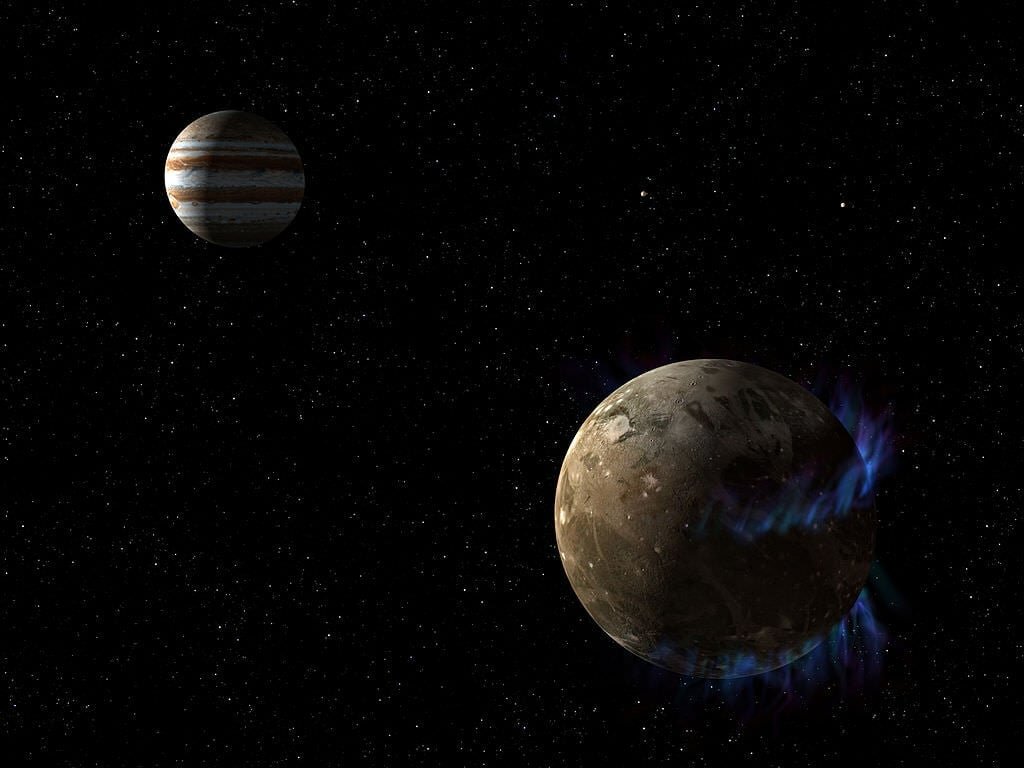
Galilean moons
Scientists from the University of Bern have published a study on the formation of Galilean moons on the arXiv preprint server. Astronomers talk a lot about the birth of planets, but they rarely mention where their moons come from, of which there can sometimes be many.
The reason for this is that we see many planets around other stars, but modern astronomical instruments do not allow us to see their moons. Therefore, scientists can mainly only study our solar system, where they pay particular attention to Jupiter and Saturn.
It is believed that at the dawn of these giant planets’ existence, in the zone where Jupiter’s four largest moons now orbit, there was a disk similar to the one from which Jupiter was formed. However, the formation of Io, Europa, Ganymede, and Callisto quickly depleted its material. So how did these moons manage to grow to such sizes?
New research
This is precisely the question that the authors of a new study sought to answer. They emphasized that the formation of Earth’s Moon and Galilean moons cannot be equated: the Moon formed according to a unique scenario, while Jupiter’s moons arose rather quickly. It took them 10 to 100 times less time than the planets.
During this period, the protoplanetary disk around the Sun had not yet completely dissipated. Therefore, matter from it was captured by the gravity of giant planets and helped form large moons. The remaining smaller moons may not have formed there or then at all.
Scientists have no definitive opinion on the size of the particles of matter that Jupiter captured for its moons. Most likely, they were very small. Although it is possible that the giant planet could have attracted entire planetesimals.
The three inner moons fit very well into this picture of formation. But the fourth, Callisto, is noticeably different from them. This body is not in resonance with the others and, unlike them, is not gravitationally differentiated. Scientists suspect that its formation is not yet complete.
According to phys.org

