

Space data centers could be a creative solution to AI’s “energy appetite.” Against the backdrop of Goldman Sachs’ forecast of a ~165% increase in data center electricity consumption by 2030, researchers at NTU Singapore have proposed moving computing into orbit: using virtually unlimited solar energy and free radiation cooling from space. Such systems are available in two formats: orbital edge centers for preliminary data processing directly on satellites, and distributed orbital systems with servers, broadband communications, and large solar panels. This can dramatically reduce the volume of unfiltered data transmitted to Earth and the load on ground networks.
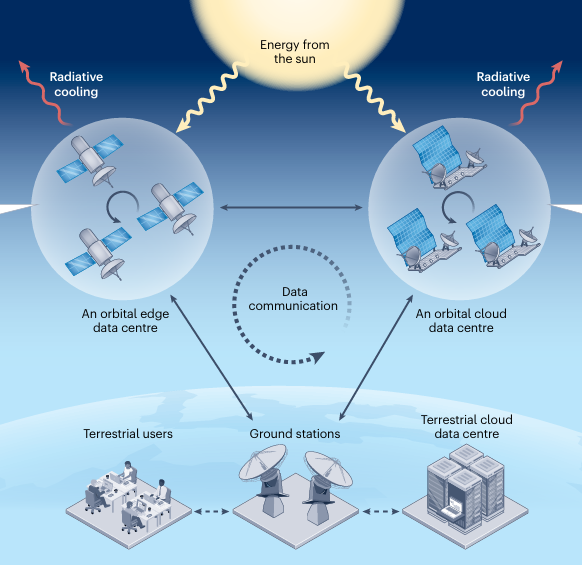
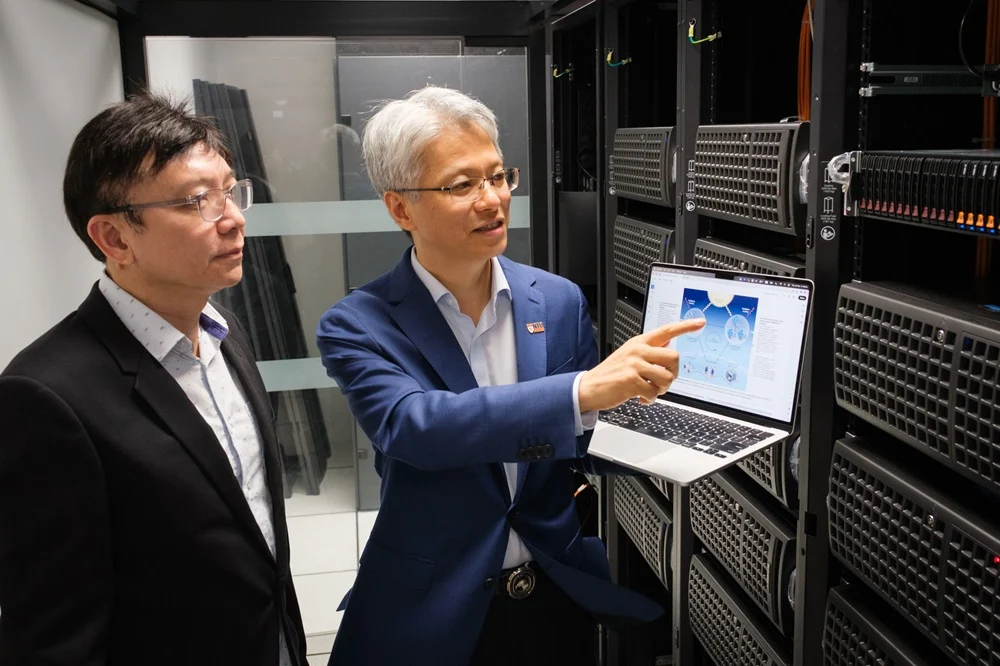
The NTU press release states that modeling (digital twin) showed a zero carbon footprint life cycle: launch emissions are offset by several years of solar energy operation. The authors introduce the life-cycle CUE metric and emphasize technological readiness thanks to the development of radiation-resistant chips and reusable rockets.
The trend of “computing in orbit” is already being tested: Axiom Space, in collaboration with IBM Red Hat, recently delivered a prototype data center to the ISS for local processing of experiments, and Lonestar is preparing a lunar data storage center as part of Intuitive Machines’ missions.
How does it work? Simply put, the idea is like this: some of the “heavy” work for AI is moved into orbit. There’s almost unlimited solar energy there to power the servers, and space is like a giant fridge where it’s easy to get rid of heat without spending money on air conditioning. The satellites carry radiation-protected computers that immediately process raw data streams (from cameras, radars, telescopes), filter out unnecessary information, and send only compressed results to Earth via radio or laser.
Why is this useful? Calculations performed directly in orbit reduce the load on radio channels and allow telescopes, probes, and orbital radars to immediately filter out noise, transmitting only significant events to Earth — transients, gravitational wave indicators, or images with anomalies. This reduces the time from observation to discovery, increases the autonomy of long-distance missions (Mars, outer planets), and makes scientific campaigns cheaper, as hundreds of gigabytes of raw data no longer need to be sent to Earth. NTU estimates that orbital preprocessing can reduce the volume of data transmission by more than 100 times.
If you are interested in the idea of “computing in orbit,” definitely check out the article “Swarm Robotics: How Collective Intelligence Will Transform Space Exploration.” It describes how dozens and hundreds of small robots act as a single “collective brain” to explore the Moon, Mars, and asteroids. Want to see how it works in practice? Go to the article!According to NTU Singapore

