

Scientists have long known that the history of Earth is the story of its transformation from an oxygen-free planet into a world rich in oxygen. A new study has revealed that this occurred in several stages.
History of Oxygen
Dr. Matthew Dodd from the School of Earth Sciences at the University of Western Australia, in collaboration with colleagues from Chengdu University of Technology, recently conducted a study on how the amount of oxygen in Earth’s atmosphere has changed over the last 2 billion years. The results are published in the journal Nature.
Scientists already knew that at the very beginning and throughout a significant part of its history, it was deprived of oxygen. Then it appeared, causing the so-called Great Oxygenation Event, but even after that, the concentration of this gas on Earth remained lower than now, and only over time reached the level familiar to us.
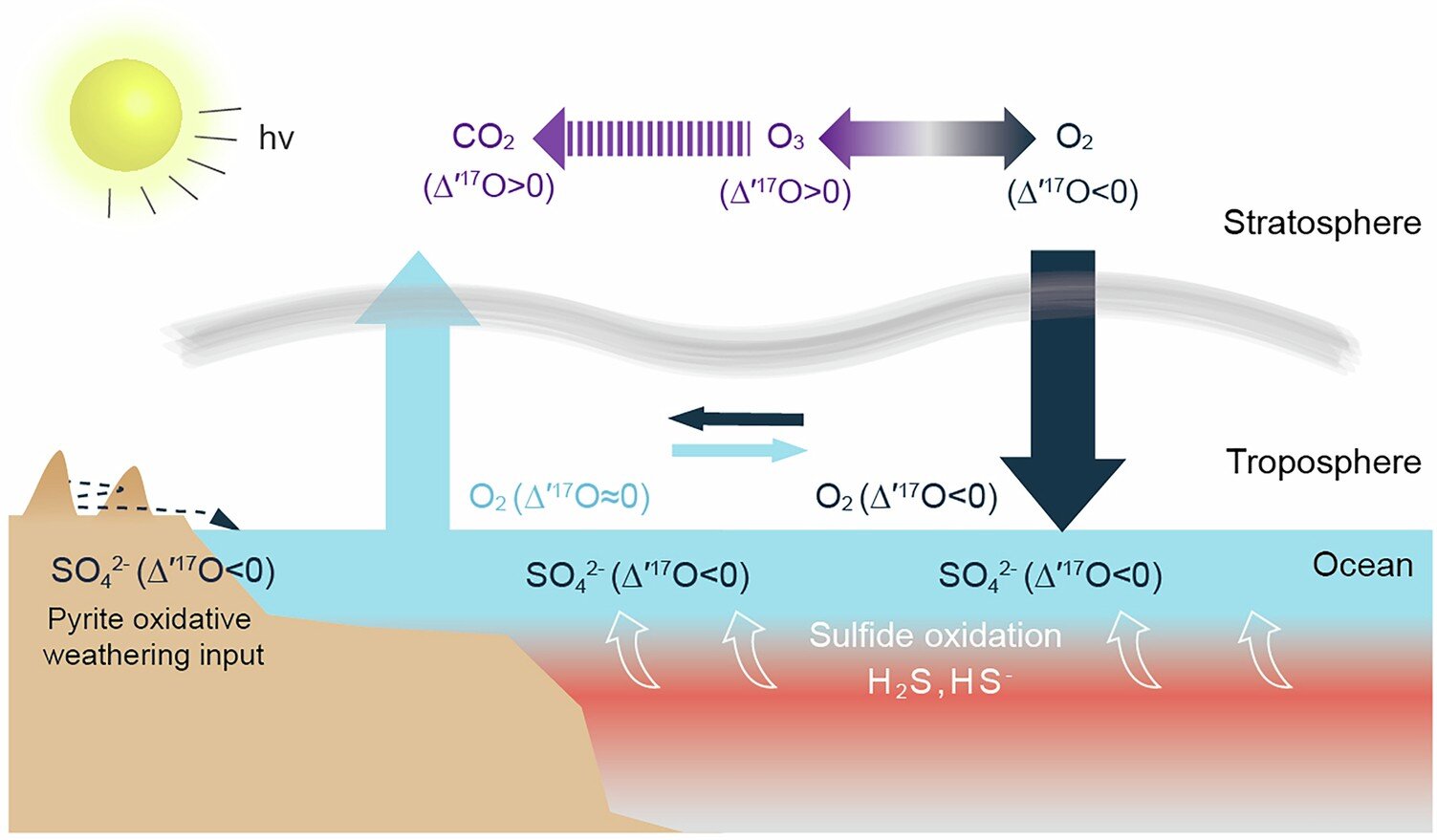
Exactly how this happened remains unknown to this day. However, scientists managed to accomplish this task by carefully selecting rock samples and studying their isotopic composition.
What scientists discovered
Research has identified three major episodes of increased oxygen content in the atmosphere: during the Paleoproterozoic (2,500–1,600 million years ago), the Neoproterozoic (1 billion–538.8 million years ago), and the Paleozoic (538.8–252 million years ago). After that, the oxygen content stabilized at approximately the current level about 410 million years ago.
It is important to note that after the Neoproterozoic increase in oxygen content, Earth’s oceans, which were largely oxygen-deficient, were periodically subjected to pulses of oxidation.
These events led to synchronized isotopic changes in carbon, sulfur, and oxygen over hundreds of millions of years, indicating that increases in atmospheric oxygen repeatedly caused temporary oxidation of the ocean.
According to phys.org

