

On July 31, the Southern δ-Aquariids meteor shower will reach its peak. However, visibility conditions will be such that it will be easy to miss this spectacle. In this article, you will learn what to do to ensure that this does not happen.
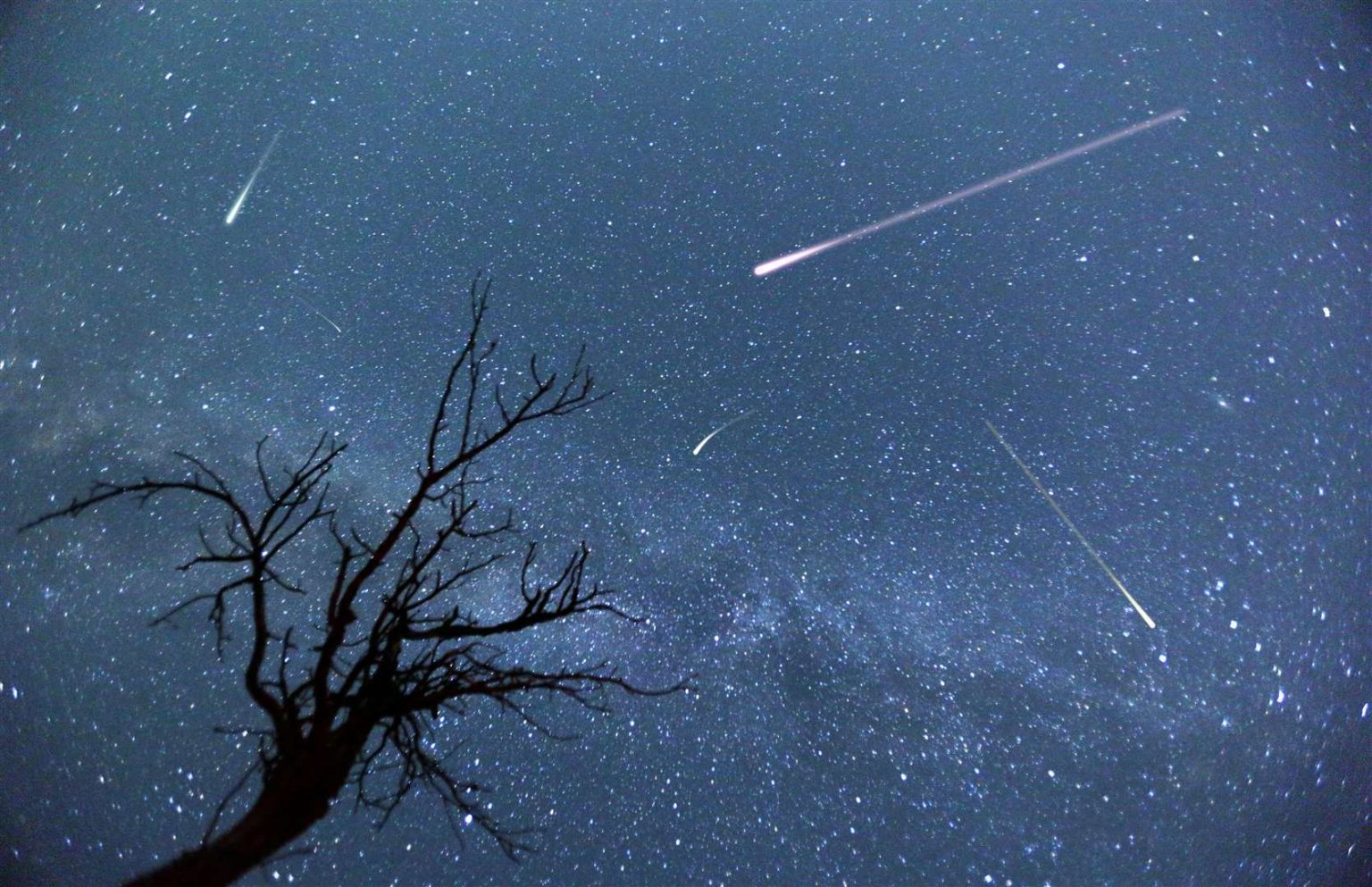
Southern δ-Aquariids
The second half of summer in the Northern Hemisphere is the best time to observe meteor showers. On the one hand, it gets dark early enough, and on the other hand, the nights are still very warm. Of course, the most famous meteor shower visible at this time is the well-known Perseids. However, even before they reach their peak in early August, there is an opportunity to admire other meteors.
We are talking about the Southern δ-Aquariids. The stream has a rather complicated name. Like the rest, it has a radiant – an area in the sky from which individual meteors seem to fly out. Streams are usually named after the constellation in which their radiant is located.
But what if two radiants of different meteor showers are located within the same constellation? Name them after specific stars in those constellations near which the radiants are located. However, in the case of the meteor shower with a radiant near δ-Aquarius, this did not work either.
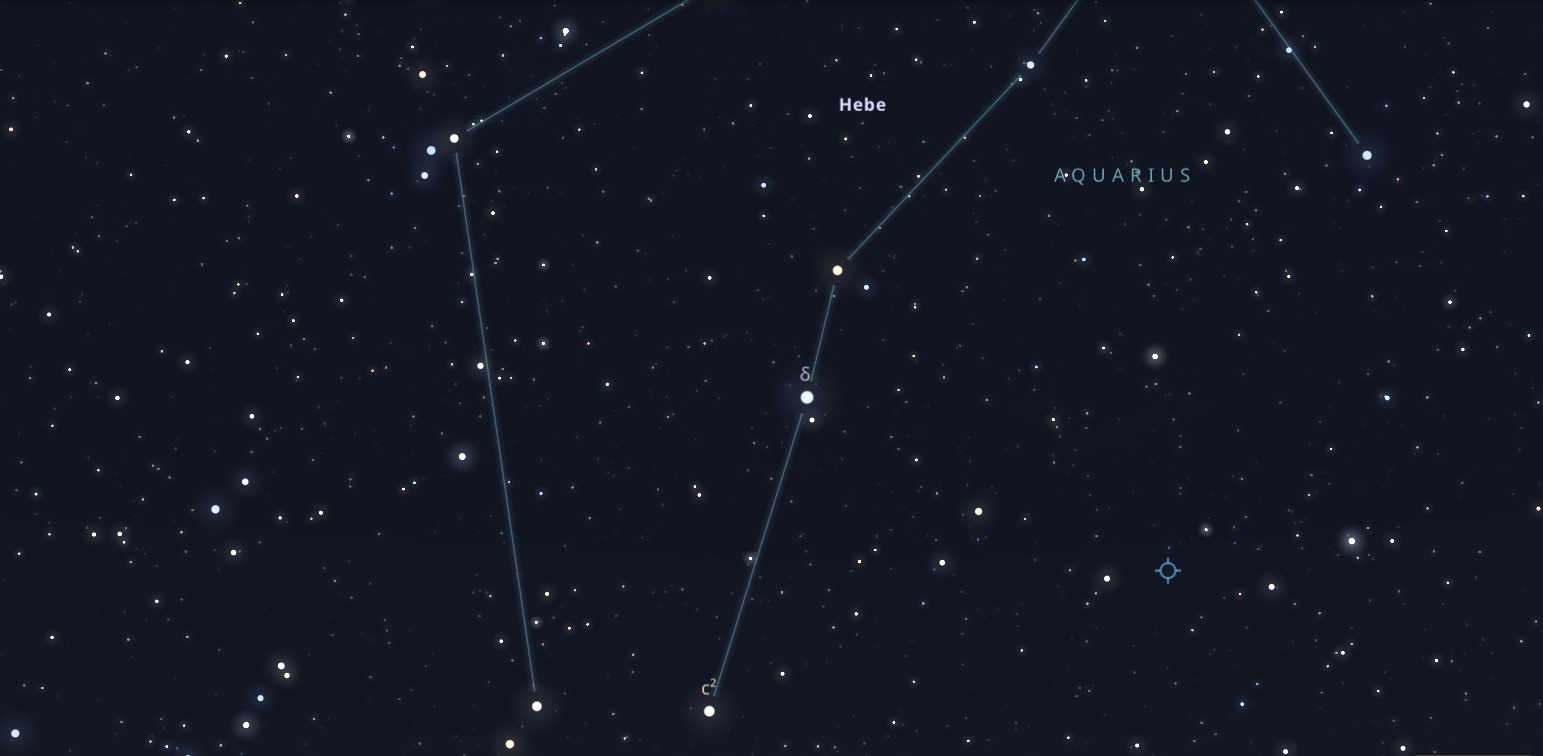
In July, there are two meteor showers whose radiants are located near this star. The weaker of the two is called the Northern δ-Aquariids, while the stronger is called the Southern δ-Aquariids.
The peak of the Southern δ-Aquariids occurs on July 30–31, and this is the best time to observe them. However, even this does not mean that it will be easy to see them. It is believed that up to 25 meteors per hour can be seen at this time.
The so-called hourly rate of the meteor shower is the number of meteors that could be seen under ideal conditions if the radiant were directly overhead. In the case of the δ-Aquariids, the radiant will be quite low above the horizon, so the actual number of visible meteors will be significantly lower.
Machholz comet
The Southern δ-Aquariids owe their appearance to the Machholz comet. To be more precise, there was once a fairly large icy body that may have even come to us from beyond the Solar System.
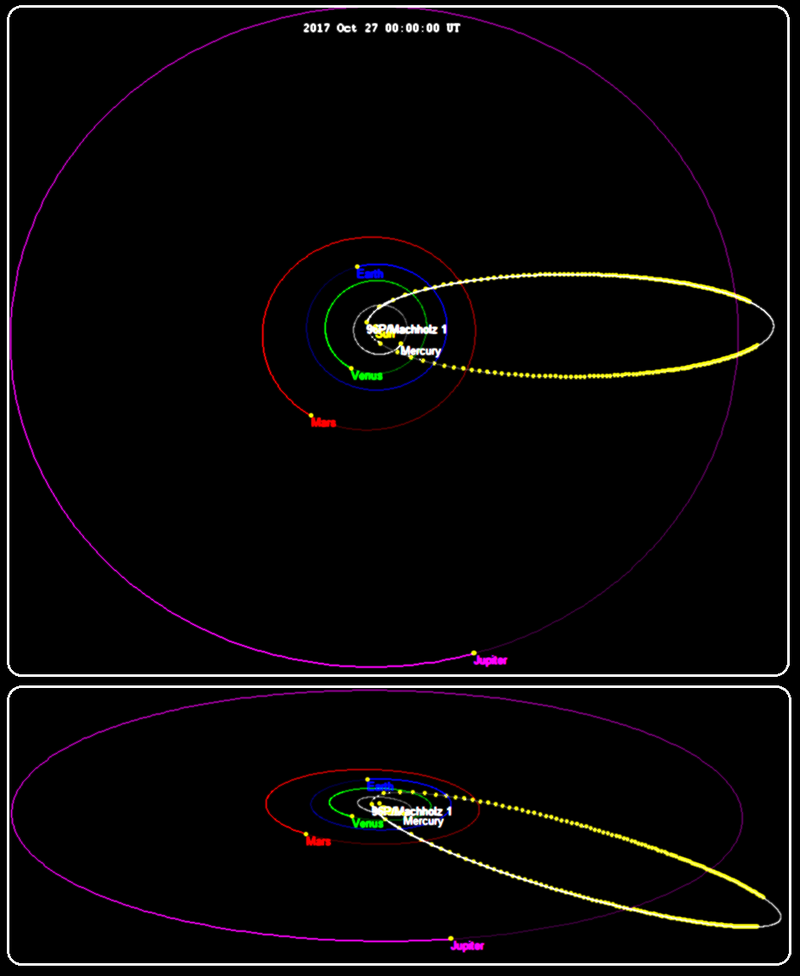
Due to the influence of large planets, this object moved into an orbit close to the Sun. It began to disintegrate, producing smaller bodies and meteor streams that occupied different but similar orbits. This process led to the formation of the Marsden and Kracht comet families. The parent body itself now has a diameter of about 6.4 km and is called P96/Machholz.
This comet has a rather unusual orbit with an inclination of 58.5° to the ecliptic. Its perihelion is located 18.5 million km from the Sun, and its aphelion is 888.9 million km away. This means that at its furthest point, it is farther from the Sun than Jupiter. Together with its unusually low cyanide content, this makes it a good candidate for an interstellar comet that was once captured by the Sun.
How to observe the δ-Aquariids
Usually, the main factor affecting how visible a meteor shower will be is moonlight. If it is too bright, it will be difficult to see anything. On the night of July 31, 2025, the illumination of our satellite’s disk will reach 42%, which could greatly affect observations.
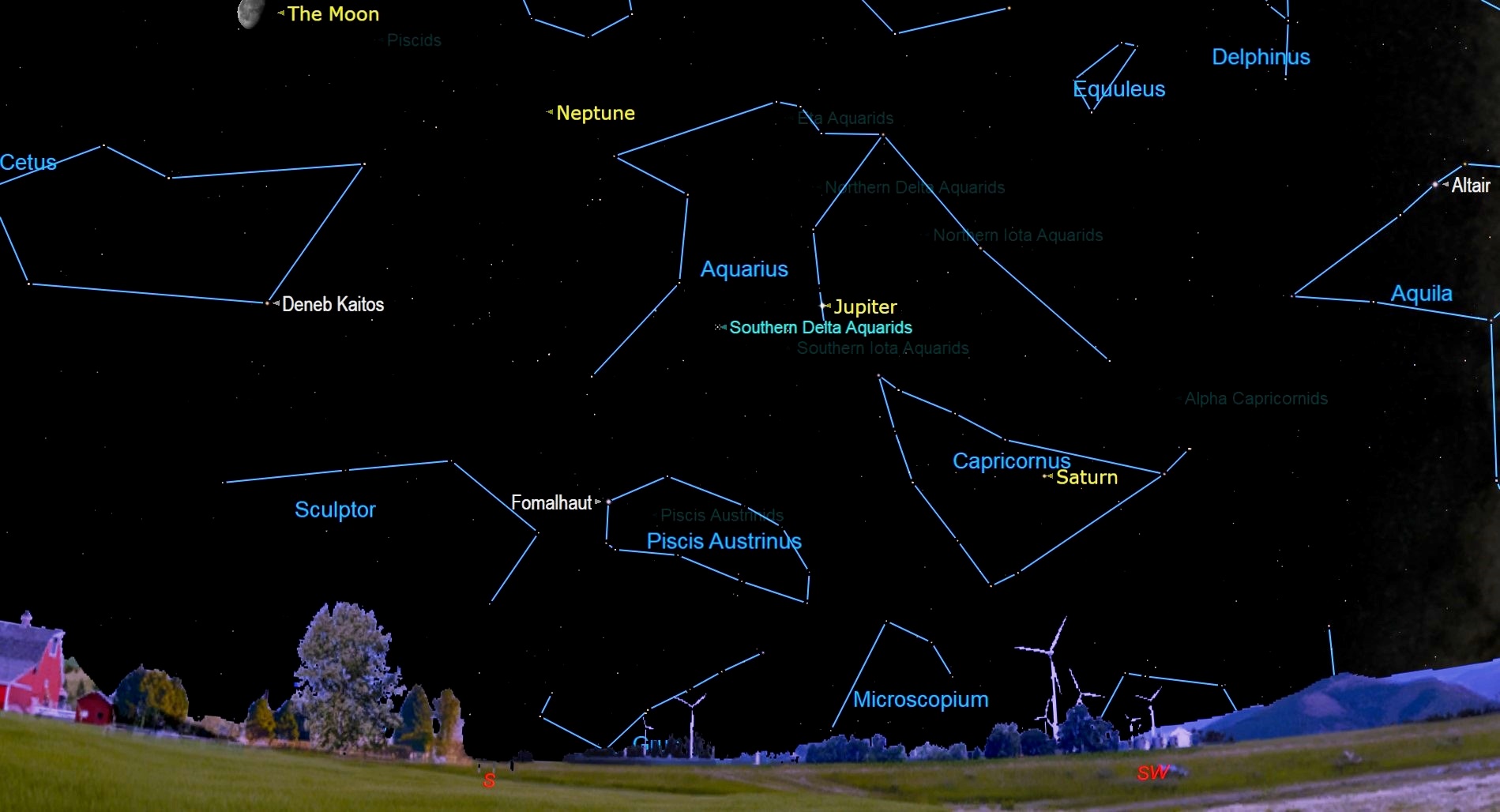
But the Moon will disappear behind the horizon in the evening, and the δ-Aquariids radiant will rise above it only after 10:30 p.m. local time (7:30 p.m. UTC or 1:30 p.m. EST). Nevertheless, the best time for observation will still be between 2:00 and 4:00 a.m. local time (11:00 p.m. UTC or 6:00 p.m. EST). However, even at this time, it is worth getting as far away from city lights as possible for observation.
The best place to observe this meteor shower is the southern hemisphere of the Earth. Here, the radiant will be high above the horizon, and the “star rain” will be twice as abundant as in the northern hemisphere.

