
Astronomers have published a new image obtained by the Hubble Space Telescope. It shows the galaxy NGC 7496. Hubble has photographed this object before.
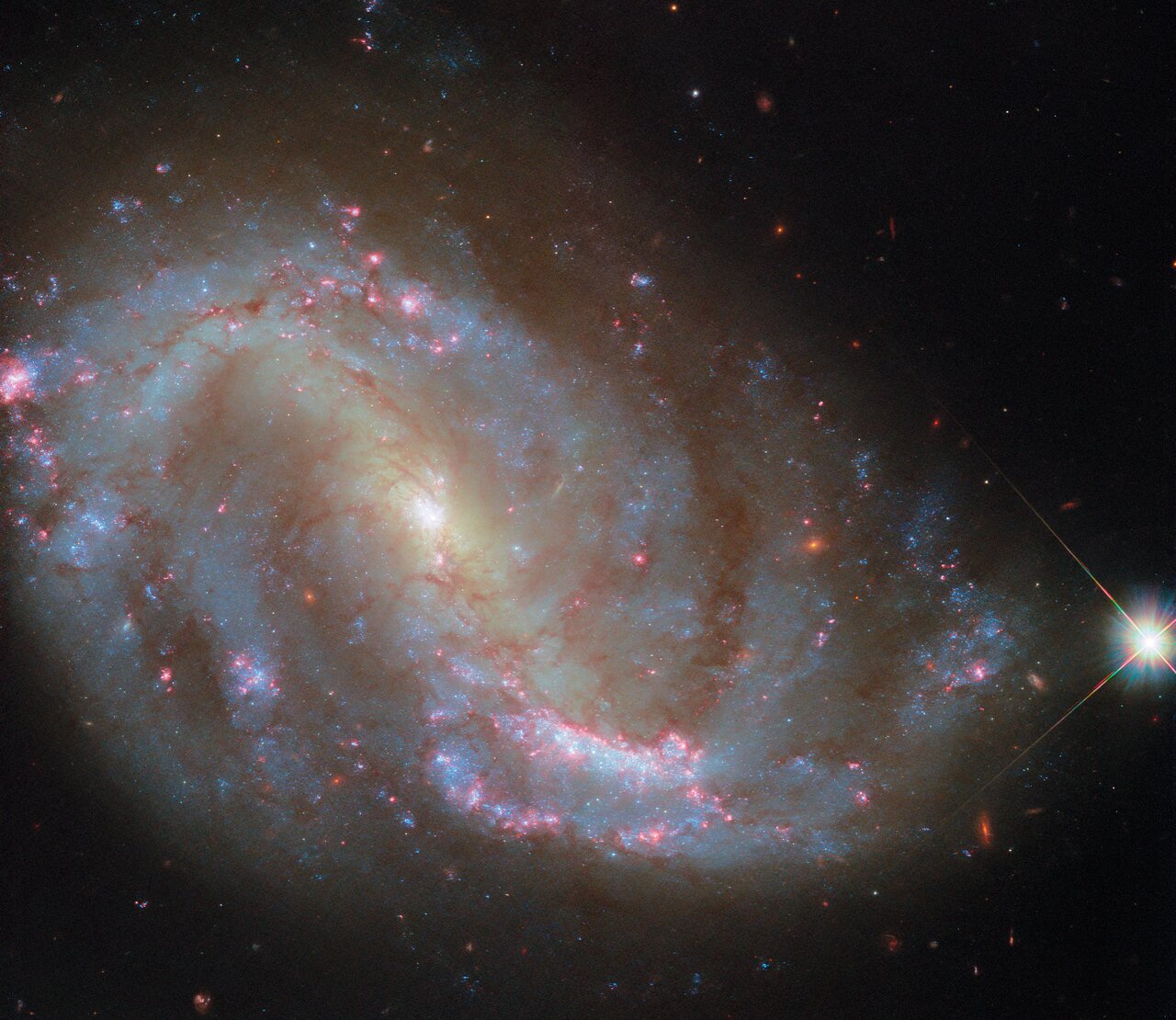
NGC 7496 is located more than 24 million light-years from Earth in the direction of the constellation Grus. It is a dusty spiral galaxy with a band of stars running through its center. It hides one of the most extreme objects in the Universe: a supermassive black hole. Such objects exist in the cores of almost all large galaxies, including our own. The key difference between the Milky Way and NGC 7496 is that its black hole is not particularly active, while the black hole in NGC 7496 actively absorbs matter from its accretion disk, accompanied by the release of large amounts of energy.
Astronomers observe NGC 7496 in wavelengths ranging from radio to ultraviolet to study its active nucleus, dust clouds, and star formation. Hubble photographed it for the first time as part of the PHANGS program in 2022. The Atacama Large Millimetre/submillimetre Array (ALMA), ESA’s Very Large Telescope, and the James Webb Space Observatory also participated. NGC 7496 was the first galaxy in the PHANGS sample to be observed by Webb.
Each of these observatories offered its own view of this well-studied galaxy. Thanks to its unique ultraviolet capabilities and high resolution, Hubble was able to see young star clusters emitting high-energy radiation. Their observations help determine the age and mass of these young stars, as well as the extent to which their light is blocked by dust.
The new image of NGC 7496 from Hubble differs from the previous photo from 2022 by including additional data on star clusters surrounded by glowing red clouds of hydrogen. They are needed by astronomers to study nebulae similar to those left behind by massive stars when they become supernovae, and those from which new stars are born.
Earlier, we reported on how Hubble photographed a galaxy with a starbursting ring.
According to Esahubble

