

Astronomers have published a new spectacular photo taken by the Hubble Space Telescope. It shows the galaxy NGC 6951, which literally sparkles, shimmering with a multitude of colors. At its center is an amazing ring-shaped structure.
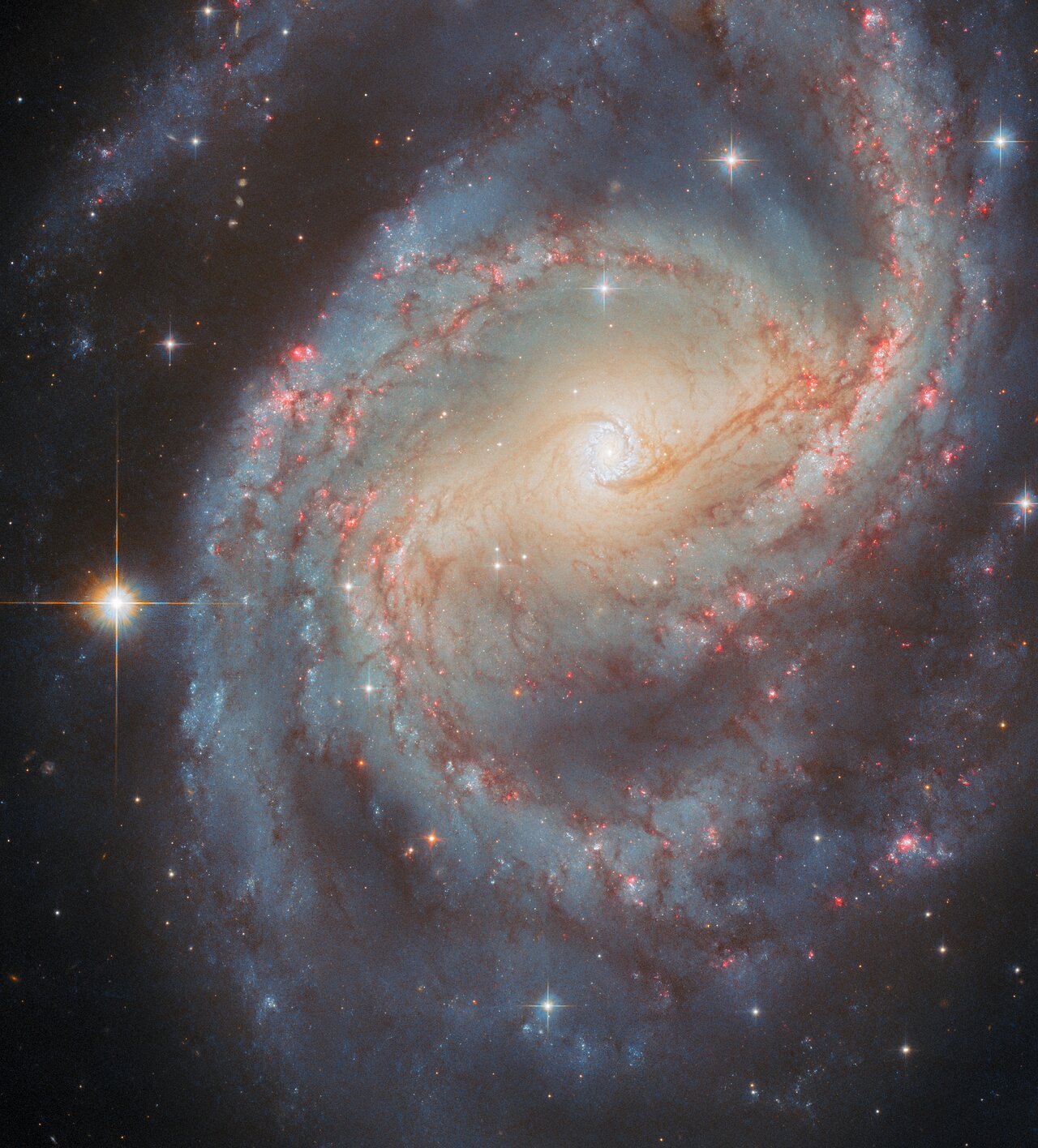
NGC 6951 is located about 70 million light-years from Earth in the direction of the constellation Cepheus. Like our Milky Way, it is a spiral galaxy with a bar. The two galaxies are also similar in terms of the size of their disks. However, there are also noticeable differences between them, the main one being their activity.
NGC 6951 is much more active than the Milky Way. The Hubble photo shows its spiral arms dotted with bright red nebulae, bright blue stars, and filamentary dust clouds. Spiral arms encircle the galactic center, which has a golden color emanating from a population of older stars. It hides a supermassive black hole that actively absorbs matter.
The center of NGC 6951 is also clearly elongated, indicating the presence of a slowly rotating band of stars. This band may be responsible for another feature of the galaxy: the white-blue ring surrounding its very heart. It is called a circumnuclear starburst ring. Essentially, it is a region of intense star formation in the shape of a circle around the galaxy’s core. The strip directs gas toward the galactic center, where it collects in a ring with a diameter of about 3,800 light-years. Two dark dust lanes running parallel to the bar mark the points where gas from the bar enters the ring.
The dense gas of the circumnuclear starburst ring is an ideal environment for the formation of an impressive number of stars. Using Hubble data, astronomers have discovered more than 80 potential star clusters in the NGC 6951 ring. Many of them formed less than 100 million years ago, but the ring itself has existed for longer — possibly 1–1.5 billion years.
Astronomers used Hubble to photograph NGC 6951 for a number of reasons. These include mapping dust in nearby galaxies, studying their centers, and observing recent supernovae. Over the past quarter century, there have been at least five supernova explosions in NGC 6951.
Earlier, we talked about how Hubble photographed a “tangled” galaxy.
According to Esahubble

