

Astronomers working with the Hubble Observatory have shared a new image of a distant cosmic object. The telescope photographed the galaxy NGC 3285B.
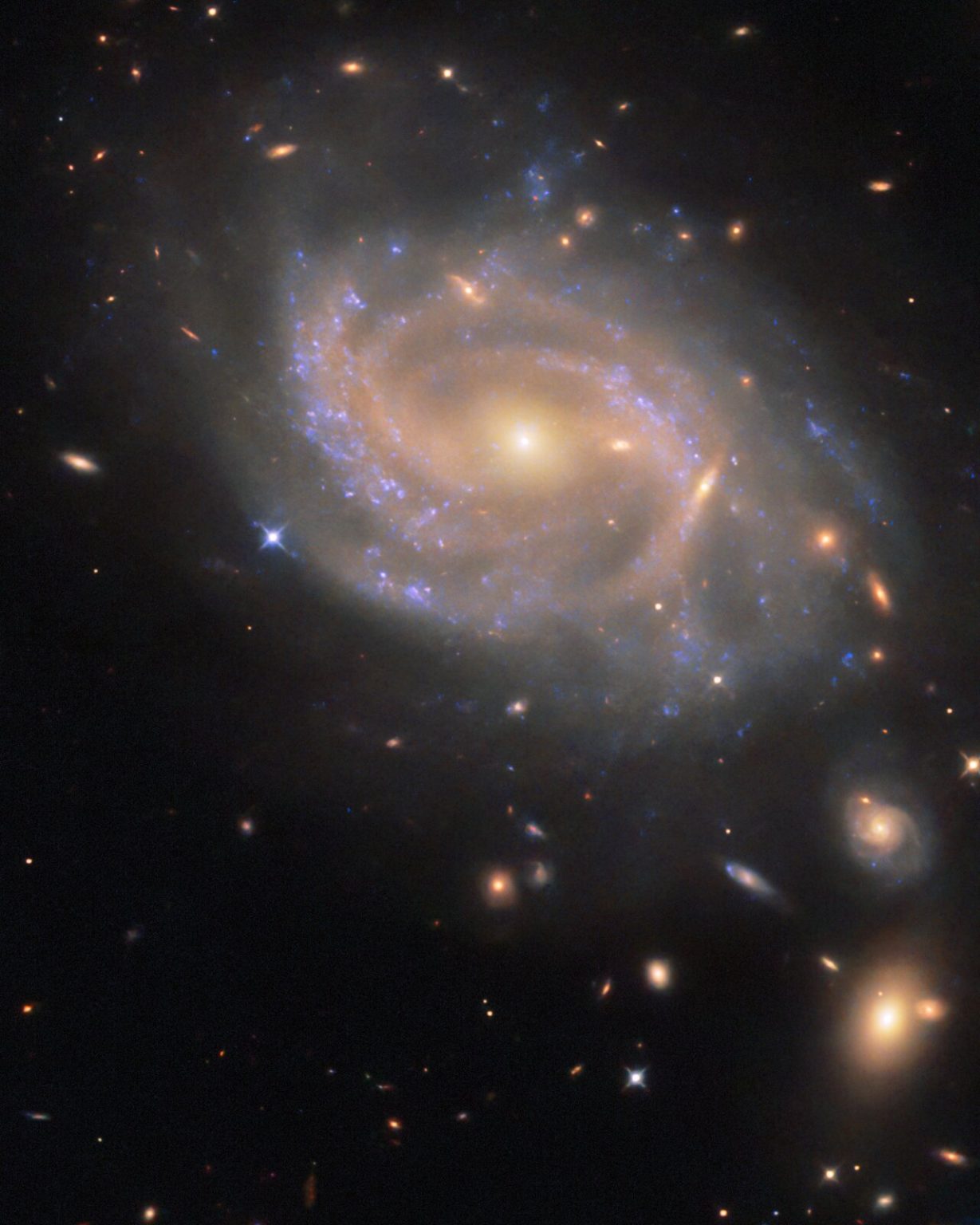
NGC 3285B is a spiral galaxy located 137 million light-years from Earth in the direction of the southern constellation Hydra. The Hubble photo shows blue clouds of gas scattered across its disk, where new stars are currently forming and illuminating the gas around them. The core of the galaxy is large and shines brightly in golden colors, while the spiral arms have a paler and weaker reddish color.
The constellation Hydra is interesting for having the largest area of all 88 modern constellations. It is also the longest constellation, stretching 100 degrees across the sky. To cross Hydra from one end to the other, it would take almost 200 full moons placed side by side.
NGC 3285B is part of the Hydra I cluster, one of the largest galaxy clusters in the nearby universe. Galaxy clusters are groups of hundreds to thousands of galaxies bound together by gravitational forces. The Hydra I cluster is held together by two giant elliptical galaxies at its center. Each of them has a diameter of about 150,000 light years, which makes them about 50% larger than our own Milky Way. As for NGC 3285B, it is located on the outskirts of its cluster, far from the massive galaxies at the center.
This galaxy attracted the attention of astronomers because a Type Ia supernova exploded in it in 2023. Such events occur when a white dwarf exceeds the theoretically possible mass limit and explodes, briefly shining 5 billion times brighter than the Sun. The supernova, named SN 2023xqm, is visible in the image as a bluish dot on the left edge of the galaxy’s disk.
Hubble took a picture of NGC 3285B as part of a program that aims to study 100 Type Ia supernovae. By observing each of them in ultraviolet, optical, and near-infrared light, researchers aim to separate the effects of distance and dust, which can make a supernova appear redder than it actually is. This program will help refine measurements of cosmic distances based on observations of Type Ia supernovae.
Earlier, we reported on how Hubble photographed a galactic time capsule.
According to Esahubble

