

Astronomers working with the Hubble Telescope have published a new image. It shows a galaxy with low surface brightness.
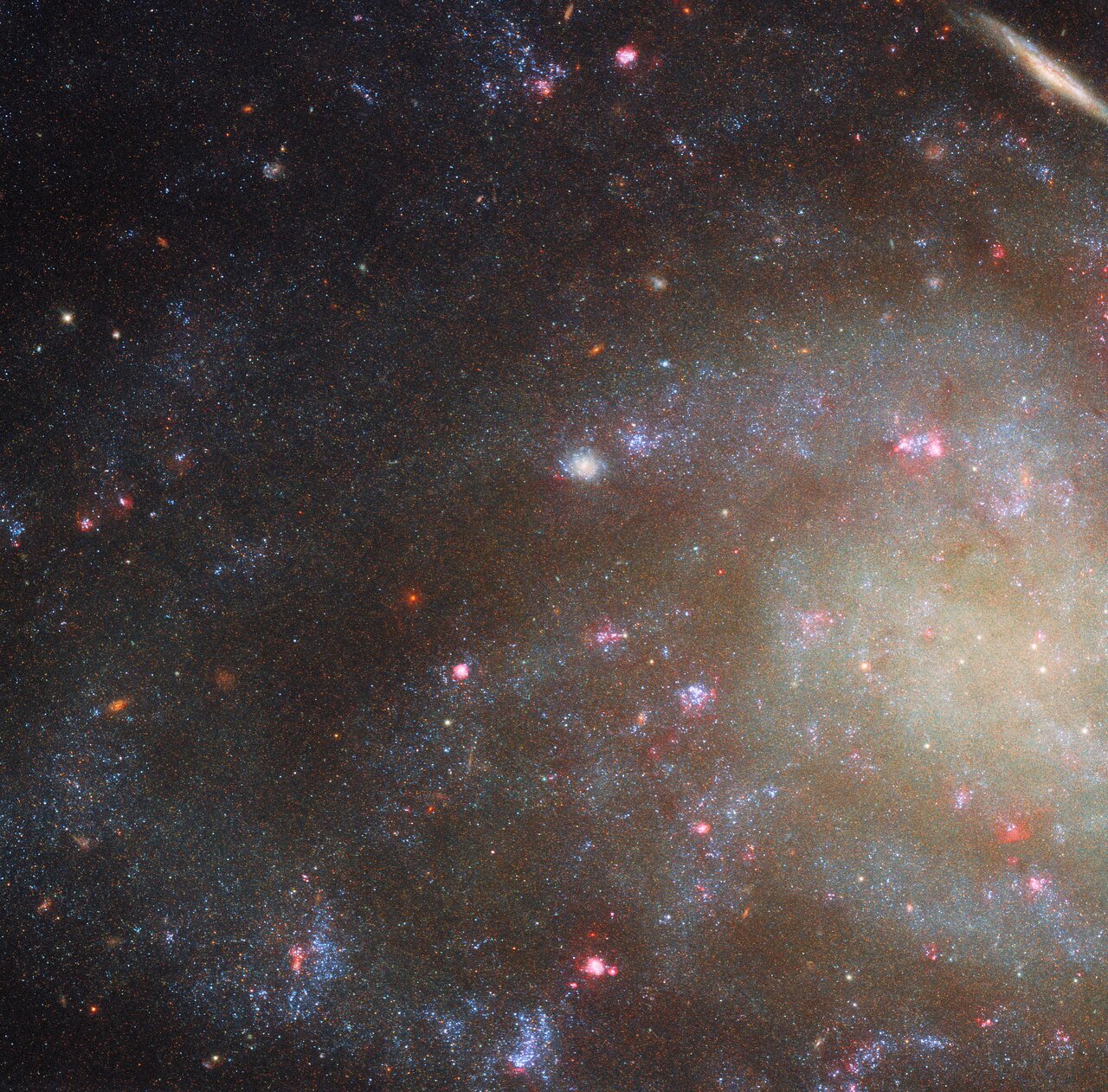
The galaxy captured in the Hubble photo is known as NGC 45. It is located 22 million light years from Earth in the direction of the constellation Cetus.
Despite its relative proximity, NGC 45 cannot boast particularly colorful portraits. The fact is that this galaxy has a low surface brightness. This is the name given to objects whose brightness, as seen by an observer on Earth, is at least one magnitude lower than that of the surrounding sky background.
The data used to create this portrait was obtained through two complementary programs. The task of the first was to survey 50 nearby galaxies in order to collect data on their star formation. As part of the second program, Hubble re-examined many of these galaxies at the H-alpha wavelength. The main source of this radiation is star-forming nebulae. In the Hubble image, they can be identified by their bright pink-red color.
Although NGC 45 may appear to be an ordinary spiral galaxy, it is actually a rather interesting object to study. Such objects are very difficult to detect because they contain relatively few stars compared to the amount of gas and dark matter. In the decades since the accidental discovery of the first low surface brightness galaxy in 1986, researchers have determined that 30–60% of the entire galaxy population may fall into this category. Studying these hard-to-detect objects is key to understanding how galaxies form and evolve.
Earlier, we reported on how Hubble captured a sea of stars in the Tarantula Nebula.
According to Esahubble

